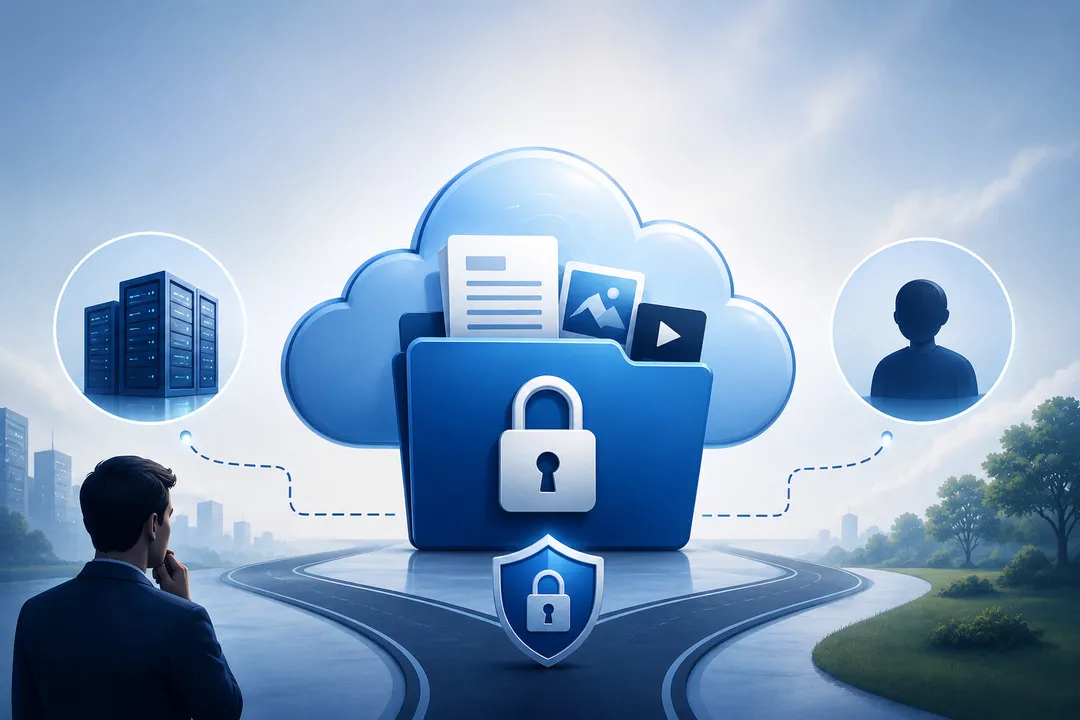

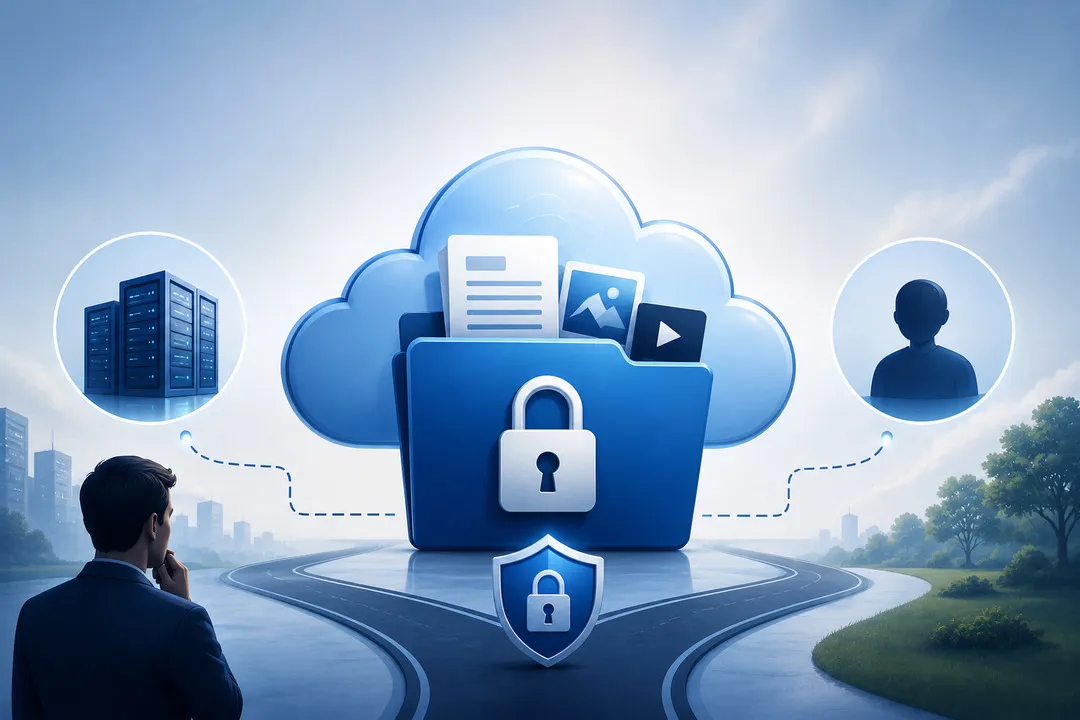
Most people assume that if they create a file, take a photo, or write a document, they own it. Legally, that's usually true.
But once that file is uploaded to the cloud, another question becomes just as important:
Who actually controls it?
As more of our personal and professional lives move online, cloud data privacy has become a growing concern. Every photo, financial record, business document, or backup stored in the cloud depends on infrastructure owned and managed by someone else.
Understanding who controls your data, where it's stored, and how it's accessed is becoming just as important as having enough storage space.
What Happens When You Upload a File?
Uploading a file to the cloud does more than free up space on your device.
A copy of that file is transferred to servers operated by your cloud provider, where it is stored, synchronized, and made available across your devices. This is what makes cloud storage so convenient you can access your information from anywhere, share it instantly, and recover it if your laptop or phone is lost.
Every file you upload becomes part of your digital footprint.
Whether it's family photos, work presentations, or important financial records, your information now lives on infrastructure that you don't directly own or manage.
That convenience, however, comes with an important trade-off.
Once your data resides on someone else's infrastructure, you depend on that provider to manage security, access controls, retention policies, and platform changes. While reputable providers invest heavily in protecting their systems, cloud data privacy ultimately requires users to trust how their information is handled.
Ownership Isn't the Same as Control
One of the biggest misconceptions about cloud storage is confusing ownership with control.
In most cases, uploading a file doesn't transfer ownership to the cloud provider. The content remains yours.
What changes is how that content is managed.
The provider controls the infrastructure where your files are stored. It determines how synchronization works, how permissions are managed, how long deleted files remain recoverable, and how the platform evolves over time.
A simple analogy helps explain the difference.
Imagine storing valuable belongings in a rented locker. The contents belong to you, but access depends on the rules, systems, and policies established by the company operating the facility.
The same principle applies to cloud storage.
Why Cloud Data Privacy Matters for Individuals
Most people don't think twice about what they're storing in the cloud.
Until they stop and look.
Cloud accounts often contain:
- Family photos and videos
- Personal documents
- Tax records
- Medical information
- Creative work
- Educational materials
Many of these files are impossible to replace.
As awareness around cloud data privacy grows, more users are asking important questions:
- Where is my data stored?
- Who can access it?
- How is it protected?
What happens if the provider changes its policies?
Ownership isn't just about legal rights anymore. It's about maintaining meaningful control over the digital information that defines much of our lives.
Why Businesses Are Paying Closer Attention
For businesses, the stakes are significantly higher.
Customer databases, contracts, financial records, intellectual property, and operational documents represent critical business assets. Losing control over this information can have legal, financial, and operational consequences.
Organizations increasingly evaluate cloud providers based on questions like:
- Where is company data stored?
- Who can access it?
- How is it protected?
Can the data be migrated elsewhere if needed?
As regulations around privacy and governance continue to evolve, cloud data privacy has become a strategic consideration rather than just an IT concern.
How Private Cloud Storage Changes the Equation
Traditional public cloud platforms are designed for convenience. Your information is stored on infrastructure owned and managed by the provider.
Private cloud storage takes a different approach.
Instead of relying entirely on third-party infrastructure, users maintain greater control over where their information resides and how it's managed.
That doesn't eliminate the need for backups, security, or responsible administration. Those responsibilities still exist.
What changes is the relationship between the user and the infrastructure.
Rather than simply renting space on someone else's systems, private cloud storage allows individuals and organizations to build an environment where ownership and operational control are much more closely aligned.
For users who prioritize cloud data privacy, this approach offers greater transparency, flexibility, and confidence in how information is handled.
Privacy Starts with Understanding Control
Cloud storage has transformed the way we work, collaborate, and preserve our digital lives. Few people would want to return to carrying files on USB drives or worrying about losing data when a device fails.
But convenience shouldn't stop us from asking an important question:
Who controls the infrastructure behind our data?
While you may legally own the files you upload, true control involves much more than ownership alone. It includes understanding where your information is stored, how it's managed, who governs access, and what happens if the rules change.
As conversations around cloud data privacy continue to grow, ownership is becoming more than a legal concept. It's becoming a cornerstone of digital independence.
Whether you use public cloud services, private cloud infrastructure, or a personal cloud solution, one principle remains worth protecting:
Your data should remain yours, not just in theory, but in practice.
Read More: https://www.myflopy.com/blogs/cloud-data-privacy-who-controls-your-uploaded-files/
























Sign in to leave a comment.