

Modern enterprises must move decisively to the cloud or risk falling behind. Today, more than 85% of organizations will be “cloud-first” by 2025, and new digital workloads are overwhelmingly begin in the cloud. A well‑structured cloud migration plan is critical for executives to achieve business agility, control costs, and mitigate risk. For example, Teleglobal helped a media client cut storage costs by ~90% during cloud modernization.
In this 7-step roadmap, we outline concrete actions from defining objectives to optimizing operations, so your migration delivers measurable ROI, secure operations, and on-schedule execution.
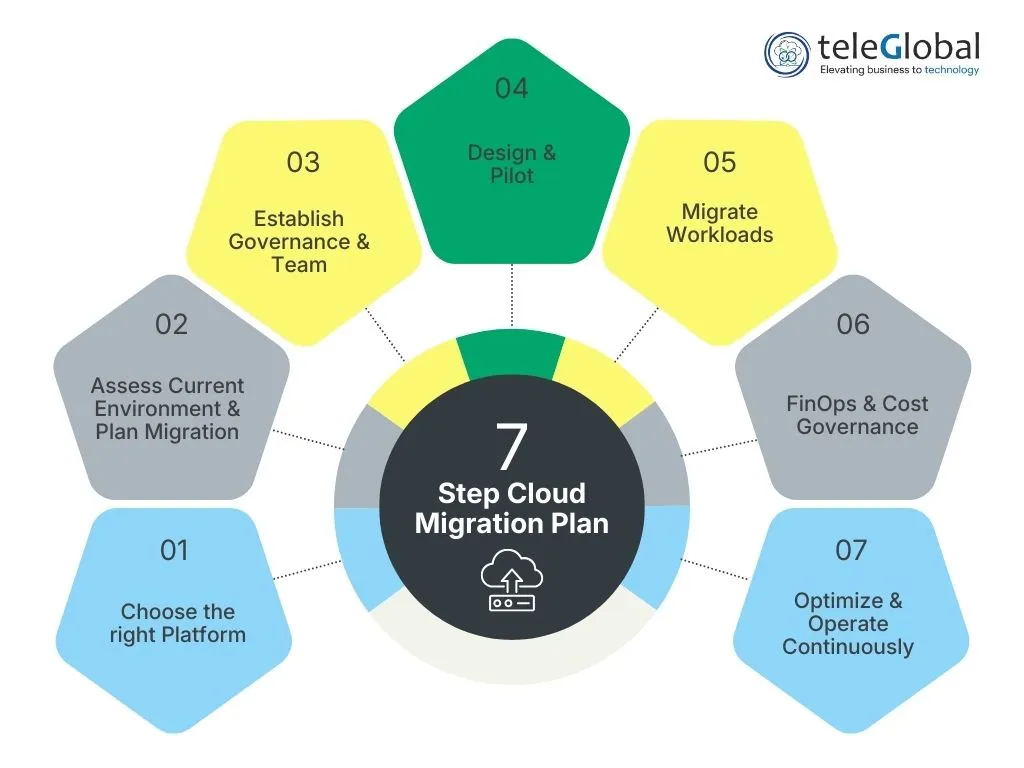
Step 1: Define Strategy & Business Case
Begin with a clear cloud strategy and business case. Set top‑level goals (cost reduction, agility, innovation) and success metrics before any technical work. At this stage, the board must agree on “why cloud?” – whether for cost savings, speed to market, resilience, or digital transformation.
Step 2: Assess Current Environment & Plan Migration
After strategy, perform a detailed assessment and planning. Conduct a cloud readiness assessment of your existing IT landscape: inventory servers, databases, dependencies, network, security posture, and compliance gaps. This inventory should be automated where possible. Identify application categories (e.g. by business-critical vs. infrequently used) and data sensitivity.
Step 3: Establish Governance & Team
With a plan in hand, formalize your governance and operating model. Establish a Cloud Center of Excellence (CCoE) or steering group to oversee the migration. This team typically includes architects, security leads, financial controllers, and a lead “cloud migration manager.”
Step 4: Design & Pilot
Before a full migration, run a pilot or proof-of-concept. Design your target cloud architecture and security, then test it on a small, non-critical workload. This step validates your assumptions (performance, integration, user experience) and uncovers hidden issues early. Choose an application that represents typical technical challenges.
Step 5: Migrate Workloads
Execute the migration waves as planned. Move applications in phases, typically starting with lower-risk systems. Common approaches include rehosting (“lift-and-shift”), replatforming, or refactoring per the 7 Rs strategies. Use automation and tools wherever possible (infrastructure as code, database replication services) to accelerate the process and reduce errors.
Step 6: FinOps & Cost Governance
Once services run in the cloud, implement FinOps (cloud financial operations) best practices. According to Deloitte, companies that establish FinOps can save billions (and cut cloud costs up to 40%). Assign financial ownership of resources (via tagging) so each department is accountable for its spend. Set budgets and alerts in your cloud consoles, enforce approvals for unplanned expenses.
Step 7: Optimize & Operate Continuously
Migration isn’t the finish line, now you optimize. Monitor performance, reliability, and security 24/7. Utilize cloud-native services to improve your apps (managed databases, serverless functions, advanced analytics). Regularly review your architecture in a “well‑architected review” or similar to catch inefficiencies. Automate routine operations (CI/CD for deployments, auto-remediation scripts).
Common Migration Challenges and Mitigations
- Underestimated Dependencies
- Cost Surprises
- Skill Gaps
- Security Gaps
- Resistance to Change
A successful cloud migration demands a balance of strategic vision and disciplined execution. By following these 7 steps from defining objectives through continuous optimization – executives can ensure the project drives real business value. Leadership attention to governance, KPIs, and cost oversight (FinOps) will keep the plan on track.
Read the Full Blog to find out the Key Activities, Key KPI's, Governance, Risk Mitigation for all steps - https://teleglobals.com/blog/7-steps-cloud-migration-plan





















Sign in to leave a comment.