
Introduction
The insurance industry is undergoing a rapid transformation as digital technologies reshape the way organizations manage data, process claims, and serve customers. Among the most impactful innovations is cognitive automation in insurance, a technology-driven approach that combines artificial intelligence, machine learning, natural language processing, and advanced analytics to automate complex insurance workflows. Unlike traditional automation that handles repetitive tasks, cognitive automation enables systems to interpret data, learn from patterns, and make informed decisions.
Insurance companies today manage massive volumes of structured and unstructured data including claim documents, medical records, emails, images, and policy files. Manual handling of this information often leads to delays, processing errors, and increased operational costs. By implementing cognitive automation in insurance, organizations can streamline claims processing, improve accuracy, detect fraud more efficiently, and deliver faster services to policyholders.
Digital transformation initiatives across the insurance sector increasingly rely on cognitive automation platforms to modernize claims management systems and improve operational efficiency. As insurers focus on customer-centric services, automation technologies are becoming essential for improving both back-office workflows and customer experience.
The Role of Cognitive Automation in Insurance Claims Processing
Claims management is one of the most critical and resource-intensive processes in the insurance lifecycle. Traditional claims handling requires manual review of multiple documents, verification of policy information, and evaluation of supporting records. This process can take days or even weeks depending on complexity.
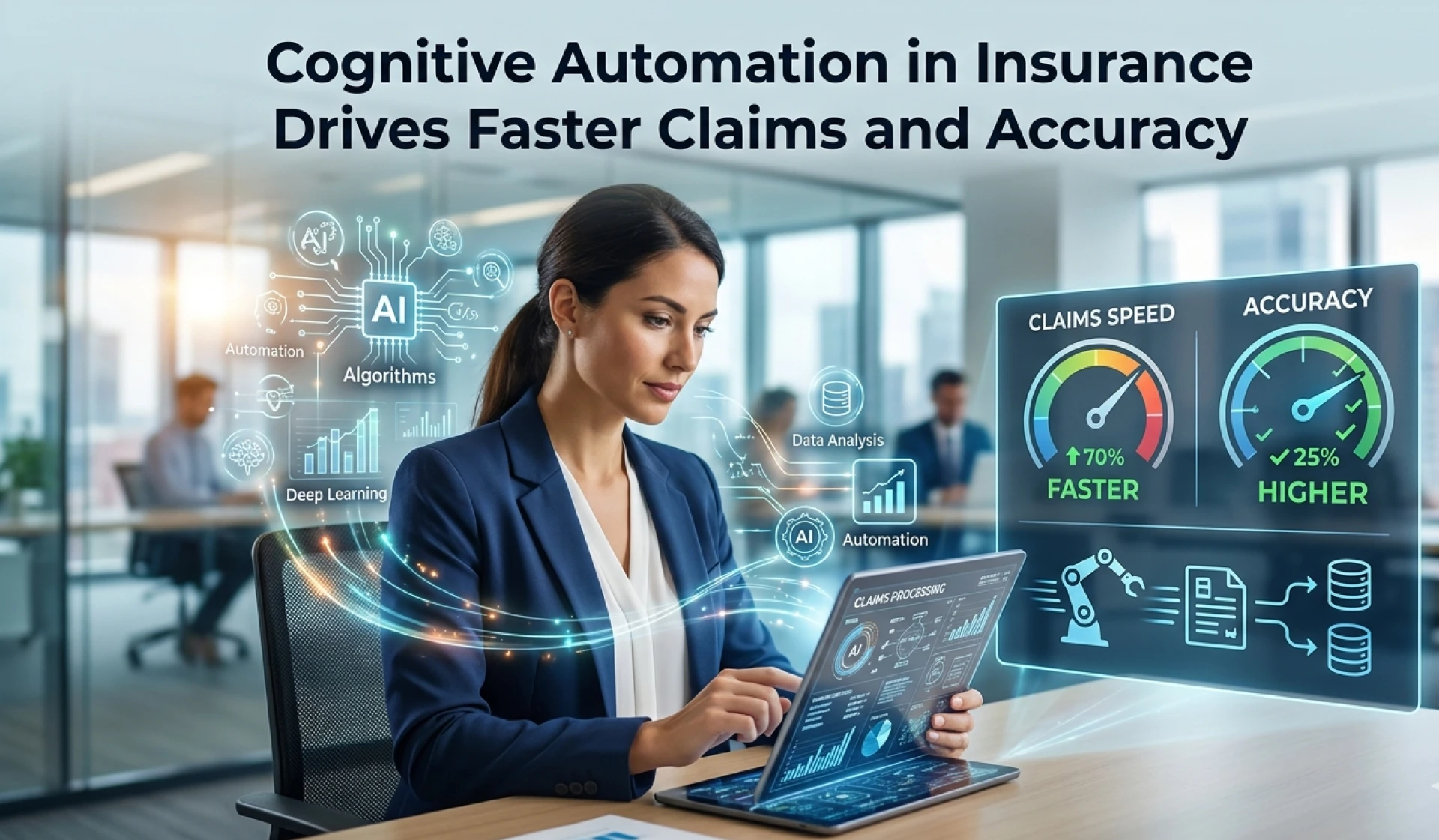
Cognitive automation in insurance transforms this workflow by enabling intelligent systems to analyze documents, extract relevant information, and validate claims automatically. Technologies such as natural language processing allow automated systems to interpret policy terms, medical reports, and customer communications.
Automation platforms can process structured and unstructured data from multiple sources, ensuring that relevant information is captured quickly and accurately. By reducing manual intervention, insurers can significantly shorten claim processing times while maintaining compliance and accuracy.
This transformation not only improves operational efficiency but also enhances the customer experience by delivering faster claim resolutions and transparent communication throughout the process.
Improving Operational Efficiency Using Cognitive Automation in Insurance
Operational efficiency remains a major priority for insurance providers facing increasing claim volumes and rising operational costs. Implementing cognitive automation in insurance enables organizations to streamline internal workflows and reduce dependency on manual processes.
Intelligent automation systems can automatically categorize incoming claims, extract key data points, and route requests to the appropriate departments. These systems continuously learn from historical data, improving decision accuracy over time.
Automation also helps eliminate redundant tasks such as manual data entry, document verification, and claim classification. By automating these repetitive activities, insurers can allocate human expertise to higher-value tasks including customer engagement, policy analysis, and complex claim investigations.
The result is a more agile operational model that improves productivity while maintaining high service quality. Organizations leveraging cognitive automation in insurance often experience faster turnaround times and improved resource utilization.
Enhancing Customer Experience with Cognitive Automation in Insurance
Customer expectations in the insurance sector have evolved significantly in the digital era. Policyholders expect faster claim settlements, transparent communication, and seamless digital interactions. Cognitive automation in insurance plays a vital role in meeting these expectations.
Automated systems can instantly analyze claim submissions, verify policy details, and provide status updates to customers. This reduces waiting times and enhances overall service transparency. Intelligent chatbots and virtual assistants powered by cognitive technologies also help insurers deliver real-time support for customer inquiries.
In addition, automation improves accuracy in claims assessment, reducing disputes and improving customer satisfaction. When policyholders receive faster and more accurate claim decisions, trust in the insurance provider increases significantly.
The integration of cognitive automation in insurance therefore contributes not only to operational efficiency but also to stronger customer relationships and improved brand reputation.
Fraud Detection and Risk Analysis in Cognitive Automation in Insurance
Fraudulent claims remain one of the biggest financial challenges for insurers worldwide. Detecting suspicious activities using traditional manual methods is time-consuming and often ineffective. Cognitive automation in insurance introduces advanced analytics capabilities that help organizations detect fraud patterns more efficiently.
Machine learning algorithms can analyze historical claims data, identify anomalies, and flag potentially fraudulent activities in real time. These systems evaluate patterns across large datasets, including claim history, behavioral indicators, and document inconsistencies.
By integrating intelligent fraud detection into claims processing workflows, insurers can minimize financial losses while ensuring legitimate claims are processed without unnecessary delays. Continuous learning capabilities allow cognitive systems to adapt to emerging fraud strategies, strengthening risk management practices.
As fraud detection becomes more sophisticated, cognitive automation in insurance provides insurers with a powerful tool for maintaining financial stability and regulatory compliance.
Data Intelligence and Decision Making
Insurance companies generate vast amounts of operational data every day. Extracting actionable insights from this information is essential for improving underwriting decisions, risk assessment, and policy design. Cognitive automation in insurance enables organizations to transform raw data into meaningful intelligence.
Automation platforms analyze multiple data sources including claim records, policy documents, customer interactions, and third-party datasets. By combining advanced analytics and machine learning models, insurers gain deeper insights into customer behavior, risk trends, and operational performance.
These insights support more accurate decision-making across the organization. For example, underwriting teams can evaluate risk profiles more effectively, while claims teams can prioritize cases that require human intervention.
The ability to leverage data intelligence is one of the key reasons why insurers are increasingly adopting cognitive automation in insurance as part of their digital transformation strategies.
Future Outlook of Cognitive Automation in Insurance
The adoption of cognitive technologies across the insurance industry continues to grow as organizations recognize the long-term value of automation. Advances in artificial intelligence, predictive analytics, and data integration are further expanding the capabilities of cognitive automation in insurance.
Future insurance platforms will rely heavily on intelligent automation to manage complex workflows, integrate real-time data streams, and support advanced decision models. These systems will enable insurers to handle larger claim volumes while maintaining high levels of accuracy and compliance.
As digital ecosystems evolve, insurers that embrace automation will be better positioned to deliver personalized services, improve operational resilience, and remain competitive in a rapidly changing market.
Conclusion
The growing complexity of insurance operations demands innovative solutions that improve efficiency, accuracy, and customer experience. Cognitive automation in insurance offers a transformative approach by combining artificial intelligence, machine learning, and advanced analytics to automate complex processes.
From accelerating claims processing to improving fraud detection and data intelligence, cognitive automation empowers insurers to modernize their operations while delivering faster and more reliable services to policyholders.
Organizations that adopt cognitive automation in insurance as part of their digital transformation strategy will gain a significant advantage in optimizing operational workflows, enhancing decision-making capabilities, and delivering superior customer experiences in the evolving insurance landscape.




























Sign in to leave a comment.