
Unsorted
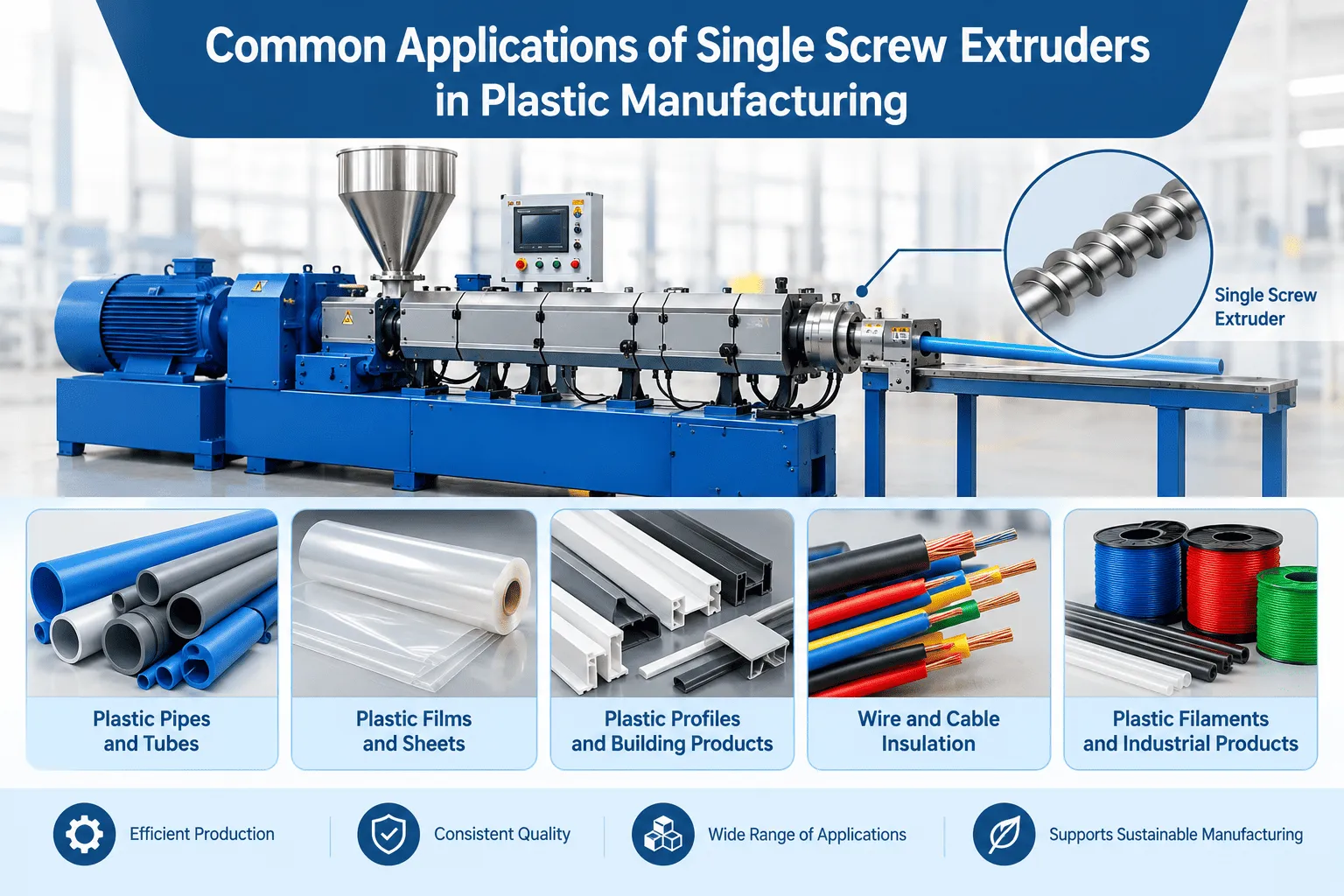
Single screw extruders play a key role in plastic manufacturing. They melt raw plastic, push it through a shaped opening called a die, and form products such as pipes, films, sheets, tubes, and profiles. These machines support continuous production and help manufacturers create products with consistent shapes and sizes. Their use depends on the plastic material, screw design, production rate, and final product requirements. Understanding these applications helps manufacturers choose the right extrusion equipment for their production needs.
How Do Single Screw Extruders Work?
A single screw extruder uses one rotating screw inside a heated barrel. Plastic pellets enter through a hopper. The screw moves them forward as heat and friction soften and melt the material. The molten plastic then passes through a die that gives it the required shape.
After leaving the die, the plastic may pass through cooling, sizing, and cutting equipment. These steps help maintain the product’s shape and dimensions.
Common Applications of Single Screw Extruders
1. Plastic Pipes and Tubes
Manufacturers use single screw extruders to produce plastic pipes and tubes for plumbing, irrigation, drainage, and industrial systems. Materials such as PVC, polyethylene, and polypropylene may be used, depending on the product and process.
The right screw and die design help maintain a steady flow and consistent wall thickness.
2. Plastic Films and Sheets
Plastic films are widely used in packaging, agriculture, and protective covers. Plastic sheets serve industries such as construction, automotive manufacturing, and packaging.
Single screw extruders can process suitable plastics into films and sheets. Cooling rolls or other downstream equipment help control thickness and surface quality.
3. Plastic Profiles and Building Products
Extrusion machines can produce continuous shapes such as window frames, door components, trims, seals, and other building products. The die determines the profile’s shape.
Manufacturers must control temperature, material flow, and cooling to reduce defects and maintain accurate dimensions.
4. Wire and Cable Insulation
Single screw extrusion is also used to apply plastic insulation or protective jackets to electrical wires and cables. The extruder melts the coating material and delivers it around the wire through a specially designed die.
Proper temperature control and coating thickness are important for product quality and performance.
5. Plastic Filaments and Industrial Products
Suitable extrusion systems can produce plastic filaments, rods, and other continuous products. Some filaments are used in 3D printing, while rods and custom shapes serve industrial applications.
The required output depends on the polymer, screw design, die opening, and cooling method.
Key Factors When Choosing an Extruder
Before selecting a machine, manufacturers should consider:
- Material type: Different plastics need different processing conditions.
- Production output: Match the machine’s capacity to your production targets.
- Product dimensions: Check the required shape, thickness, and tolerance.
- Screw and die design: These affect material flow and product quality.
- Cooling system: Proper cooling helps maintain shape and dimensions.
- Maintenance needs: Consider spare parts, service support, and operating costs.
A suitable machine can help reduce waste, improve production consistency, and support efficient operation.
Frequently Asked Questions
What are single screw extruders used for?
They are used to process suitable plastics into pipes, tubes, films, sheets, profiles, wire coatings, and other continuous products.
Which plastics can a single screw extruder process?
Depending on the machine design, common materials include polyethylene (PE), polypropylene (PP), polyvinyl chloride (PVC), and polystyrene (PS). Processing conditions vary by polymer grade.
What is the difference between single screw and twin screw extruders?
A single screw extruder uses one screw and suits many standard extrusion tasks. Twin screw systems can offer stronger mixing and greater flexibility for some compounding and material-processing needs.
How do I choose an extruder machine manufacturer in USA?
Compare the manufacturer’s equipment range, application experience, technical support, machine specifications, and ability to meet your material and output requirements. Ask for details that match your specific production process.
Conclusion
Single screw extruders support many essential plastic manufacturing processes, from pipe and film production to profiles, cable coatings, and filaments. The right machine depends on the material, product design, required output, and process controls. For manufacturers comparing extrusion equipment, US Extruders can be a starting point for reviewing available options and identifying machinery that fits their production goals. Source:- https://tinyurl.com/5n82n3ne

















Sign in to leave a comment.