

Data analytics has become one of the fastest-growing career fields, attracting students, fresh graduates, and working professionals from different backgrounds. With businesses increasingly relying on data to make informed decisions, the demand for skilled data analysts continues to rise. However, while many people begin learning data analytics with enthusiasm, not everyone follows the right approach. Small mistakes during the learning process can slow your progress and make it difficult to build practical skills.
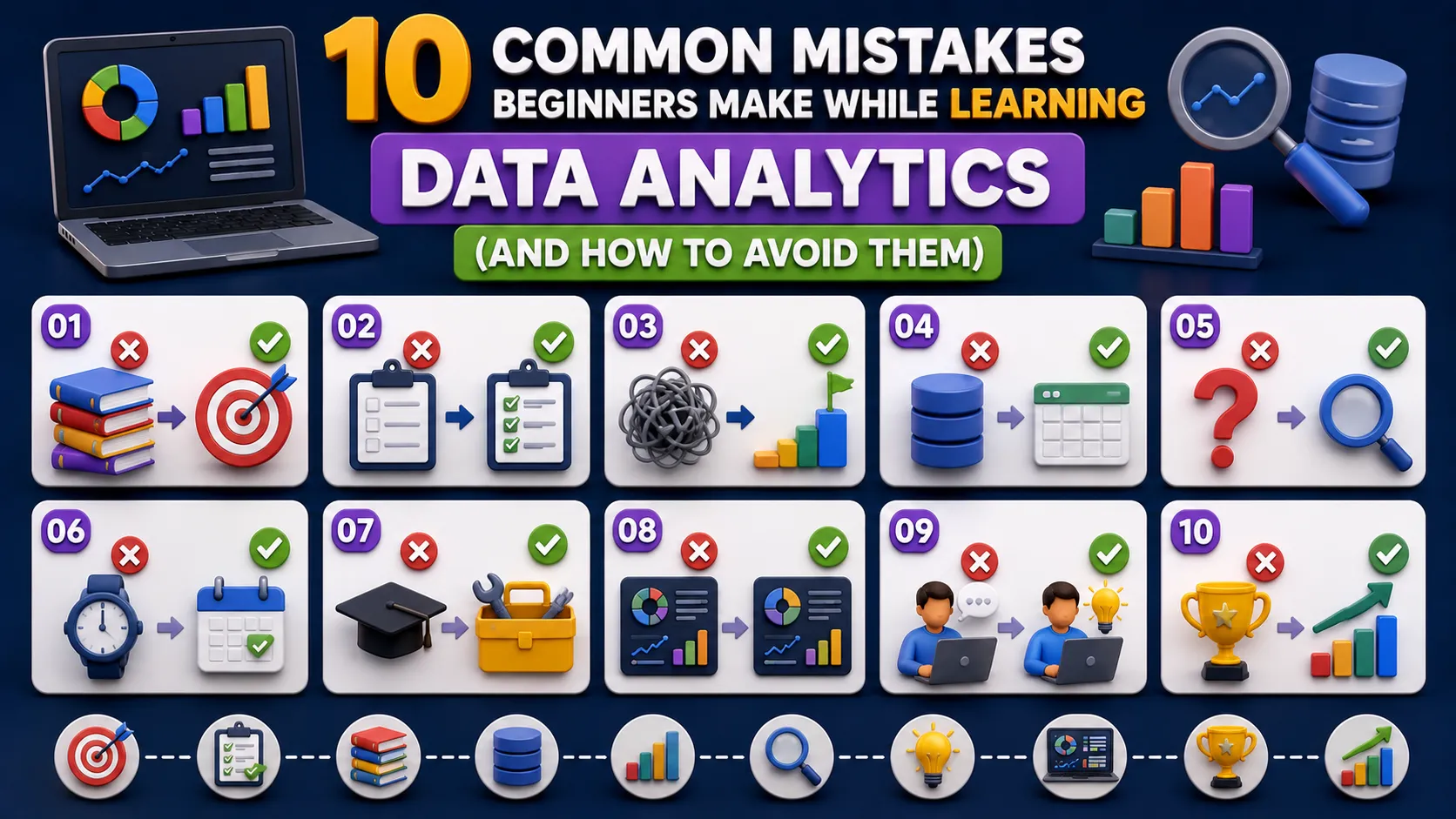
If you're planning to enroll in Data Analytics Certification Training in India or have recently started your learning journey, understanding these common mistakes can help you learn more efficiently and prepare for real-world opportunities.
1. Focusing Only on Theory
Many beginners spend weeks watching tutorials or reading about concepts without actually working on datasets. While theory is important, data analytics is a practical skill that improves through hands-on experience.
After learning a concept, immediately apply it using a real dataset. Practice cleaning data, creating charts, and drawing insights instead of simply moving to the next lesson.
2. Skipping Excel Fundamentals
Some learners believe Excel is outdated and jump directly to Python or Power BI. In reality, Excel remains one of the most widely used tools in business analytics.
Functions like Pivot Tables, VLOOKUP, XLOOKUP, conditional formatting, and data validation are still used by organizations around the world. Building a strong Excel foundation makes learning advanced tools much easier.
3. Ignoring SQL
SQL is one of the most important skills for a Data Analyst because business data is usually stored in databases.
Many beginners delay learning SQL, only to realize later that most job descriptions require it. Start practicing simple queries, filtering data, joins, aggregate functions, and grouping early in your learning journey.
4. Learning Too Many Tools at Once
It's tempting to learn Excel, SQL, Python, Power BI, Tableau, Machine Learning, and AI simultaneously.
Instead, follow a structured learning path. Master one tool before moving to the next. This helps you build confidence and understand how each tool fits into the analytics workflow.
5. Avoiding Real Projects
Projects are where real learning happens.
Instead of only completing classroom exercises, build projects such as:
- Sales dashboards
- Customer churn analysis
- Marketing performance reports
- Financial dashboards
- Retail inventory analysis
Projects strengthen your portfolio and demonstrate practical skills to employers.
6. Ignoring Data Cleaning
Many beginners want to create dashboards immediately without cleaning their data first.
Real datasets often contain duplicate records, missing values, inconsistent formatting, and incorrect entries. Learning how to clean and prepare data is one of the most valuable skills a Data Analyst can develop.
7. Forgetting the Business Problem
A dashboard may look visually appealing, but if it doesn't answer an important business question, it has limited value.
Always ask yourself:
- What problem am I solving?
- Who will use this report?
- What decisions will this analysis support?
Understanding the business context makes your analysis much more meaningful.
8. Not Building a Portfolio
Completing a course is only part of the journey.
Recruiters often want to see examples of your work before scheduling interviews. Create a GitHub repository or online portfolio showcasing dashboards, SQL queries, Python notebooks, and project documentation.
A well-organized portfolio demonstrates your practical knowledge and commitment to learning.
9. Neglecting Communication Skills
Data Analysts don't just analyze data—they explain it.
Practice presenting your findings in simple language. Learn to tell a story with data using charts, dashboards, and concise summaries. Strong communication skills help decision-makers understand your recommendations.
10. Stopping Practice After Certification
Perhaps the biggest mistake is assuming that learning ends after earning a certificate.
Technology continues to evolve, and new tools and features are introduced regularly. Continue practicing with fresh datasets, participate in analytics challenges, explore new visualization techniques, and keep updating your portfolio.
Continuous learning is what separates good analysts from great ones.
How to Learn Data Analytics the Right Way
A structured learning approach can make your journey much smoother.
A comprehensive Data Analytics Certification Training in India should combine theoretical concepts with practical projects, business case studies, and interview preparation. Look for a program that includes Excel, SQL, Python, Power BI, Tableau, data visualization, statistics, and hands-on assignments using real datasets.
This balanced approach helps you build both technical expertise and the confidence to solve real business problems.
Final Thoughts
Every beginner makes mistakes while learning something new, and data analytics is no exception. The important thing is to recognize these mistakes early and develop better learning habits. Focus on understanding concepts, practicing consistently, working on real-world projects, and improving your ability to communicate insights.
If you're serious about building a career in analytics, don't measure your progress by the number of certificates you collect. Measure it by the projects you complete, the problems you solve, and the confidence you gain while working with data. With dedication, continuous practice, and the right Data Analytics Certification Training in India, you can develop the skills needed to succeed in one of today's most exciting and rewarding career fields.

























Sign in to leave a comment.