
Introduction
Municipal water networks are among the most important parts of urban infrastructure. They supply clean water to homes, offices, hospitals, industries, public buildings, and community facilities. However, many water distribution systems face a common challenge: hidden leakage in underground pipelines.
These leaks may not always appear on the surface immediately. In many cases, water keeps escaping underground for weeks or months before it is noticed. This can lead to water loss, low pressure, road damage, higher pumping costs, service complaints, and increased Non-Revenue Water, also known as NRW.
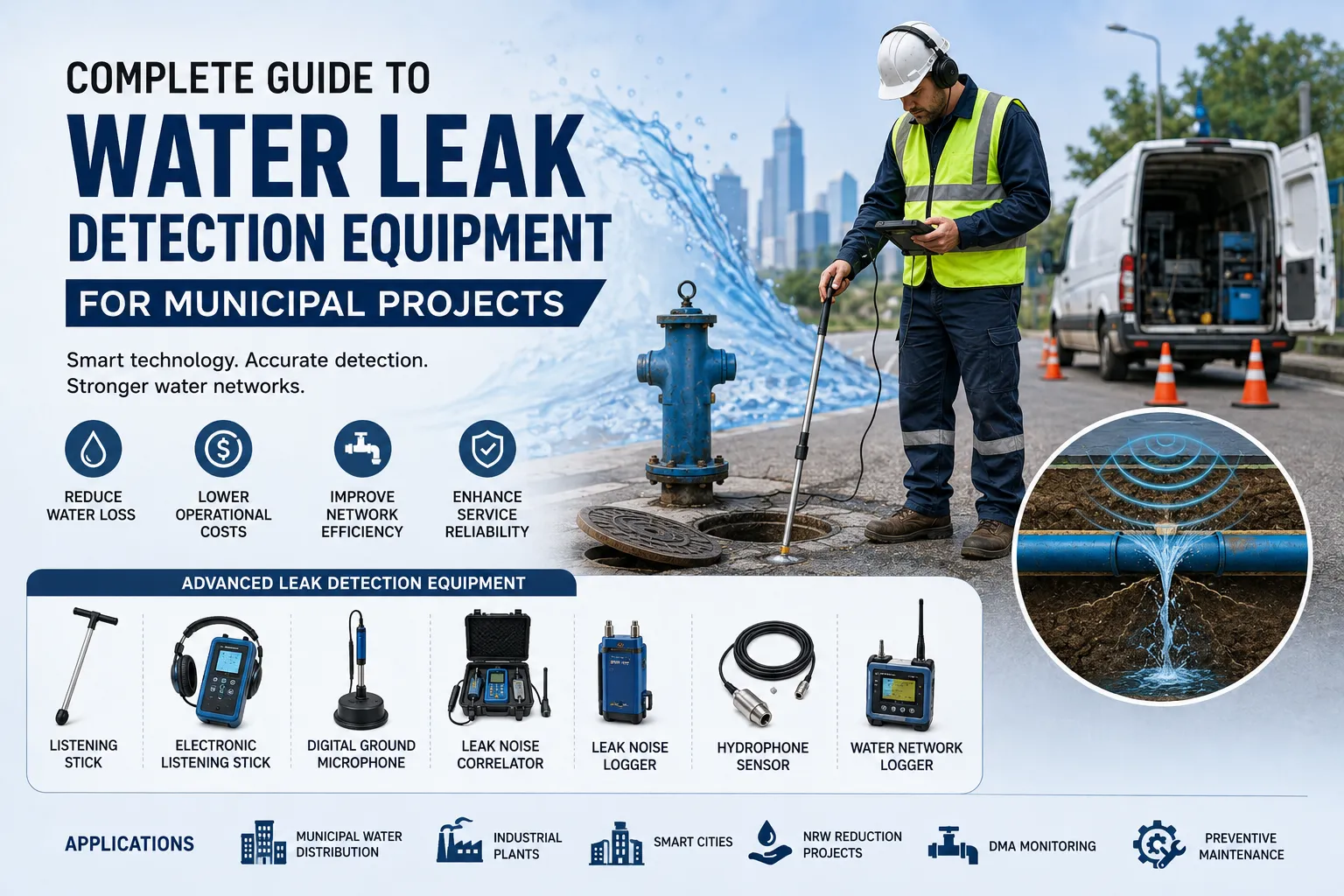
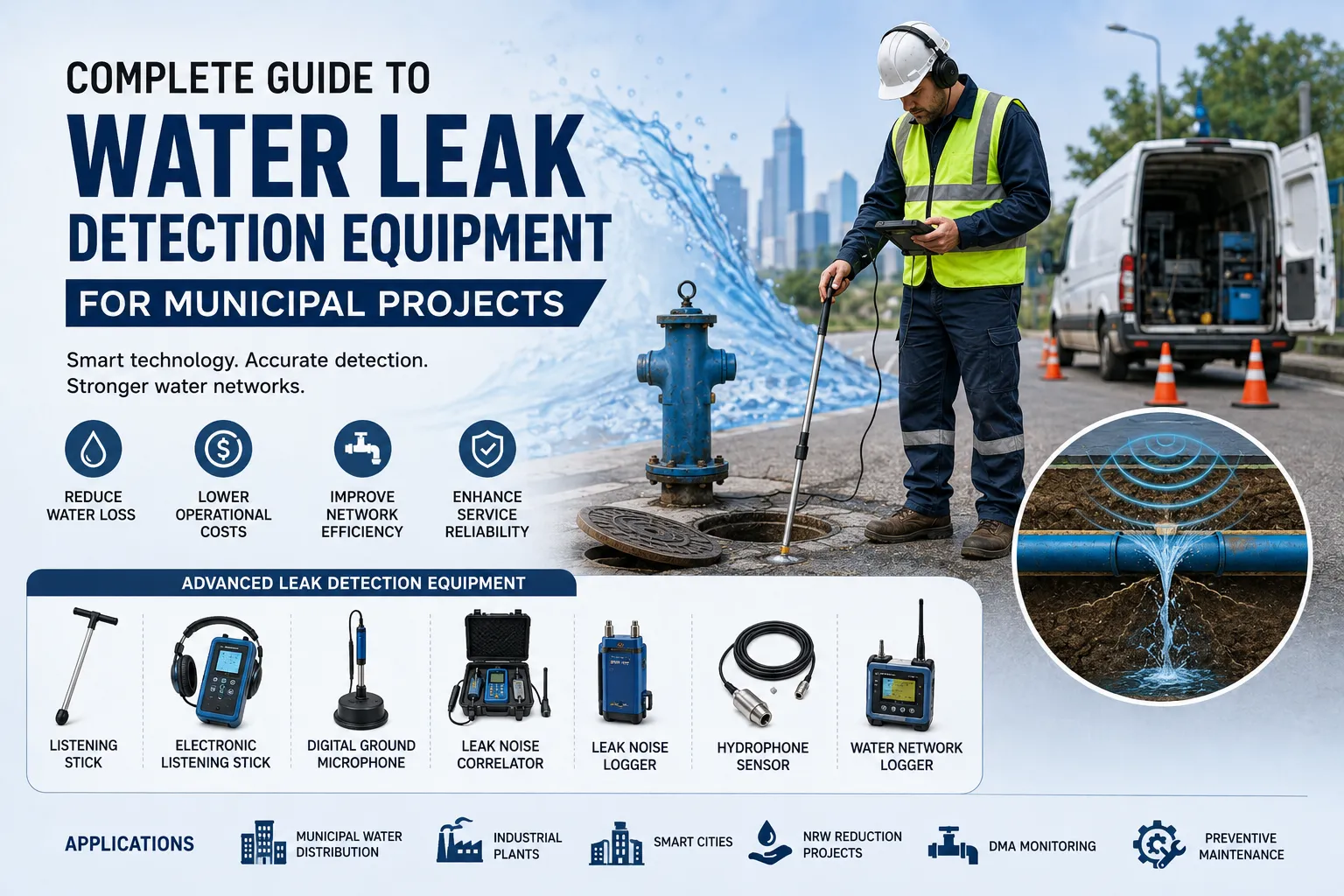
This is why water leak detection equipment is essential for municipal projects. Modern leak detection tools help water utilities identify, monitor, and locate leaks in buried pipelines without unnecessary digging. From basic listening sticks to digital ground microphones, correlators, hydrophones, leak noise loggers, and smart monitoring systems, each equipment type has a specific role in improving water network performance.
This complete guide explains the types of water leak detection equipment used in municipal projects, how they work, when to use them, and what factors should be considered before selecting the right system.
What Is Water Leak Detection Equipment?
Water leak detection equipment refers to instruments used to identify and locate leaks in water pipelines, especially buried municipal water distribution networks. These tools help field teams listen for leak sounds, monitor pressure and noise patterns, correlate leak positions, and collect network data for better maintenance planning.
A reliable water leak detection system helps municipal teams detect hidden pipe leakage, reduce unnecessary excavation, and improve maintenance planning.
Municipal water leak detection equipment is commonly used for:
- Underground pipeline leak detection
- Water distribution network maintenance
- NRW reduction projects
- DMA monitoring and validation
- Minimum Night Flow analysis support
- Leak pinpointing before excavation
- Pressure and flow monitoring
- Emergency repair planning
- Preventive maintenance of water networks
Why Municipal Projects Need Leak Detection Equipment
Municipal water pipelines often run below roads, footpaths, public spaces, commercial areas, industrial zones, and residential colonies. When a leak occurs underground, it can be difficult to detect visually. Traditional trial-and-error digging can increase cost, damage roads, disturb traffic, and delay repairs.
Leak detection equipment helps municipal teams move from reactive repair to planned maintenance.
Key benefits include:
- Faster identification of hidden leaks
- Reduced water loss and NRW
- Better pipeline maintenance planning
- Lower unnecessary excavation
- Improved service pressure
- Reduced road and asset damage
- Better use of manpower and field resources
- Improved data for long-term network management
For cities, towns, industrial areas, and water boards, leak detection equipment supports both operational efficiency and sustainable water supply.
How Underground Water Leak Detection Works
Most buried water pipe leaks produce sound and vibration. As pressurized water escapes through a crack, joint, hole, or damaged section, it creates noise. This noise can travel through the pipe wall, soil, fittings, valves, hydrants, and surrounding ground.
For buried pipelines, an underground water leak detector helps municipal teams locate hidden leakage points before excavation and repair work.
Acoustic leak detection equipment helps operators identify these leak sounds. The operator listens for changes in sound intensity and frequency to narrow down the suspected leak area. As the operator moves closer to the leak point, the detected sound intensity usually increases.
Typical leak-related sounds may include:
- Water flow sound
- Impact sound
- Friction sound
- Vibration sound
The highest sound level often helps identify the likely leak location. However, final confirmation depends on pipe material, pressure, ground condition, background noise, and operator skill.
Main Types of Water Leak Detection Equipment
1. Listening Sticks
A listening stick is one of the simplest tools used for basic leak detection. It allows the operator to listen to pipe noise through valves, fittings, hydrants, or accessible points. Basic listening sticks are useful for initial checks and routine field surveys.
A listening stick can be useful for basic field inspection where municipal teams need a simple tool for checking leak sounds at valves, hydrants, or pipeline access points.
They are suitable for:
- Basic leak listening
- Field-level inspection
- Pipe fitting checks
- Simple municipal maintenance work
- Initial leak confirmation
A listening stick is usually low-cost and easy to use, but it depends heavily on operator experience and may not be enough for complex or deep buried leaks.
2. Electronic Listening Stick
An electronic listening stick improves basic listening by amplifying leak sounds. It helps operators hear weak leak noise more clearly, especially in noisy urban environments. Some tools combine listening stick and ground microphone functions for more flexible field use.
Best used for:
- Routine leak survey
- Valve and fitting inspection
- Buried water pipeline checks
- Urban water distribution networks
- Quick confirmation before advanced testing
Electronic listening tools are useful for municipal teams that need better sound clarity than a basic mechanical listening stick.
3. Digital Ground Microphones
A digital ground microphone is used to detect leak sounds from the ground surface. The operator places the sensor on the road, pavement, soil, or other surface and listens for leak noise. Advanced systems may include filters, digital display, frequency settings, and noise reduction features.
A digital ground microphone water leak detector is useful for pinpointing leak sounds from the ground surface after the suspected leak zone has been identified.
Digital ground microphones are useful for pinpointing leaks after the general leak area is identified. They are commonly used in municipal water distribution networks because they help reduce unnecessary excavation.
Best used for:
- Leak pinpointing
- Buried pipe leak localization
- Road and pavement areas
- Municipal pipeline maintenance
- Follow-up after correlator or logger alerts
For urban projects, digital ground microphones help field teams work more accurately in road, pavement, and public utility environments.
4. Leak Noise Correlators
A leak noise correlator is a more advanced device used to locate leaks between two points on a pipeline. Sensors are placed at access points such as valves, hydrants, or fittings. The system analyzes the time difference in leak noise reaching each sensor and calculates the likely leak position.
A water leak noise correlator is helpful when municipal teams need to locate leaks across longer pipeline sections or in areas where manual listening is difficult.
Correlators are useful when the leak sound is difficult to pinpoint manually or when pipelines are long and complex.
Best used for:
- Medium and long pipe sections
- Difficult leak locations
- Noisy urban areas
- Professional municipal leak detection
- Confirmation before excavation
For large water utilities, correlators help improve accuracy and reduce guesswork.
5. Leak Noise Loggers
Leak noise loggers are used for monitoring water networks over time. They can be installed at selected points in the network to listen for leak noise, usually during quiet periods such as night hours. Some loggers can send data remotely through cellular or telemetry networks.
A leak noise logger can monitor the water network during quiet hours and help identify suspected leakage zones before field teams begin pinpointing work.
Best used for:
- Continuous network monitoring
- NRW reduction projects
- DMA-based leakage management
- Early leak detection
- Large municipal water networks
- Remote data collection
Leak noise loggers are useful for shifting from complaint-based repair to proactive leak management.
6. Hydrophones
Hydrophones are sensors used to detect leak noise within the water column. They can be especially useful for large-diameter pipelines, trunk mains, plastic pipes, and situations where leak noise does not travel well through pipe walls.
A hydrophone leak noise sensor can support leak detection in large mains, plastic pipes, and trunk water pipelines where standard surface listening may not provide clear results.
Best used for:
- Large diameter pipelines
- Plastic pipes
- Trunk mains
- Low-noise leak conditions
- High-value municipal networks
Hydrophones can support more reliable leak detection in applications where standard acoustic methods may be less effective.
7. Pressure and Flow Monitoring Equipment
Leak detection is not only about listening for sound. Pressure and flow data are also important for municipal network management. Sudden pressure changes, abnormal flow patterns, and high minimum night flow can indicate hidden leakage.
Water network loggers support pressure, flow, and leakage monitoring for long-term municipal water management.
Best used for:
- DMA monitoring
- Minimum Night Flow analysis
- Network pressure management
- Leakage zone identification
- Long-term water supply optimization
Pressure and flow monitoring help utilities understand where losses are happening and which zones need detailed field investigation.
8. Smart Water Network Monitoring Systems
Smart monitoring systems combine sensors, telemetry, analytics, and remote data transmission. These systems help municipal teams monitor leakage conditions without depending only on manual surveys.
Useful features may include:
- Remote leak alerts
- Data logging
- Pressure and flow monitoring
- GPS-based survey records
- Cellular communication
- Dashboard-based review
- Historical trend analysis
Smart monitoring is especially useful for cities working on NRW reduction, 24x7 water supply improvement, smart city infrastructure, and water conservation projects.
How to Choose the Right Water Leak Detection Equipment
1. Understand the Pipe Network
Before choosing equipment, review the municipal water network type.
Check:
- Pipe material
- Pipe diameter
- Average pressure
- Pipe depth
- Age of network
- Leak history
- Access points available
- Traffic and site conditions
- Urban noise level
Metallic pipes, plastic pipes, trunk mains, and branch lines may need different detection methods.
2. Identify the Project Objective
Different projects need different tools.
For example:
- For basic inspection, a listening stick may be enough.
- For pinpointing buried leaks, a ground microphone is useful.
- For long pipe sections, a correlator may be better.
- For continuous monitoring, leak noise loggers are suitable.
- For NRW projects, a mix of loggers, correlators, pressure monitoring, and field survey tools may be required.
The equipment should match the project objective, not just the budget.
3. Consider Pipe Material
Leak sound travels differently through different pipe materials. Metallic pipes often transmit sound better than plastic pipes. Plastic and large-diameter mains may need hydrophones or specialized sensors.
For municipal networks with mixed pipe materials, a combination of acoustic tools, correlators, hydrophones, and monitoring loggers may provide better coverage.
4. Check Pressure Conditions
Acoustic leak detection works better when the pipeline has enough pressure to generate leak noise. Low-pressure systems can make detection more difficult. In such cases, data from pressure loggers, flow monitoring, and night-flow analysis can help identify leakage zones before field pinpointing.
5. Review Field Conditions
Municipal teams often work in difficult environments such as:
- Busy roads
- Markets
- Residential colonies
- Industrial areas
- Wet soil
- Road traffic noise
- Deep pipelines
- Mixed utility corridors
- Poor access conditions
Equipment should be rugged, portable, easy to use, and suitable for outdoor field conditions.
6. Look for Data Logging and GPS Features
Modern municipal projects require records. GPS and data logging help teams store leak locations, survey points, pipeline attributes, and inspection history.
These features are helpful for:
- Report generation
- GIS mapping
- Contractor monitoring
- Maintenance planning
- Asset management
- Future leak history review
For municipal projects, proper data recording helps teams track repeated leaks, plan future repairs, and improve overall network reliability.
7. Evaluate Training and Support
Leak detection depends on both equipment and operator skill. Even advanced equipment requires trained users to interpret sounds, data, pressure patterns, and field signals correctly.
Before purchase, check:
- Demonstration support
- Operator training
- Technical support
- Product service availability
- Spare parts and accessories
- Field application guidance
- Experience in municipal projects
Good support improves long-term equipment value.
Role of Leak Detection in NRW Reduction
NRW, or Non-Revenue Water, refers to water that is produced but not billed due to physical losses, commercial losses, metering issues, or unauthorized consumption. In municipal networks, hidden pipeline leakage is one of the major contributors to physical water loss.
Water leak detection equipment supports NRW reduction by helping utilities:
- Identify hidden leakage zones
- Monitor network leakage trends
- Prioritize repair work
- Validate DMA performance
- Reduce physical water losses
- Improve billing efficiency indirectly
- Improve water pressure and supply reliability
Municipal teams can improve NRW reduction programs by combining field leak detection tools with pressure monitoring, flow analysis, zone-wise reporting, and planned maintenance.
Recommended Equipment Mix for Municipal Projects
A practical municipal leak detection setup may include:
| Requirement | Recommended Equipment |
|---|---|
| Basic leak listening | Listening stick |
| General field survey | Electronic listening stick |
| Pinpointing buried leaks | Digital ground microphone |
| Leak location between two points | Leak noise correlator |
| Continuous network monitoring | Leak noise loggers |
| Large pipes and plastic mains | Hydrophones |
| DMA and NRW monitoring | Pressure and flow loggers |
| Smart utility management | Remote monitoring system |
For serious municipal projects, one tool is usually not enough. A combination of tools provides better detection, confirmation, monitoring, and reporting.
Best Practices for Municipal Leak Detection
Municipal teams can improve results by following these best practices:
- Start with network data review
- Identify high-loss zones or DMAs
- Use night-time monitoring where possible
- Confirm suspected areas with field equipment
- Use correlators for difficult sections
- Pinpoint final leak position with ground microphone
- Record GPS location and pipe details
- Prioritize repairs based on leak severity
- Recheck the area after repair
- Maintain leak history for future planning
A structured approach helps reduce repeat work and improves confidence in leak detection results.
Conclusion
Water leak detection equipment plays a critical role in municipal water management. It helps utilities detect hidden underground leaks, reduce NRW losses, improve pressure, avoid unnecessary excavation, and plan maintenance more effectively.
For small surveys, listening sticks and electronic listening tools may be enough. For accurate pinpointing, digital ground microphones and correlators are more suitable. For large municipal networks, leak noise loggers, hydrophones, pressure monitoring, and smart telemetry systems provide stronger long-term value.
The right equipment depends on pipe material, network pressure, site conditions, project size, data needs, and maintenance goals. For municipal projects, the best approach is often a combination of acoustic detection, monitoring systems, data logging, and trained field teams.
FAQs
1. What is water leak detection equipment?
Water leak detection equipment is used to detect and locate leaks in water pipelines, especially buried municipal water networks. It includes listening sticks, ground microphones, correlators, hydrophones, loggers, and monitoring systems.
2. Which equipment is best for underground water leak detection?
For pinpointing buried leaks, digital ground microphones and leak noise correlators are commonly used. For continuous monitoring, leak noise loggers are useful.
3. Can water leak detection equipment work on plastic pipes?
Yes, but plastic pipes may require specialized methods such as hydrophones or advanced acoustic tools because leak noise travels differently compared to metallic pipes.
4. How does acoustic leak detection work?
Acoustic leak detection works by listening to sound and vibration created when pressurized water escapes from a damaged pipeline section.
5. What is a leak noise logger?
A leak noise logger is a monitoring device installed at selected points in a water network to detect leak noise over time. Some loggers can transmit data remotely.
6. How does leak detection help reduce NRW?
Leak detection helps identify and repair hidden pipeline leakage, which reduces physical water loss and supports better water distribution efficiency.
7. Is GPS useful in water leak detection?
Yes. GPS helps record leak locations, survey points, pipe details, and field data for reporting, GIS mapping, and future maintenance planning.
8. Do municipal projects need only one leak detection tool?
Usually no. Municipal networks often need a combination of listening tools, ground microphones, correlators, hydrophones, loggers, and pressure monitoring systems.



























Sign in to leave a comment.