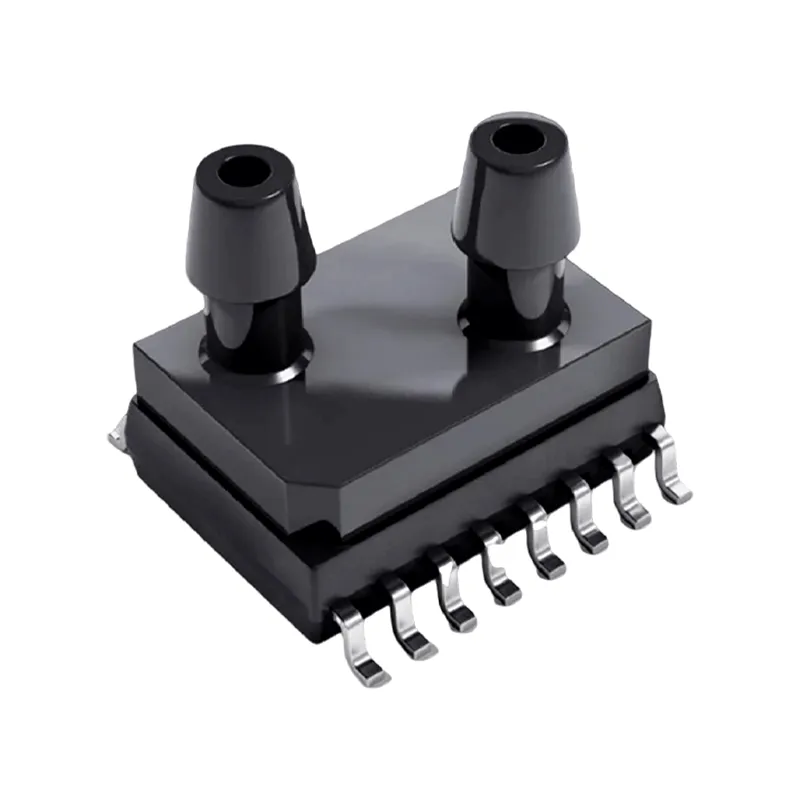

A Hall sensor is a magnetic-sensitive device based on the Hall effect, which can accurately convert changes in magnetic fields into electrical signal outputs. It plays a crucial role in modern industrial control, automotive electronics, and consumer electronic products. This article will delve into its core principles, main types, wide range of application fields, significant advantages, and provide practical selection guidance.
Working Principle and Core Types of Hall Sensors
The essence of the Hall effect is that when an electric current passes through a conductor perpendicular to an external magnetic field, a potential difference is generated across the conductor in the direction perpendicular to both the current and the magnetic field. Hall sensors work precisely based on this physical phenomenon.
According to the different output signals and processing methods, Hall sensors are mainly divided into three categories:
Hall Element: This is the most basic type, directly outputting a Hall voltage (VH) proportional to the magnetic field strength. It has a simple structure and can be used for analog signal measurement or as a digital switch through subsequent circuits.
Hall Switch IC (Digital Output): This type of sensor integrates a Hall element with a signal processing circuit. It compares the Hall voltage with a preset threshold and directly outputs a clean digital high-low level signal, making it ideal for switching applications such as position detection and speed counting. It is further subdivided into unipolar switches, bipolar latch types, etc.
Linear Hall IC (Analog Output): This type of sensor integrates a high-gain amplifier inside, which can amplify the weak Hall voltage and output it linearly. Its output voltage has a continuous, linear proportional relationship with the magnetic field strength within a certain range, suitable for applications requiring precise measurement of magnetic field strength or displacement.
Wide Application Scenarios of Hall Sensors
Thanks to its non-contact and high-reliability characteristics, Hall sensors have applications in almost all electronic fields:
Industrial and Automotive: Used in motor control (such as brushless DC motor commutation), angle and position detection, current sensors, liquid level meters, and rotary encoders.
Consumer Electronics: Flip/leather case detection for smartphones, autofocus drive for digital camera lenses, and power-on/off sensing for laptops.
Home Appliances: Used as non-contact control switches in household appliances such as range hoods and washing machines, improving product lifespan and safety.
Other Fields: Including flow meters, linear displacement measurement, and various scenarios requiring non-contact current limiting and current measurement.
Key Advantages of Choosing Hall Sensors
Why are Hall sensors widely favored by engineers? Their core advantages lie in:
Non-contact, Long Lifespan: Since detection does not require physical contact, wear is avoided, resulting in extremely high reliability.
Strong Environmental Adaptability: Can work stably under harsh conditions such as oil pollution, dust, and humidity.
Low Power Consumption: Very suitable for battery-powered portable devices.
High Response Frequency: Can detect rapidly changing magnetic fields.
Good Linearity and Temperature Stability: Modern integrated Hall ICs can maintain excellent performance over a wide temperature range.
Cost-Effective: Highly economical in mass applications.
How to Select a Suitable Hall Sensor: Five Key Considerations
Faced with numerous models, correct selection is crucial for project success. Be sure to evaluate the following five points:
1. Definition of Application Requirements: Clearly determine whether a switch signal (such as detecting presence/absence) or a continuous analog signal (such as measuring distance, strength) is needed. This directly determines whether to choose a digital or linear type.
2. Magnetic Field Conditions: Consider the strength, polarity (unipolar, bipolar) of the magnetic field to be measured, and its relative movement mode with the sensor.
3. Environmental Requirements: Determine the temperature range in which the sensor needs to work, and whether it needs to resist vibration, corrosion, or electromagnetic interference.
4. Performance Parameters: According to the application accuracy requirements, determine the required sensitivity, resolution, response time, and temperature drift range.
5. Output and Package: Match the output interface required by the system (open-drain output, push-pull output, voltage analog output, etc.). The package form needs to adapt to the installation space and process requirements.

There are several well-known semiconductor manufacturers in the market that offer distinctive and reliable Hall sensor product series, meeting different needs from general-purpose to automotive-grade. Understanding the above principles and selection points will help you quickly lock in the most suitable solution for specific applications.































Sign in to leave a comment.