
The usage of large language models in daily business is rapidly progressing from experimentation. They are used by teams for decision support, content production, internal knowledge search, and customer service automation. The hazards are as real as the advantages, which are obvious. Unchecked AI can lead to problems with compliance, reveal private information, or generate erroneous results.
Because of this, enterprise LLM governance is being discussed in boardrooms rather than merely as an IT issue.
Enterprise LLM Governance is really about responsibility and control. It offers the framework that guarantees big language models are secure, dependable, and in line with corporate goals. For CEOs and company executives, a robust governance framework fosters innovation while safeguarding revenue and reputation.
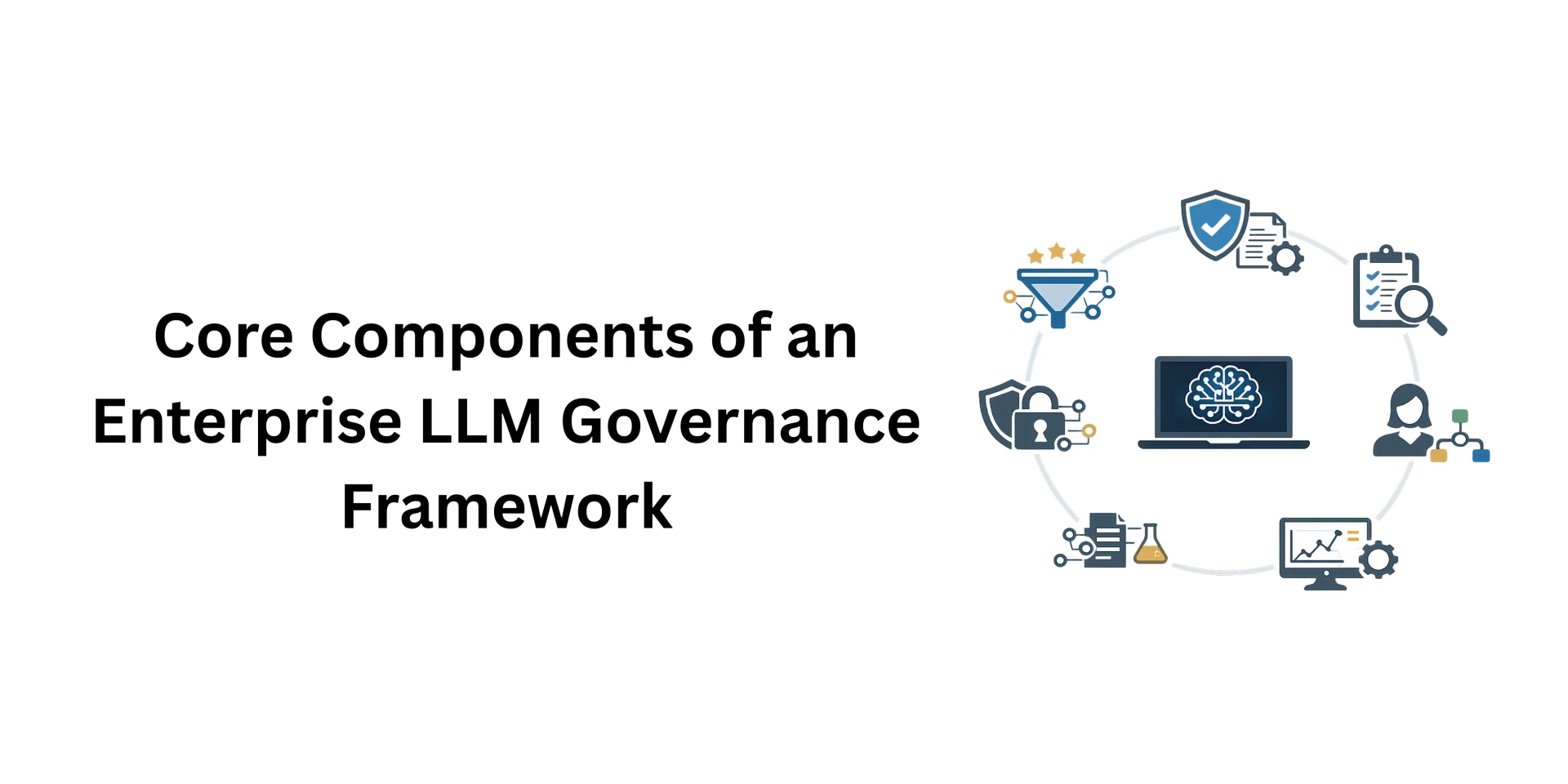
Clear Policies and Standards
Every governance framework begins with clear regulations.
Teams frequently use AI tools inconsistently when there are no written policies in place. While one department may experiment with sensitive data, another may use authorised data sources. Risk might easily arise from this lack of organization.
Enterprise LLM Governance should outline:
- Acceptable use cases
- Requirements for data management
- Expectations for security
- Guidelines for ethical AI
The organization as a whole gains a common understanding thanks to these standards. More significantly, because teams are aware of the boundaries before they start, they are able to make decisions more quickly.
Data Security and Privacy Controls
Data is essential to large language models. However, not every system should have access to every piece of data.
Enterprise LLM Governance is based on data classification, encryption, and strict access controls. From training to implementation, sensitive client data, financial data, or proprietary papers need to be safeguarded at every turn.
This element is non-negotiable for industries that are subject to regulations. Governance lowers the possibility of expensive breaches and guarantees adherence to privacy regulations. Customers are also reassured that their information is handled appropriately.
Model Evaluation and Testing
Not all models are prepared for manufacturing.
Organisations must assess models for accuracy, bias, dependability, and safety before implementation. Systems that have not been adequately tested may yield inaccurate or detrimental outcomes that undermine the reputation of the company.
A well-developed framework for enterprise LLM governance consists of:
- Benchmarking performance
- Identifying bias
- Testing for security
- Human evaluation
Leaders can better understand how models react in real-world scenarios by testing them. It also lessens post-launch surprises.
To put it simply, software would not be released without quality tests. AI ought to be the same.
Continuous Monitoring and Oversight
After a model goes online, governance continues.
As user behaviour or data changes over time, LLMs may drift. Teams can track performance, identify irregularities, and promptly address hazards with the use of continuous monitoring.
Usage logs, automated alerts, and routine audits are a few examples of this. Long after deployment, continuous monitoring guarantees that models continue to be accurate and compliant.
Instead of treating AI as a "set it and forget it" technology, Enterprise LLM Governance views it as a live system that needs to be monitored.
Responsibility and Ownership
Lastly, someone needs to take accountability.
Clear ownership is distributed among technical, legal, and business teams by effective governance structures. Decisions are more transparent and problems are resolved more quickly when accountability is established.
Teams know who approves changes or handles risk, and executives can see how AI supports strategy. Because of this congruence, the government no longer acts as a barrier to business.
In conclusion
Adopting huge, unstructured language models may cause more issues than they solve. Enterprise LLM governance offers the framework that enables companies to responsibly and confidently scale AI.
Organisations can innovate without jeopardising trust by combining well-defined policies, robust security, comprehensive review, ongoing monitoring, and clearly defined accountability.
For leaders, striking this balance is not just wise but necessary for sustained success.


























Sign in to leave a comment.