

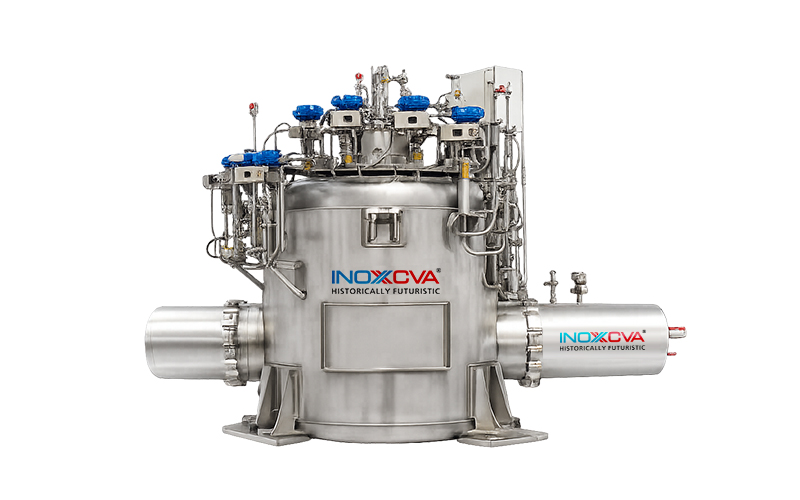
Delivering super-cooled fluids safely is one of the hardest jobs in cryogenic engineering. A cryogenic valve box is a specialised apparatus that brings valves, sensors and controls together in a single vacuum-insulated enclosure. It delivers fluids such as liquid helium and liquid hydrogen to demanding users, including particle accelerators and cryopumps. Its insulation is designed to eliminate heat leaks. It also manages temperature, pressure and gas flow, and acts as the key interface for operating the system. Safety features such as pressure relief for quenches are built in.
Why Preventing Heat Loss Matters
Liquid hydrogen sits at about −252.9°C, and liquid helium can reach −268.9°C. Both are scarce and expensive. Any warming causes boil-off, which means lost product and higher operating costs. Superior insulation and careful design are therefore essential, not optional extras.
The INOXCVA Difference
INOXCVA brings proven experience to this field. It has engineered specialised valve boxes for major projects such as ITER, FAIR and ISRO.
- Proven at the extremes: designs delivered for some of the world’s most demanding scientific facilities.
- Collaborative custom design: each solution is tailored to your infrastructure and thermal performance needs.
- Superior insulation expertise: designs minimise boil-off loss, cutting the cost of expensive cryogens.
- End-to-end cryogenic integration: units connect seamlessly with your entire cryogenic system.
A good example is the feedbox supplied for the FAIR project in Germany. A feedbox plays a similar role at the point where cryogens are fed into the system, ensuring they arrive with the right parameters and optimum quality.
Key Benefits
- Simplified design: centralised components give cleaner layouts.
- Maximised efficiency: superior insulation reduces fluid loss.
- Enhanced safety and control: all critical functions sit in one accessible location.
- Cost-effective: installation time and maintenance complexity are lower.
Specifications and Configuration
Valve boxes are built from high-grade stainless steel (304L/316L). They have a copper or aluminium radiation shield and high-performance multi-layer insulation. The radiation shield is dynamically cooled with return helium gas or liquid nitrogen, which further limits heat ingress.
A typical valve box contains:
- Control valves
- Open/close valves
- Safety relief valves
- Temperature sensors
- Pressure sensors
- Flow meters
- Heat exchangers
- Phase separators
- Sub-coolers
Applications
Liquid helium is used mainly in large physics experiments, scientific research and the medical industry. Its most important role is cooling the superconducting magnets in:
- Fusion reactors such as ITER
- Particle accelerators such as CERN and FAIR
- MRI scanners
Valve boxes work together with INOXCVA’s vacuum-insulated piping and multi-transfer lines (MTL). Together they make sure liquid helium reaches each user safely, with the required parameters and quality.
Engineer Your Solution
If you are planning or upgrading a cryogenic system, an integrated and well-insulated valve box can simplify your layout, protect valuable cryogens and improve safety. Working with a partner that has already delivered for ITER, FAIR and ISRO helps you get a design that fits your needs from the start.





















Sign in to leave a comment.