

Businesses that want to accept cryptocurrency have more options than simply displaying a wallet address. Today, crypto payments can be added to websites, online stores, booking platforms, and business systems through different payment methods.
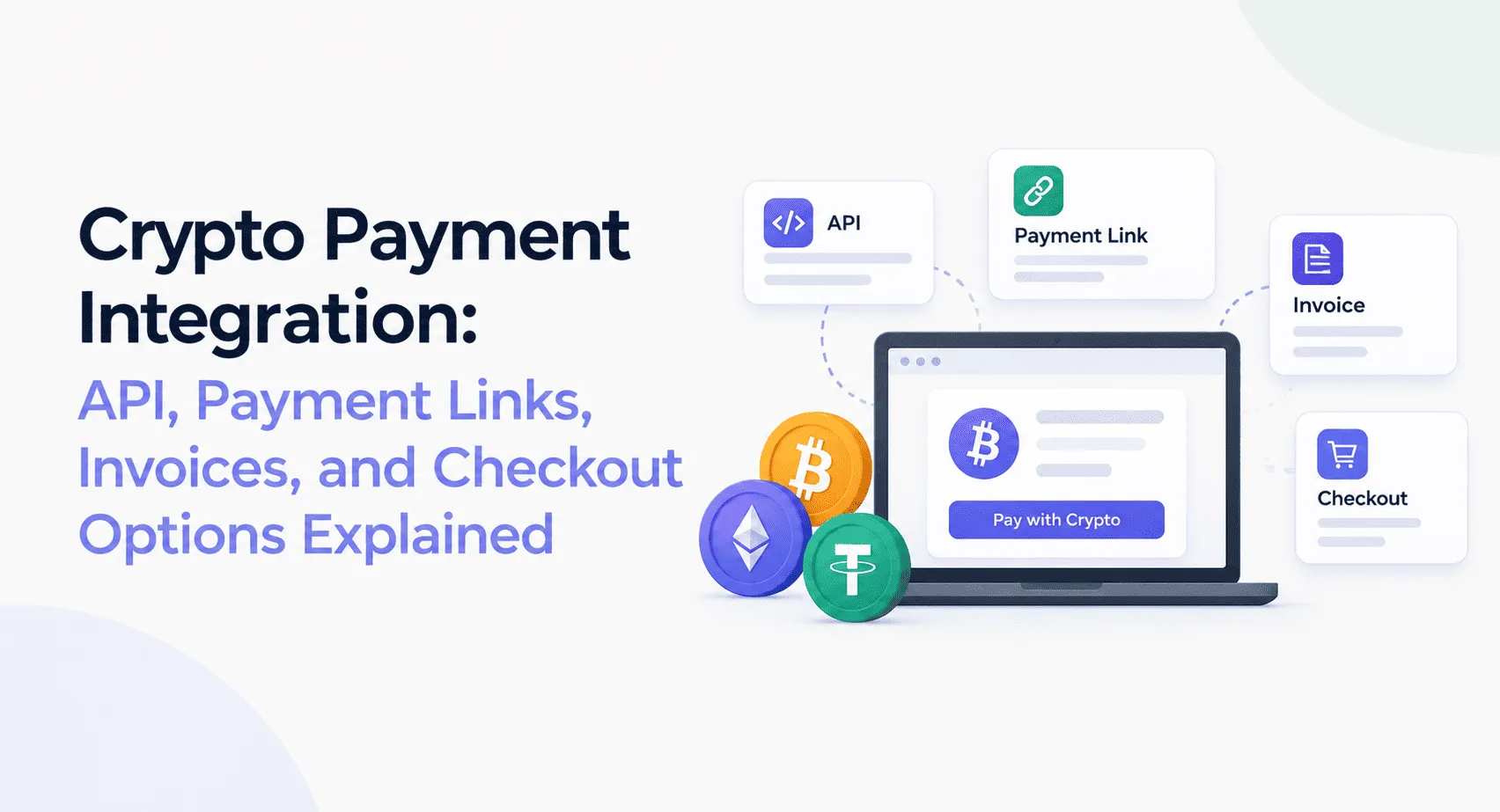
A business can use a crypto payment infrastructure or simple API for a customized checkout, create a payment link for a quick transaction, send an invoice to a customer, or use a ready-made crypto checkout page. Each option works differently and suits different business needs.
Understanding these options can help businesses choose a payment setup that is practical for their customers and easy to manage.
What Is Crypto Payment Integration?
Crypto payment integration means connecting cryptocurrency payments to a business website, application, or payment process.
Instead of asking customers to arrange every payment manually, businesses can provide a structured way to pay using supported cryptocurrencies. The payment system can help with details such as payment instructions, transaction status, order confirmation, and payment records.
The right integration depends on how the business sells its products or services. An online shop may need a checkout option, while a freelancer may only need a payment link or invoice.
Crypto Payment API
A crypto payment API is designed for businesses that want to connect crypto payments directly to their own software.
API stands for Application Programming Interface. In simple terms, it allows two software systems to communicate with each other.
For example, an online travel platform could connect its booking system to a crypto payment service. When a customer selects cryptocurrency at checkout, the payment system can provide the required payment information and send the transaction status back to the business system.
When Is an API Useful?
An API is generally more suitable for businesses that need a customised payment experience or want crypto payments to work as part of an existing platform.
It can be useful for:
- E-commerce websites.
- Travel and hotel booking platforms.
- SaaS businesses.
- Marketplaces.
- Mobile applications.
- Businesses with automated billing systems.
The main advantage is flexibility. Developers can build the payment experience around the business's existing website or application rather than sending customers to a completely separate process.
However, API integration usually requires technical development and testing, so it may not be the best choice for a small business looking for the quickest setup.
Crypto Payment Links
Payment links are one of the simpler ways to request cryptocurrency.
A business can create a payment request and share the link with a customer through email, messaging apps, social media, or another communication channel. The customer can then open the link and follow the payment instructions.
This can be useful for freelancers, agencies, consultants, service providers, and small businesses that do not need a fully integrated checkout.
For example, a designer could send a customer a payment link after completing a project. The customer opens the link, reviews the payment details, and completes the transaction using the available payment method.
Payment links can also be useful when the payment does not start from an online shopping basket.
Crypto Invoices
Crypto invoices provide a more structured way to request payment.
An invoice can include information such as the amount owed, payment details, and a description of the product or service. This makes invoices particularly useful for business-to-business transactions.
A marketing agency working with an overseas client, for example, could issue a crypto invoice after completing a monthly service.
Invoices can also make payment records easier to organise, particularly when a business handles multiple customers and transactions.
However, businesses should make sure that the invoice clearly states the accepted cryptocurrency and network. Sending funds through the wrong network can result in payment problems.
Crypto Checkout Options
A crypto checkout is designed for customers who are purchasing something directly through a website or application.
Instead of manually copying a wallet address, the customer can select cryptocurrency as a payment option and follow the checkout instructions.
A good checkout experience should make important information easy to understand. This may include:
- The cryptocurrency being requested.
- The blockchain network to use.
- The amount to pay.
- The payment status.
- Instructions for completing the transaction.
This approach can be particularly useful for e-commerce stores, travel businesses, digital services, and other companies that receive regular online payments.
Hosted Payment Pages
Not every business wants to build its own crypto checkout.
A hosted payment page provides a ready-made payment interface that customers can access through a business website, payment link, or other channel.
This can reduce the amount of development work required. The business can focus on its products and customers while the payment provider manages much of the payment interface.
For smaller businesses, this can be a practical starting point before moving towards a more customised API integration.
How Do These Options Compare?
Each crypto payment method serves a different purpose.
| Payment option | Best suited for | Technical effort |
| API | Custom websites and applications | Higher |
| Payment links | Simple payment requests | Low |
| Invoices | Business and service payments | Low |
| Checkout | Online purchases | Medium |
| Hosted payment page | Businesses wanting a ready-made solution | Low to medium |
There is no single option that is best for every business. The choice depends on the type of customers, payment volume, website structure, and level of customization required.
How to Choose the Right Crypto Payment Integration
Businesses should consider a few practical questions before choosing an integration.
First, think about how customers currently pay. If most payments happen through an online store, a checkout integration may make more sense than individual payment links.
Second, consider technical resources. A business with an in-house development team may prefer an API, while a smaller company may benefit from payment links or hosted pages.
Third, look at the cryptocurrencies and blockchain networks supported by the payment provider. Customers should be able to use payment methods that are relevant to the business's target markets.
Finally, consider settlement, transaction records, fees, security controls, and regulatory requirements. These factors can have a significant impact on the overall payment experience.
How Crypto Integration Supports Cross-Border Payments
Crypto payment integration can also be useful for businesses serving international customers.
A customer and business do not necessarily need to use the same local banking system when a supported cryptocurrency is used for payment. However, international crypto payments still come with considerations such as regulation, asset volatility, network fees, and settlement.
Businesses planning to accept crypto internationally should understand these factors before adding the payment option. Our guide to crypto payments for cross-border commerce covers the main challenges and opportunities businesses should consider.
Security and Payment Verification
Crypto payment integration should include clear processes for checking whether a payment has been received correctly.
Businesses should verify the transaction status rather than relying only on a customer screenshot or message. They should also protect API credentials, administrative accounts, payment information, and other sensitive systems.
Customer instructions should be clear as well. If a payment requires a specific blockchain network, the checkout or invoice should make this obvious.
Good payment design is not only about making transactions possible. It is also about reducing avoidable mistakes.
Which Crypto Payment Method Should You Use?
The best option depends on the business model.
A payment link may be enough for a freelancer who receives occasional payments. A crypto invoice can work well for agencies and service providers. An online retailer may need a crypto checkout, while a large platform may benefit from an API integration.
Some businesses may also use more than one method. For example, an online company could use an integrated checkout for regular customers while using payment links or invoices for specific business clients.
The important thing is to choose an approach that fits the way customers actually make payments.
Conclusion
Crypto payment integration is no longer limited to manually sending wallet addresses. Businesses can choose from APIs, payment links, invoices, hosted payment pages, and integrated checkout options.
Each method has its own advantages. APIs offer greater flexibility, payment links are simple to share, invoices work well for business transactions, and checkout solutions can create a smoother online purchasing experience.
Before choosing an option, businesses should consider their customers, technical resources, supported assets, fees, security, settlement process, and regulatory responsibilities.
With the right setup, cryptocurrency can become a practical additional payment option without forcing businesses to completely change how they already operate.







Sign in to leave a comment.