

A lot of companies spend money on CSR. Very few can tell you whether it actually worked.
That gap — between spending on social initiatives and genuinely understanding their outcome — is exactly where most corporate social responsibility programs fall short. Money goes out. Projects get completed. Reports get filed. But the real question is, did any of this actually change something for someone? — often goes unanswered.
That's what CSR impact assessment is for. And if your company is serious about its social commitments, it's the conversation you need to be having.
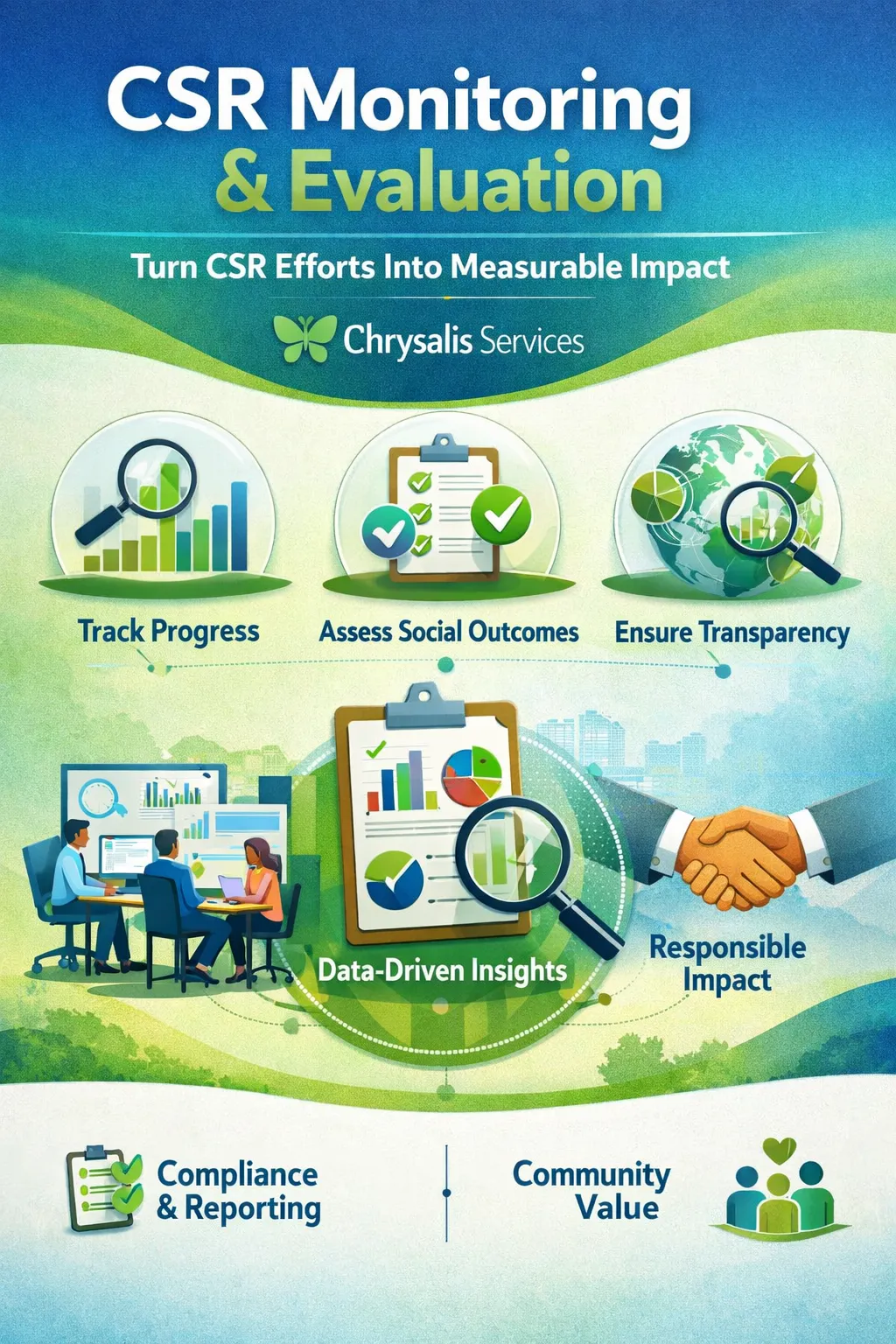
What Is CSR Impact Assessment, Really?
Let's start simple. CSR stands for Corporate Social Responsibility — the efforts a company makes to have a positive effect on society and the environment alongside its business activities. This includes things like funding education programs, supporting rural livelihoods, improving access to healthcare, building infrastructure in underserved areas, or running environmental sustainability projects.
Impact assessment is the process of measuring whether those efforts actually created meaningful, lasting change.
Not just, “Did we spend the money?” Not just, “Did we complete the project?” But did the lives of real people improve because of what we did?
That's a harder question. But it's the only question that truly matters.
A CSR impact assessment looks at your programs from the outside in. It gathers data — both numbers and human stories — to understand what changed, for whom, by how much, and why. It compares where things were before your intervention to where they are after. It asks communities directly what they experienced. And it tells you, honestly, what worked, what didn't, and what could be done better.
Why Companies Avoid It — and Why That's a Mistake
Here's the uncomfortable truth: many companies avoid proper impact assessment because they're afraid of what they'll find.
What if the program didn't work as well as we hoped? What if the community didn't benefit the way we thought? What if the money could have been spent more effectively?
These are uncomfortable questions. But avoiding them doesn't make the situation better. It just means you keep repeating the same mistakes, year after year, while communities receive support that doesn't actually serve them well.
The companies that are genuinely making a difference with their CSR — and the ones that are building real trust with communities, regulators, and stakeholders — are the ones willing to look honestly at their own work.
Impact assessment is not a threat to your CSR program. It's the tool that makes your CSR program stronger.
What Good CSR Impact Assessment Actually Looks Like
A proper impact assessment is not a box-ticking exercise. It's a structured, thoughtful process. Here's what it typically involves:
Baseline Data Collection
Before any programme begins — or early in its life — you need to understand the starting point. What is the current state of the community or issue you're addressing? What do people have access to? What are the gaps? Without a baseline, you have nothing to compare against later.
Theory of Change
A good impact assessment starts with a clear theory: If we do X, it will lead to Y, which will ultimately result in Z. This logical chain keeps the program focused and gives assessors something concrete to test. Many CSR programs skip this step and then wonder later why results are unclear.
Data Collection During and After
Throughout the programme — and at the end — data is gathered through surveys, interviews, focus groups, and observation. Both quantitative data (numbers, percentages, measurable outcomes) and qualitative data (stories, experiences, perceptions) are important. Numbers tell you what happened. Human stories tell you what it meant.
Independent Evaluation
The most credible assessments are done by third parties — people with no stake in the outcome. Internal evaluations have their place, but they're naturally prone to bias, even when the intentions are good. An independent assessor asks harder questions and provides findings the organisation can actually trust.
Actionable Reporting
The output of an impact assessment shouldn't just be a dense report that sits on a shelf. It should be readable, honest, and — most importantly — useful. It should clearly show what worked, what didn't, and what specific changes would improve outcomes in future.
Where CSR Consulting Comes In
Understanding that impact assessment matters is one thing. Actually doing it well is another.
This is where CSR consulting becomes genuinely valuable — not as a luxury, but as a practical necessity for companies that want their social investments to mean something.
A good CSR consulting partner doesn't just help you measure what you've already done. They help you design programmes that are measurable from the beginning. They bring expertise in research methodologies, community engagement, sector-specific knowledge, and regulatory understanding. They know how to ask the right questions, gather honest data, and translate findings into decisions.
They also save you from the most common and costly mistake in corporate CSR: jumping into implementation without a clear strategy.
Many companies choose their CSR initiatives based on what looks good in a press release, what the leadership team personally connects with, or what peer companies seem to be doing. None of these are bad starting points — but none of them are a strategy either.
A CSR consulting partner helps you look at your company's specific context — your geography, your sector, your stakeholder relationships, your compliance obligations under the Companies Act — and build a programme that is genuinely aligned with community needs and your organisation's capacity to deliver.
That alignment is what separates CSR that creates real impact from CSR that just creates activity.
The Compliance Angle — and Why It's Not Enough on Its Own
In India, CSR spending is a legal requirement for qualifying companies under Section 135 of the Companies Act. Companies meeting certain thresholds of net worth, turnover, or net profit are required to spend 2% of their average net profit on CSR activities.
This has led to a significant increase in CSR investment across the country — which is genuinely positive. But compliance and impact are not the same thing. A company can be fully compliant and still be making no meaningful difference.
The goal shouldn't be to spend the mandated amount and file the report. The goal should be to spend it well — in ways that create real, measurable change in communities that need it. Impact assessment is the bridge between those two things.
It tells you whether your compliance spending is also delivering on the actual intent of the law: improving lives.
What Happens When You Start Taking Impact Seriously
Companies that invest in proper CSR impact assessment and work with experienced CSR consulting support tend to see a shift — not just in their social programmes, but in how they think about their role in communities.
They start designing better programmes from the start because they know how to build in measurability.
They make smarter decisions about where to invest and which implementing agencies to trust.
They build more genuine relationships with communities — because communities can tell the difference between organisations that listen and ones that don't.
They produce more credible reports for regulators, investors, and the public — because the findings are based on real evidence, not polished narratives.
And perhaps most importantly, they stop feeling like CSR is a burden or an obligation — and start seeing it as something they can genuinely be proud of.
This transformation — from compliance-driven spending to impact-driven investment — is exactly what Chrysalis Services supports organisations through. With deep expertise in CSR consulting, impact assessment frameworks, and community-level research, they help companies move from doing CSR to doing CSR well.
Choosing the Right CSR Consulting Partner
If you're looking for support with CSR impact assessment or broader CSR consulting, here's what to look for:
Sector experience. Do they understand the areas you're working in — education, livelihoods, health, environment, water, skill development? Generic consultants may not ask the right questions in specific contexts.
Research rigour. Strong impact assessment requires proper methodology — not just anecdotal feedback. Look for partners who understand both quantitative and qualitative research methods.
Community-centred approach. The best consultants centre the voices of communities in their assessments — not just the priorities of the corporate funder. This produces more honest findings and more meaningful programmes.
Transparency. A good partner will tell you when a programme isn't working. If a consultant only ever confirms what you hoped to hear, that's not impact assessment — it's validation for hire.
Clear deliverables. You should receive reports and recommendations you can actually use — not just thick documents that demonstrate effort without producing insight.
The Bottom Line
CSR impact assessment is not a paperwork exercise. It is the mechanism through which your company's social investment becomes accountable, honest, and genuinely useful.
Without it, you're spending in the dark — hoping for the best, unable to learn from what isn't working, and ultimately unable to demonstrate that your CSR is doing what it's supposed to do.
With it, you have a clear picture of your impact. You can improve. You can report with confidence. And the communities you work with receive something far more valuable than good intentions — they receive programmes that actually respond to their real needs.






























Sign in to leave a comment.