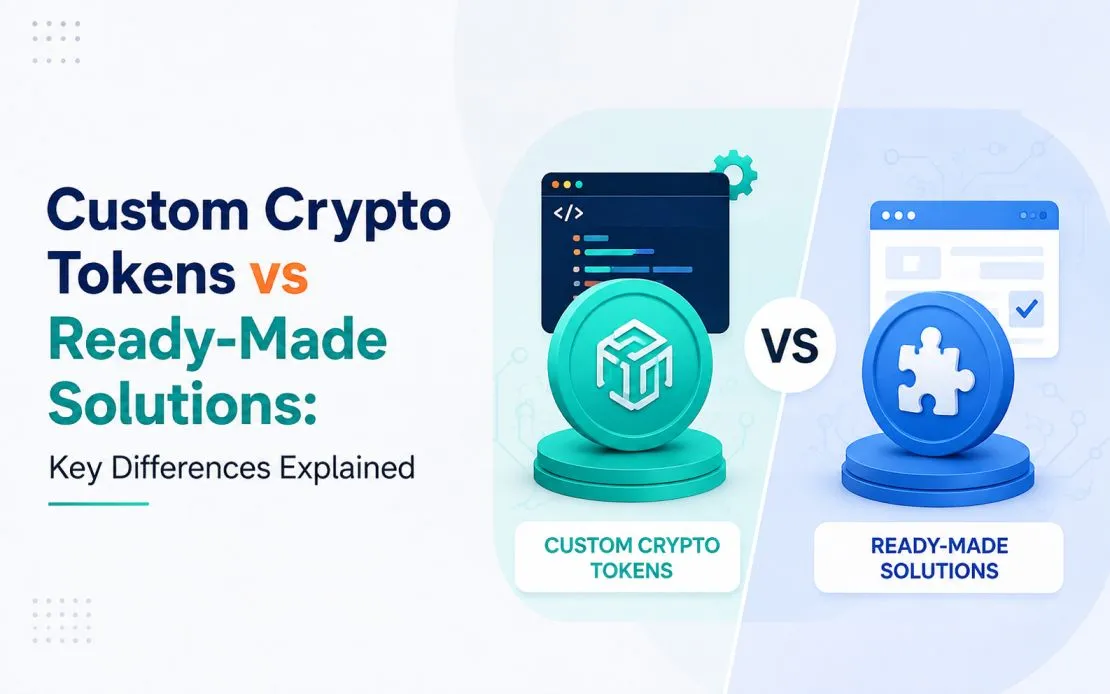

Businesses entering the blockchain space often face an important decision before launching a digital asset: Should they develop a custom crypto token or use a ready-made token solution? Both approaches can create a functional blockchain-based asset, but they differ substantially in flexibility, control, security, scalability, compliance, and long-term costs.
A ready-made solution can shorten the path from concept to deployment. A custom token, in contrast, gives businesses greater control over token behavior, economics, integrations, and future development. The right choice depends on the purpose of the token and the complexity of the ecosystem surrounding it.
For businesses evaluating custom token development, Blockchain App Factory focuses on building token solutions around specific project requirements rather than treating token creation as a one-size-fits-all process. Understanding the differences between these two approaches helps businesses determine which model fits their objectives, technical requirements, and growth plans.
What Is a Custom Crypto Token?
A custom crypto token is a blockchain-based asset developed around the specific requirements of a business or project. Instead of relying entirely on predefined functionality, developers can design the token's smart contract, tokenomics, permissions, integrations, and supporting infrastructure around a particular use case.
The token can be designed for different purposes, including payments, loyalty programs, governance, gaming economies, memberships, fundraising, asset representation, or platform incentives.
For example, a gaming company may require a token that supports in-game transactions, player rewards, marketplace purchases, and controlled token emissions. A standard token contract may provide basic transfers, but the gaming ecosystem can require additional logic to connect the asset with the application's economy.
Custom development makes those requirements part of the architecture.
What Are Ready-Made Token Solutions?
Ready-made token solutions use pre-built contracts, templates, frameworks, or platforms that allow businesses to create tokens with limited customization.
These solutions generally provide standard features such as token name, symbol, supply, decimals, minting, burning, and transfer functionality. Depending on the provider, they may also include features such as transaction taxes, ownership controls, liquidity mechanisms, or basic dashboards.
Their primary advantage is simplicity.
A business with straightforward requirements can avoid designing every component from scratch. Instead, it can configure predefined parameters and deploy a token using an existing framework.
This can work well for projects that need a conventional token without extensive customization.
The limitation appears when the business model requires functionality that falls outside the template's architecture.
The Biggest Difference: Flexibility
Flexibility is one of the clearest differences between custom and ready-made token solutions.
A ready-made solution generally works within predetermined parameters. If the platform supports ten features, the business chooses among those features. Adding a completely new mechanism can require modifications to the underlying code or even migration to a different solution.
Custom development takes the opposite approach.
The development team starts with the business requirements and builds the token architecture around them.
A project may require:
- Custom minting and burning rules
- Complex vesting schedules
- Role-based permissions
- Governance mechanisms
- Staking functionality
- Transfer restrictions
- Dynamic transaction fees
- Tokenized asset controls
- Ecosystem-specific rewards
- Custom wallet or application integrations
These requirements can be incorporated into the architecture from the beginning.
This flexibility becomes particularly important when the token is expected to become a core component of a larger business platform.
Cost Is More Complicated Than the Initial Development Price
Ready-made solutions often appear cheaper because the upfront development requirement is smaller.
A business can configure an existing system and avoid paying for extensive smart contract development. This makes the approach attractive for early-stage projects with limited budgets or simple token requirements.
Custom token development usually requires greater initial investment because developers need to design, build, test, audit, and deploy a solution specific to the project.
But comparing only the initial price can be misleading.
A ready-made solution may introduce additional costs when the business needs customization later. Modifying a template, integrating external systems, rebuilding tokenomics, or migrating to another architecture can become expensive.
Custom development has a higher initial cost but can provide greater control over the underlying architecture.
The right comparison is therefore the total cost of ownership, not simply the cost of initial deployment.
Security Depends on the Implementation, Not Just the Approach
Security is another area where businesses need to avoid simplistic assumptions.
A ready-made token can benefit from an established contract framework, especially if it has been extensively tested and independently audited. But businesses still need to understand the contract's permissions, upgrade mechanisms, ownership controls, and dependencies.
A custom token gives developers direct control over the codebase, but that also creates responsibility for testing and security.
A custom contract should undergo appropriate testing and review before deployment. Depending on the project's risk profile, this can include automated testing, static analysis, manual code review, testnet deployment, and independent auditing.
The critical question is not whether a token is custom or ready-made. It is whether the actual implementation has been designed and reviewed appropriately.
Tokenomics Is Easier to Tailor With Custom Development
Tokenomics often exposes the limitations of ready-made solutions.
A standard template may allow businesses to select a total supply and define basic allocations. More complex projects may need detailed economic logic.
For example, a project could need separate vesting schedules for founders, investors, advisors, community rewards, and treasury allocations. It may also need controlled emissions, staking rewards, token burns, or governance-based incentives.
Custom development allows these rules to be integrated with the token's technical architecture.
This matters because tokenomics and smart contract functionality should support each other. If the economic model says token supply is controlled while the contract contains unrestricted minting capabilities, users may question the credibility of the model.
Blockchain and Ecosystem Compatibility
Businesses also need to consider where their token will operate.
Ethereum uses standards such as ERC-20 for fungible tokens. BNB Chain supports BEP-20 tokens, while Solana uses its own token infrastructure. Each ecosystem has different characteristics related to transaction costs, performance, tooling, liquidity, and application compatibility.
Ready-made platforms may support only a predefined selection of networks.
That can be sufficient for businesses targeting one ecosystem. But companies planning a multi-chain strategy may require architecture designed around multiple blockchain environments.
Custom development provides greater control over this decision.
It can also simplify the integration of the token with wallets, exchanges, marketplaces, decentralized applications, payment systems, analytics platforms, and other infrastructure.
Control Over Administrative Functions
Token ownership and administrative permissions can have major implications for trust.
A ready-made contract may include predefined administrative capabilities. These could include minting, burning, pausing transfers, changing fees, or modifying certain settings.
Businesses need to understand exactly what powers exist and who controls them.
With custom development, permission structures can be designed according to the project's governance model. Administrative functions can be divided among different roles, placed behind multisignature controls, or governed through other appropriate mechanisms.
For example, a business may separate treasury management from contract administration instead of giving one wallet unrestricted control.
This level of control becomes increasingly important as token value and user adoption increase.
Compliance Requirements Can Favor Custom Architecture
Businesses targeting users in the United States, United Kingdom, India, and other jurisdictions also need to consider regulatory requirements.
A token's legal treatment can depend on its functionality, distribution method, underlying rights, marketing, and business model.
Ready-made contracts may not provide the controls needed for a particular regulated use case. A business dealing with tokenized assets, investment-related rights, or restricted transfers may require features such as wallet eligibility controls, transfer restrictions, identity integrations, or transaction monitoring.
Custom development allows these requirements to influence the technical architecture from the beginning.
Legal and regulatory analysis should still be performed separately by qualified professionals. Technical customization alone does not make a token compliant.
When a Ready-Made Solution Makes Sense
Ready-made solutions can be appropriate when the project's requirements are straightforward.
For example, a small community project may need a basic fungible token with a fixed supply and standard transfer functionality. Building an extensive custom architecture in such a case can introduce unnecessary cost and complexity.
A ready-made approach can make sense when:
- The token has conventional functionality.
- The project needs a faster deployment path.
- Multi-layer customization is unnecessary.
- The selected contract has strong security credentials.
- The business accepts the platform's limitations.
- Future requirements are unlikely to change substantially.
The important consideration is whether the predefined architecture actually matches the project's needs.
When Custom Token Development Is the Better Choice
Custom development becomes more valuable when the token is an important part of the company's product or business infrastructure.
A custom approach is particularly relevant when a project requires:
- Complex tokenomics
- Specialized utility
- Custom governance
- Multi-chain functionality
- Advanced compliance controls
- Proprietary integrations
- Tokenized real-world assets
- Unique reward mechanisms
- Long-term ecosystem expansion
In these situations, the token is not simply a digital asset. It is part of the product itself.
A Practical Comparison
| Factor | Custom Crypto Token | Ready-Made Token |
| Customization | High | Limited to available features |
| Initial development effort | Higher | Lower |
| Deployment speed | Usually slower | Usually faster |
| Tokenomics flexibility | High | Moderate to limited |
| Integration control | High | Depends on platform |
| Administrative control | Customizable | Predefined |
| Multi-chain strategy | Can be designed around requirements | Depends on provider |
| Long-term flexibility | High | Depends on template |
| Technical responsibility | Higher | Shared with solution provider |
| Best suited for | Complex business ecosystems | Straightforward token launches |
The Decision Should Start With the Business Model
The biggest mistake businesses can make is choosing a token development approach based only on price or deployment speed.
A better decision starts with the product.
What will the token do? Who will use it? Which blockchain ecosystem will support it? Will it interact with a DEX? Does it need staking or governance? Will supply change over time? Are there transfer restrictions? Does it represent an underlying asset? Which jurisdictions will the project target?
The answers determine whether a predefined token architecture is sufficient.
If the token is simply a standard utility asset, a ready-made solution may provide everything the business needs. If the token is central to a complex ecosystem, custom development provides the architectural freedom needed for future expansion.
Conclusion
The difference between custom crypto tokens and ready-made solutions comes down to control, flexibility, complexity, and long-term requirements.
Ready-made solutions can provide a faster and simpler path for projects with conventional needs. Custom token development requires greater planning and investment, but it gives businesses greater control over token functionality, tokenomics, security architecture, integrations, permissions, and future expansion.
Businesses should not choose a custom token simply because customization sounds more advanced. They should choose it when their business model requires capabilities that a predefined solution cannot reliably provide.
For companies planning a specialized token ecosystem, Blockchain App Factory provides custom token development solutions designed around project-specific functionality, blockchain requirements, tokenomics, integrations, and security considerations.
The right objective is not to build the most complicated token. It is to choose the architecture that gives the token the functionality, control, and scalability required to support the business behind it.























Sign in to leave a comment.