

Your product is solid. Your onboarding flow works. But your churn dashboard tells a different story every quarter, and you're starting to suspect the problem isn't the product at all — it's that nobody owns the relationship after the sale closes. That's the gap a customer success recruiter is built to close.
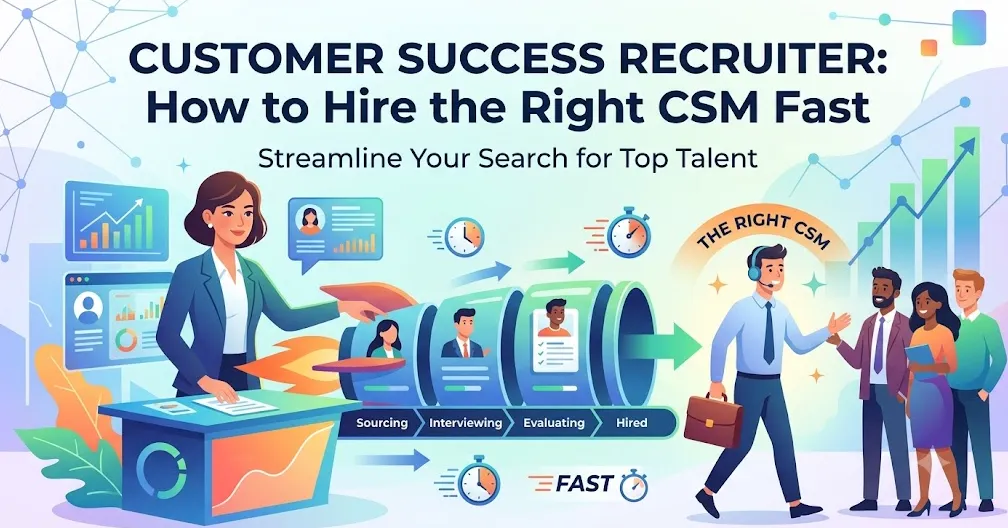
Most SaaS founders don't struggle to find a candidate for their open CSM role. They struggle to find the right one — someone who can read a health score, spot churn risk three weeks before it shows up in the numbers, and turn a frustrated account into a renewal. A specialized customer success recruiter exists precisely because that skill set doesn't show up reliably on a generic job board.
Why Hiring a Customer Success Manager Is Harder Than It Looks
Customer success is one of the few roles that sits at the intersection of support, sales, and product strategy. A candidate can look great on paper — years of "customer-facing experience," a CRM certification, a friendly interview manner — and still fail within 90 days because the role actually demands things a resume can't show: pattern recognition across usage data, the judgment to know when to escalate versus when to coach a client through friction, and the discipline to manage a renewal pipeline without a sales manager standing over their shoulder.
Generalist hiring processes aren't built to test for any of that. They test for communication skills and general customer service instinct, which matters, but isn't sufficient. That mismatch is why CSM turnover runs high at growth-stage SaaS companies, and why so many founders end up re-hiring for the same seat twice in one year.
What a Customer Success Recruiter Actually Does
A customer success recruiter is a specialist who sources, screens, and places candidates specifically for CSM, customer success ops, and account management roles — not a general staffing rep working ten unrelated job categories at once.
In practice, that means they:
- Understand the difference between reactive support skills and proactive retention skills, and screen for the latter
- Know how to evaluate a candidate's grasp of health scores, QBRs (quarterly business reviews), NRR (net revenue retention), and expansion revenue — not just "customer service experience"
- Pull from a talent pool that's already been pre-qualified for SaaS or subscription-based business models, rather than starting a search from zero
- Can move fast, because sourcing and screening are already built into their workflow instead of being reinvented for every open role
Generalist Recruiter vs. Customer Success Recruiter: The Real Difference
| Factor | Generalist Recruiter | Customer Success Recruiter |
|---|---|---|
| Candidate pool | Broad, cross-industry | Pre-vetted for CSM/retention roles |
| Screening depth | Communication + culture fit | Health scores, churn signals, renewal process, tooling (Gainsight, ChurnZero, HubSpot) |
| Time to shortlist | 3–6 weeks | Often under 2 weeks |
| Role-specific red flags caught | Rarely | Consistently |
| Onboarding support | Minimal | Often includes compliance, contracts, and ramp support |
What to Look for in a Customer Success Recruiter
Not every recruiter who claims CSM experience actually specializes in it. Before signing with one, check for:
- A documented screening process for retention-specific skills, not just a generic behavioral interview script
- Access to a global or remote talent pool, since the best CSM candidates increasingly aren't limited to your home city
- Speed benchmarks they can actually back up — ask how long their average placement takes, and ask for a reference
- Compliance and contract handling, especially if you're hiring across borders, since payroll, tax, and labor law get complicated fast
- A replacement or guarantee policy if a placed candidate doesn't work out within the first few months
Pro Tip: Ask any recruiter you're evaluating to walk you through how they'd screen a candidate for "proactive churn prevention" specifically. A recruiter who specializes in customer success will have a concrete answer involving usage data and early-warning signals. A generalist will talk about communication skills instead.
How CrewBloom Approaches Customer Success Manager Recruitment
CrewBloom built its Customer Success Manager solution around the reality that most in-house hiring teams don't have the bandwidth or specialized screening tools to vet for retention-specific skills at scale. The process centers on drawing from a global talent pool, running candidates through structured, role-specific vetting, and handling the compliance and employment logistics that come with hiring across 22-plus countries — so a founder isn't stuck untangling international payroll and labor law on top of everything else.
Placements are typically ready to onboard within roughly 15 to 20 business days, and companies can bring on CSM talent full-time or part-time depending on where they are in their growth curve, without being locked into long-term contracts if the fit isn't right. For a founder trying to plug a retention gap before the next renewal cycle hits, that speed and flexibility matters as much as the candidate quality itself.
Expert Insight: Having worked alongside dozens of SaaS teams scaling their customer success function, one pattern shows up again and again — companies that treat their first CSM hire as "just a support person with a nicer title" almost always have to re-hire within a year. The founders who get it right from the start treat the CSM search with the same rigor they'd apply to a sales hire, because in a subscription business, the CSM effectively is the ongoing sales relationship.
Common Mistakes SaaS Founders Make When Hiring a CSM
- Hiring for personality alone. A warm, likable candidate who can't read a health score or manage a renewal pipeline will still let accounts churn quietly.
- Skipping a data-literacy check. If a candidate can't explain how they'd use usage data to flag at-risk accounts, that's a real gap, not a minor one.
- Underestimating time-to-productivity. A rushed hire without proper vetting often needs 60–90 days just to become useful, which is time your existing accounts don't have.
- Ignoring geographic flexibility. Limiting the search to local candidates shrinks the talent pool dramatically and usually means paying more for less specialized experience.
Did You Know? Companies with strong net revenue retention (NRR above 120%) tend to have customer success functions that operate proactively rather than reactively — meaning the CSM is flagging risk before the client ever files a ticket, not just answering tickets faster.
The Real Cost of a Bad Customer Success Hire
It's tempting to think of a mis-hire as just a wasted salary. It's more than that. A CSM who can't do the job well means missed renewal windows, silent churn that doesn't get flagged until it's too late, and account managers or founders pulled back into firefighting mode instead of focusing on growth. Add in the cost of re-recruiting, re-onboarding, and the lost institutional knowledge of the accounts that churned in the gap, and a single bad hire in this role can quietly cost a growth-stage SaaS company far more than the recruiter's fee would have.
That's the actual case for using a customer success recruiter instead of a generalist: it's not about convenience, it's about protecting revenue that's already been earned.
FAQ
1. What does a customer success recruiter do differently from a regular recruiter?
A customer success recruiter screens specifically for retention-focused skills — reading health scores, managing renewals, running QBRs — rather than general customer service ability, and typically draws from a pool already familiar with SaaS tools and metrics.
2. How long does it take to hire a Customer Success Manager through a specialized recruiter?
Timelines vary, but specialized recruiters with pre-vetted talent pools often place candidates in two to three weeks, compared to four to six weeks or longer through a generalist process.
3. Can a customer success recruiter help with remote or international hires?
Yes, Many specialized recruiters, including CrewBloom, source from global talent pools and handle the compliance and contract logistics that come with hiring across different countries.
4. What's the difference between a Customer Success Manager and a Customer Support Rep?
A support rep typically responds to inbound issues. A CSM proactively manages the account relationship, tracks health scores, drives renewals and expansion, and works to prevent churn before it happens.
5. How much does it cost to hire a Customer Success Manager through a recruiter?
Costs vary by recruiter, region, and whether the hire is full-time or part-time. It's worth comparing that cost against the revenue risk of an unfilled or poorly filled CSM seat, which is often far higher.
6. What should I look for in a CSM candidate besides communication skills?
Look for data literacy (ability to interpret usage and health-score data), familiarity with retention metrics like NRR and churn rate, and experience running structured renewal or QBR processes.
7. Is it better to hire a CSM full-time or part-time first?
It depends on account volume and growth stage. Many companies start part-time to validate the function and scale to full-time as the client base and renewal complexity grow — a flexible recruiter can support either path without long-term lock-in.




























Sign in to leave a comment.