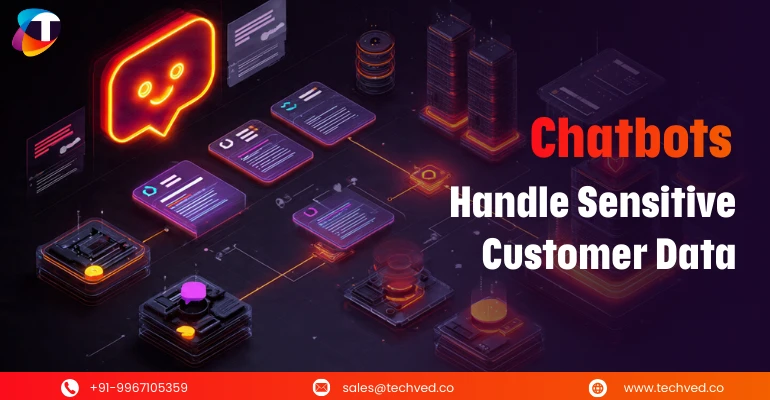

The insurance industry is accelerating its chatbot digital transformation journey. From policy servicing to claims automation, AI-powered assistants are redefining responsiveness and efficiency.
But alongside innovation comes a critical responsibility:
How to secure customer data in insurance chat?
Insurance chatbots routinely process financial records, identity proofs, medical information, and policy documents. Without strong cybersecurity measures, these digital touchpoints can become risk surfaces.
Let’s explore how modern ai chatbot technology safeguards sensitive data and what insurers must demand from an ai chatbot development company to build secure, compliant systems.
What Is an AI Chatbot in the Insurance Context?
Before diving into cybersecurity, it’s important to understand what is an ai chatbot in an enterprise insurance ecosystem.
An AI chatbot is an intelligent assistant powered by natural language processing (NLP), machine learning (ML), and secure backend integrations. Unlike rule-based bots, AI chatbots:
- Understand context and intent
- Personalize conversations
- Integrate with CRM and policy systems
- Automate workflows
Insurance companies deploy ai chatbot services to improve accessibility, reduce call center pressure, and enhance chatbot customer experience.
But with deeper system integration comes greater cybersecurity exposure.
The Cybersecurity Challenge in Insurance Chatbots
Insurance chatbots process:
- Personally identifiable information (PII)
- Health records
- KYC documentation
- Payment details
- Policy history
This makes them attractive targets for:
- Data breaches
- API exploitation
- Identity fraud
- Phishing simulations
- Model manipulation
The question is not whether to deploy AI — but how to secure customer data in insurance chat environments without slowing innovation.
How to Secure Customer Data in Insurance Chat?
Here are the essential cybersecurity pillars every insurer must adopt:
1. End-to-End Encryption
All conversations must be encrypted both in transit and at rest. TLS encryption protects communication channels, while AES-256 secures stored data.
2. Multi-Factor Authentication (MFA)
For policy access, claim status, or financial transactions, MFA prevents unauthorized logins.
3. Role-Based Access Control (RBAC)
Internal systems connected to chatbots should restrict access based on role and need-to-know basis.
4. Secure API Management
Chatbots connect to core insurance platforms. A secure chatbot development company ensures:
- API gateways
- Token-based authentication
- Input validation
- Rate limiting
5. Data Minimization
Collect only what is required. The less data processed, the lower the risk exposure.
6. Audit Trails and Monitoring
Every chatbot interaction should be logged for compliance, fraud detection, and anomaly tracking.
Cybersecurity must be embedded from architecture to deployment.
Learning from AI Chatbots in Banking
The rise of ai chatbots in banking has established benchmarks for secure digital conversations. Banks deploy AI bots for:
- Account queries
- Fraud alerts
- Transaction history
Insurance chatbots often process even more sensitive health and claim-related data.
This means insurers must adopt equal or stronger cybersecurity frameworks compared to financial institutions.
AI Chatbots for B2B Insurance Ecosystems
Insurance businesses operate within extended ecosystems — brokers, agents, and enterprise clients.
AI chatbots for b2b and ai chatbot services for b2b support:
- Broker onboarding
- Policy documentation
- SLA management
- Claims coordination
These integrations increase attack surfaces because chatbots interact with enterprise systems.
Security here requires:
- Enterprise SSO integration
- Zero-trust architecture
- Segmented databases
- Continuous vulnerability scanning
Without governance, automation can amplify risk.
AI Chatbot for Technical Support: Internal Security Risks
Many insurers deploy an ai chatbot for technical support to assist employees and agents.
These bots access:
- Internal policy databases
- System manuals
- Customer records
If improperly configured, internal chatbots can become entry points for data leaks.
Security best practices include:
- Knowledge base sandboxing
- Strict permission layers
- Controlled AI model training
- Human-in-the-loop oversight
Internal systems must be protected as rigorously as customer-facing channels.
Choosing the Right AI Chatbot Development Services
Not all ai chatbot development services are enterprise-ready.
A credible ai chatbot development company should provide:
- Secure cloud or private deployment options
- Compliance-ready architecture
- Regular penetration testing
- AI model governance
- Data anonymization mechanisms
A standard ai chatbot development tutorial 2025 no longer focuses only on NLP accuracy. It emphasizes:
- Ethical AI
- Secure data pipelines
- Bias mitigation
- Transparent model training
- Regulatory compliance
Security is not a feature add-on. It is the foundation of responsible AI.
Cybersecurity as a Competitive Advantage
Strong cybersecurity doesn’t just reduce risk — it enhances trust.
A secure chatbot ecosystem improves:
- Customer confidence
- Regulatory compliance
- Brand credibility
- Long-term retention
When cybersecurity strengthens chatbot customer experience, insurers move beyond automation and toward sustainable digital leadership.
Organizations like TECHVED approach AI implementation with a balanced focus on user experience, compliance, and enterprise-grade security ensuring that innovation does not compromise data integrity.
The Bigger Picture: Secure Chatbot Digital Transformation
Insurance companies cannot treat chatbot deployment as a standalone IT project.
True chatbot digital transformation means:
- Aligning AI with cybersecurity strategy
- Integrating compliance into development
- Conducting continuous monitoring
- Training employees on data governance
- Preparing incident response protocols
Cybersecurity is not the cost of innovation it is the enabler of scalable innovation.
Final Thoughts
AI chatbots are reshaping insurance interactions. They improve speed, personalization, and operational efficiency.
But trust remains the currency of insurance.
The real success metric is not just faster responses it is secure conversations.
By partnering with the right chatbot development company and investing in secure ai chatbot technology, insurers can protect confidential customer data while delivering superior digital experiences.
In the age of AI, cybersecurity is not optional.
It is the foundation of customer trust.



























Sign in to leave a comment.