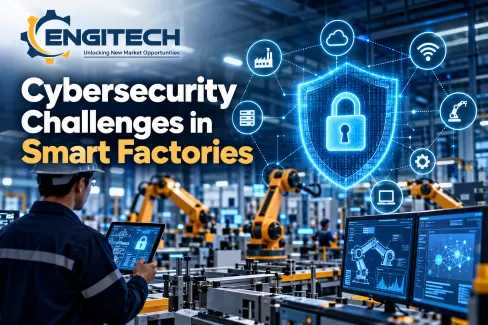

Smart factories are influencing how industries are manufacturing, controlling, and managing goods. Recent manufacturing plants boast sophisticated technology, including connected equipment, robots, sensors, cloud computing technologies, artificial intelligence devices, and analytics tools that work together to improve manufacturing productivity and operations.
However, with an increase in online linkages and connections in smart factories comes a new cybersecurity issue.
Unlike traditional manufacturing plants, smart factories are a lot more reliant on computer technologies and interlinked devices. Because of this, if one machine breaks down, it could adversely affect the entire system. Thus, hackers are currently targeting OT (operational technologies), industrial controlling systems, interconnected equipment, and IoTs. This means that manufacturing has to prioritize cybersecurity.
What Is a Smart Factory?
A smart factory means that the machines, systems of production, sensors, software, and people are interconnected in a manufacturing environment. These systems collect and share data continuously for improving production processes, quality control, maintenance, management of stock, and decision-making.
The technologies that enable smart manufacturing include IIOT, artificial intelligence, machine learning, robotics, cloud computing, and digital twins.
The idea is clear: to make a system of production that understands what is happening, reacts quickly to changes in the environment, and works better.
However, the use of numerous connected devices means that the number of vulnerabilities increases.
Why Cybersecurity Matters in Smart Manufacturing
Conventional cybersecurity is primarily concerned with protecting computing devices, software programs, databases, and networks. However, smart factories bring an additional level of complication because there are greater connections between IT systems and operational technology.
A security breach of an office computer may lead to data theft as well as monetary loss. Hacking into a manufacturing facility has the potential of halting the production process, affecting the workings of machines, causing poor product quality, and fostering dangers.
This difference makes industrial cybersecurity extremely crucial. Businesses should ensure not only the protection of the sensitive business data but also make sure that PM systems are reliable, available, and trustworthy.
Major Cybersecurity Challenges in Smart Factories
1. Increased Number of Connected Devices
The increasing number of devices connected to the internet is one of the issues that makes it hard for organizations to protect the internet.
Smart factories can contain thousands of connected components, including sensors, cameras, PLCs, automated machines, and others. Each piece of connected equipment can be an entry point for attackers if it is not well configured, is outdated, or is not protected well enough.
It is also important to mention that some industrial devices could work for years. It is far more difficult to replace or upgrade industrial equipment than modern computers. Thus, organizations can face problems with outdated systems that were developed long before today's threats existed.
2. Legacy Industrial Systems
A substantial number of manufacturing plants employ a mixture of modern smart technologies and older equipment. Legacy equipment may involve obsolete operating systems, unsupported software, or older communication protocols.
Since replacing an entire production system is both expensive and disruptive, organizations tend to retain the old systems but connect them to new technologies instead. This causes security holes.
A legacy piece of equipment may lack security functions but at the same time exists in the network with the modern environment as a cloud platform, analytical tools, and IoT devices. If the hacker manages to exploit one weak point, he will fail to exploit more important systems.
3. IT and OT Convergence
In the future, we may see a complete merging of IT and OT applications as a result of the merging of the two approaches. IT systems are involved in managing information, while OT systems handle active production processes.
This creates a need for communication between two worlds. Machine-generated information is transmitted to cloud systems while business applications can access manufacturing data for their processes.
If the integration obtains operational advantages, it creates additional risks in terms of information security. An attacked IT system can serve as a gateway to OT systems if certain segmentation rules are not followed. Read more


























Sign in to leave a comment.