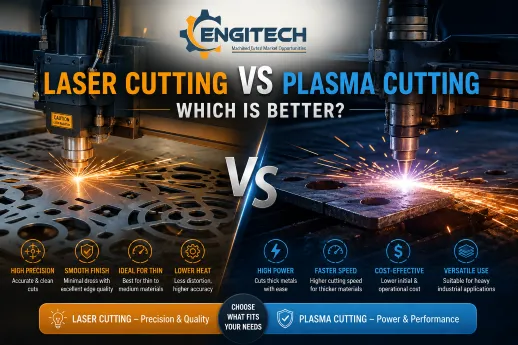

The method selected for metal cutting can have a significant effect on the time taken for production, accuracy achieved, wastage of materials, surface finish of the material, and general costs incurred for production. Some of the most commonly used methods today include laser cutting and plasma cutting. Though both these methods are based on thermal cutting techniques, they use different processes and techniques to achieve their end result.
In terms of laser cutting and plasma cutting, the question arises: which is better? The answer to this question actually depends on a number of factors, including the material being cut, the thickness of the material, how accurate the process needs to be, the quality of the cut edge, and the volume of production, as well as the costs involved.
What Is Laser Cutting?
Laser cutting uses a non-contact technique that applies a focused ray of light to melt or burn material in accordance with predetermined cutting specifications. CNC lasers enable the machinery to fabricate shapes, holes, and profiles with a high level of precision.
Many improvements have been made to allow laser cutting applications with the latest in fiber laser technology. These systems are ideal for processing sheet metal and medium-thickness materials, where speed, high accuracy, and smooth edges are required. It appears that the latest laser technology has changed the concept that lasers are only appropriate for processing thin materials. New laser systems can be used for cutting thicker plates.
Another advantage of laser cutting is the ability to manufacture pieces with high accuracy and little post-processing. The narrow zone of cutting minimizes the area affected by heat and provides for maintaining geometric accuracy, which is beneficial for components that have complex shapes or are produced with close tolerances.
What Is Plasma Cutting?
Plasma cutting involves the use of an electrically conductive gas, which is ignited into a high-temperature plasma arc. The plasma jet can easily melt metals, and its gas force removes melted metals away. Unlike laser cutting, plasma cutting requires the workpiece to be electrically conductive to perform plasma cutting.
The plasma systems can effectively cut materials like steel, stainless steel, aluminum, and other conductive metals. Their ability to cut heavier plates makes them most suited for structural fabrication, construction machinery, industrial equipment, and many other applications, where cutting thicker plates is of more importance than precision in detail.
The plasma cutting process also has the advantage of lower cost, especially with thicker materials and less complicated profiles. However, it can produce more dross, beveling, and heating distortion due to the fact that the cut width is greater and the heat input is more than in laser cutting.
Laser Cutting vs Plasma Cutting: Key Differences
The most notable distinction between laser and plasma cutting involves the energy delivery process to the material to be cut. The laser is used to direct energy on a very small area, while high-temperature ionized gas is used in plasma cutting to create the arc. This distinction affects the precision of cutting and quality of cuts as well as the amount of input heat and jobs that each of these technologies can perform.
1. Precision and Accuracy
When precision is the issue in a cutting process, laser cutting has the advantage over all other technologies. The use of a narrow beam of light by a laser to create a narrow kerf within the material allows one to ensure great accuracy and the manufacture of various intricate parts and forms.
Using a CNC plasma system improves the process significantly, although the wider plasma beam produces more variations.
2. Cutting Speed
The cutting velocity is directly determined by the thickness of the material, type of material, power of the machine, and part geometry. Laser cutting is believed to be the fastest of cutting processes for thin or medium sheet materials. In some thickness ranges, modern fiber lasers can outperform conventional plasma systems.
However, this advantage may change when the thickness of the material increases. Some studies have revealed that plasma may be faster than certain laser systems on thick mild-steel sheet, especially in the case of lower-energy laser machines.
This implies that manufacturers should not select the cutting process based solely on the maximum speed parameters. Instead, it is recommended to consider the actual cutting speed of the process for the particular thickness of the material and production needs.
3. Edge Quality and Finishing
The quality of the cut edge is another area where laser cutting often scores high. Thanks to the narrow kerf and the focused heat, clean edges are produced with minimal dross when processing suitable metal sheets.
Plasma cutting also produces good cuts but generally leaves more dross and often produces a cut edge that is beveled. Depending on the specifics of the application, it may be necessary to include additional steps such as grinding, deburring, or finishing in the costs of plasma cutting.
4. Material Thickness
Material thickness plays an important role in deciding whether to use plasma or laser cutting. Although laser cutting is most effective for thin and medium materials, advances in laser technology mean it is now capable of cutting thicker materials as well. Plasma cutting, on the other hand, is still considered the best method for cutting very thick conductive materials.
Traditional comparisons often state that plasma is the better choice for very thick materials. However, advances in fiber laser cutting technology are beginning to change this situation. Certain newer laser machines are capable of operating at thicknesses that were once exclusively reserved for plasma cutting.
5. Operating and Equipment Costs
The cost of the machine is only one component of cutting costs, as power consumption, gases, consumables, maintenance, utilization, labor, material loss, and secondary finishing must also be factored in.
Plasma machines may offer lower initial investment and, thus, provide greater value for heavy fabrication. While laser systems may require a higher upfront cost, their productivity and precision make them the most cost-effective solution.
The best way to approach the problem is to find the costs per finished part, not just compare hourly rates.



























Sign in to leave a comment.