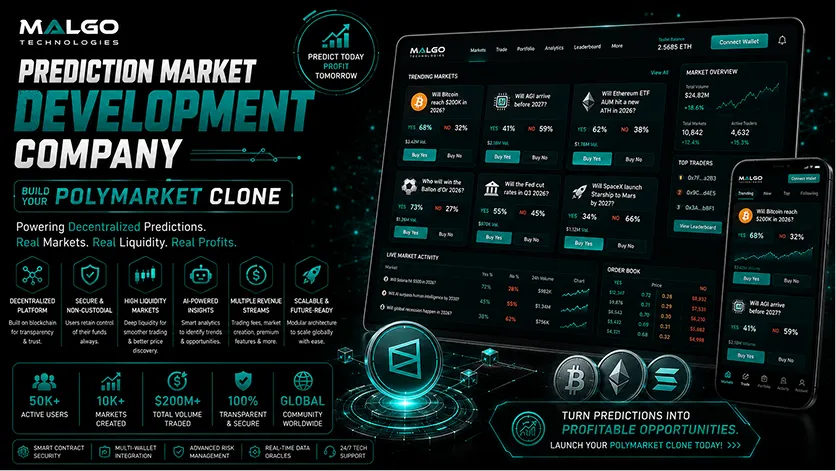

Prediction markets have moved beyond being a niche concept for economists and forecasting enthusiasts. Today, users can trade positions on questions tied to politics, sports, finance, technology, entertainment, weather, and other real-world events. Platforms such as Polymarket have demonstrated how an intuitive trading interface, transparent market mechanics, blockchain infrastructure, and real-time information can turn event forecasting into an active digital marketplace.
For entrepreneurs and businesses exploring this space, Polymarket clone development provides a way to build a prediction market platform with similar core mechanics while creating an independent brand, market structure, compliance framework, and user experience.
A successful platform, however, is not simply a website with YES and NO buttons. It requires an order-matching environment, market creation and resolution logic, wallet infrastructure, liquidity mechanisms, real-time data, security controls, and a carefully designed regulatory framework.
This guide explains the major features, technology considerations, development process, and factors that influence the overall development cost of a Polymarket-like prediction market platform.
What Is a Polymarket Clone?
A Polymarket clone is a custom prediction-market platform inspired by the functional model of Polymarket. It enables users to trade contracts representing possible outcomes of future events.
For example, a market could ask:
- Will a particular team win a championship?
- Will a specific economic indicator cross a defined threshold?
- Will a technology product launch before a certain date?
- Will an event occur before a predetermined deadline?
The platform creates tradable outcome positions, allows participants to submit buy and sell orders, displays changing market probabilities, and settles positions after the event is resolved.
Polymarket describes prediction-market prices as reflecting the market's current probability of an event. Its documentation also explains that users trade against other participants rather than against a traditional sportsbook-style house. A clone should therefore be viewed as a prediction-market product inspired by an established business model, not as a literal copy of another company's source code, branding, intellectual property, or proprietary infrastructure.
How Does a Prediction Market Work?
At the simplest level, a prediction market converts an uncertain future event into a tradable contract.
Suppose a platform creates a YES/NO market around an event. Traders who believe the YES outcome is undervalued can submit buy orders, while participants with the opposite view can sell or take the NO side.
As information changes, supply and demand change. The market's displayed probability can therefore move continuously before settlement.
The basic workflow is:
- An administrator or authorized market creator defines an event.
- The platform publishes the question and settlement criteria.
- Traders deposit or connect an approved payment or wallet method.
- Users place buy or sell orders.
- The matching engine pairs compatible orders.
- Market prices update in real time.
- External information determines the actual event outcome.
- An approved resolution mechanism finalizes the market.
- Winning positions are settled according to the contract rules.
The CFTC describes event contracts as instruments based on future events that can use binary outcomes, multiple-choice outcomes, or outcome ranges. It also notes that contract prices can represent participants' perceived probability of an outcome.
Why Build a Polymarket-Like Prediction Market?
The opportunity is not limited to reproducing an existing interface. Businesses can build specialized prediction markets around a particular audience or vertical.
Potential models include:
- Sports prediction markets
- Financial and economic event markets
- Technology forecasting platforms
- Entertainment prediction markets
- Weather and climate markets
- Corporate forecasting platforms
- Research and data-driven forecasting communities
- Private prediction markets for organizations
- Community-driven event markets
The real product opportunity lies in combining market liquidity, trustworthy resolution, accessible trading, and high-quality information.
A platform with hundreds of poorly defined markets may provide less value than a smaller marketplace where questions have precise settlement rules and sufficient trading activity.
Core Features of a Polymarket Clone
1. User Registration and Account Management
The platform should provide a frictionless onboarding experience while maintaining appropriate identity and compliance controls.
Typical functionality includes:
- Email or social authentication
- Wallet-based authentication
- Password and account recovery
- Multi-factor authentication
- Identity verification where applicable
- User profile management
- Session and device management
- Account restrictions and verification status
The exact onboarding process should depend on the jurisdictions, asset model, and regulatory classification of the proposed platform.
2. Prediction Market Creation
Market creation is one of the most important administrative functions.
Authorized operators should be able to define:
- Market title
- Description
- Possible outcomes
- Opening and closing dates
- Resolution date
- Settlement source
- Resolution conditions
- Trading status
- Category
- Market visibility
- Trading restrictions
Clear settlement rules are essential. A vague question can create disputes even when the underlying event itself is straightforward.
3. YES/NO and Multiple-Outcome Markets
A basic prediction market can support binary YES/NO contracts.
More advanced implementations can support:
- Multiple outcomes
- Multiple-choice contracts
- Numeric ranges
- Threshold-based outcomes
- Conditional markets
- Event combinations
The contract model should be selected carefully because greater complexity can affect liquidity, user comprehension, settlement, and market-making requirements.
4. Real-Time Order Book
An order book provides visibility into current demand and supply.
A professional implementation can display:
- Bid orders
- Ask orders
- Available quantity
- Spread
- Recent trades
- Market probability
- Price movement
- Trading volume
- Open interest
- Historical market activity
This is where prediction-market software begins to resemble an exchange rather than a conventional betting website.
5. Matching Engine
The matching engine is the operational core of the platform.
It receives orders, validates them, checks available balances, identifies compatible orders, executes trades, and updates account positions.
A robust engine should address:
- Limit orders
- Market orders, where appropriate
- Partial fills
- Order cancellation
- Order priority
- Duplicate-order prevention
- Balance validation
- Transaction sequencing
- Concurrent requests
- High-volume trading
- Failure recovery
Latency and reliability matter because users expect their orders and balances to update quickly.
6. Wallet and Balance Management
A prediction-market platform needs a secure method for handling user balances.
Depending on the business model, the architecture may support:
- Custodial wallets
- Non-custodial wallets
- External wallet connections
- Stablecoin balances
- Fiat payment integrations
- Deposit and withdrawal management
- Transaction history
- Internal ledgering
If blockchain settlement is used, the platform should maintain a reliable separation between the trading ledger and on-chain settlement processes.
7. Blockchain Integration
Blockchain technology can provide transparent settlement and publicly verifiable transactions.
Polymarket's public documentation states that its platform operates on Polygon and uses USDC for transactions.
A new platform does not necessarily need to reproduce that exact architecture. Depending on its requirements, a development team could evaluate:
- Polygon
- Ethereum-compatible networks
- Other low-cost EVM networks
- Layer-2 infrastructure
- Hybrid off-chain/on-chain architectures
The appropriate choice depends on transaction throughput, settlement requirements, user experience, liquidity, regulatory considerations, and operational complexity.
8. Smart Contracts
Smart contracts can automate parts of the market lifecycle.
Possible smart-contract responsibilities include:
- Escrow logic
- Position representation
- Collateral management
- Settlement
- Payout distribution
- Market state transitions
- On-chain verification
Smart contracts should be independently audited before handling meaningful user funds.
9. Market Resolution
Resolution determines which outcome is considered correct.
This is one of the most important components of prediction-market software because even a technically perfect trading engine can fail if the settlement process is ambiguous.
Polymarket's help documentation says its markets use UMA's Optimistic Oracle for resolution, with predefined market rules and a proposal-and-dispute process.
A new platform could consider:
- Oracle-based resolution
- Trusted data providers
- Automated API feeds
- Human review
- Dispute mechanisms
- Multi-source verification
- Governance-based resolution
The selected mechanism should match the type of event being resolved.
10. Admin Dashboard
A comprehensive back office should allow authorized administrators to manage the entire marketplace.
Important modules include:
- User management
- KYC/verification status
- Market management
- Category management
- Order monitoring
- Trade monitoring
- Liquidity monitoring
- Resolution management
- Dispute management
- Risk controls
- Suspicious-activity alerts
- Transaction monitoring
- Content moderation
- System analytics
- Audit logs
Role-based permissions are particularly important so that one administrator does not automatically have unrestricted access to every sensitive operation.
11. Notifications
Users can receive notifications about:
- Order execution
- Order cancellation
- Market updates
- Market closure
- Resolution
- Account activity
- Deposits
- Withdrawals
- Security events
Real-time notifications can be delivered through WebSockets, push notifications, email, or in-app messaging.
12. Analytics and Market Data
Analytics turn raw trading activity into useful information.
A platform can expose:
- Trading volume
- Market activity
- Historical probability
- User positions
- Order-book depth
- Liquidity indicators
- Market participation
- Category-level performance
For operators, analytics can also reveal inactive markets, unusual trading behavior, liquidity gaps, and infrastructure bottlenecks.
Recommended Technology Stack for Polymarket Clone Development
The technology stack should be selected according to expected traffic, trading complexity, blockchain requirements, and compliance architecture rather than simply copying another platform.
Frontend
A modern web application could use:
- Next.js
- React
- TypeScript
- Tailwind CSS
- WebSocket-based real-time updates
- Charting libraries for market visualization
Next.js and React are well suited to applications that combine content-heavy market pages with highly interactive trading interfaces.
Backend
Possible backend technologies include:
- Node.js
- NestJS
- TypeScript
- REST APIs
- WebSocket services
- Event-driven microservices where scale requires them
The backend should separate user management, market management, trading, wallet operations, notifications, and analytics where appropriate.
Database
A practical architecture can use:
- PostgreSQL for transactional data
- Redis for caching and short-lived state
- ClickHouse or another analytical database for large-scale market analytics, if required
PostgreSQL can manage users, markets, orders, trades, balances, and operational records, while a specialized analytics layer can handle high-volume historical data.
Matching Engine
The matching engine may be implemented as a dedicated high-performance service.
Depending on the expected scale, developers may use:
- Node.js for simpler implementations
- Go for performance-sensitive services
- Rust for highly performance-critical matching infrastructure
The important consideration is not the programming language alone but deterministic order processing, concurrency management, persistence, and fault recovery.
Blockchain Layer
For an EVM-compatible implementation, the stack may include:
- Solidity
- Ethers.js or Viem
- Hardhat or Foundry
- Polygon or another suitable EVM network
- Multisignature wallet infrastructure
- Blockchain indexing services
The final network should be selected after evaluating throughput, ecosystem maturity, liquidity, wallet support, and regulatory requirements.
Oracle and Resolution Layer
Depending on the product model, developers may integrate:
- Decentralized oracles
- Sports-data providers
- Financial-data providers
- Weather APIs
- Government datasets
- Trusted media sources
- Custom verification services
The key requirement is that every market should clearly define what source determines the final outcome before trading begins.
Polymarket Clone Development Architecture
A scalable architecture can be organized into several layers:
User Interface → API Gateway → Trading Services → Matching Engine → Ledger → Blockchain/Settlement Layer
Supporting services can include:
- Authentication service
- Market service
- Wallet service
- Risk engine
- Notification service
- Oracle service
- Analytics service
- Compliance service
- Administration service
This modular approach makes it easier to scale the most active components independently.
For example, the market discovery service may experience a completely different workload from the order-matching engine. Treating them as separate services can prevent a sudden increase in browsing traffic from interfering with trading operations.
Factors That Influence Polymarket Clone Development Cost
The overall development cost varies considerably because a prediction market is not a single-feature application.
Major cost drivers include:
Product Scope
A basic event-market platform has significantly different requirements from a full trading ecosystem with advanced order books, wallets, liquidity tools, mobile applications, analytics, and automated settlement.
Trading Engine Complexity
A sophisticated matching engine requires substantially more engineering and testing than a simple fixed-outcome transaction workflow.
Blockchain Architecture
Choosing between an entirely off-chain architecture, a hybrid model, and deeper on-chain execution can change development complexity significantly.
Market Resolution
Automated oracle resolution, manual verification, multi-source validation, and dispute mechanisms each introduce different technical requirements.
Security
Wallets, smart contracts, authentication systems, APIs, and trading infrastructure all create security considerations.
Security testing, smart-contract audits, penetration testing, monitoring, and incident-response systems should be considered part of the product architecture rather than optional additions.
Compliance Requirements
Prediction markets can fall under different legal frameworks depending on the jurisdiction, product structure, participants, and underlying events.
The CFTC states that event contracts can be regulated financial instruments in the United States and highlights requirements surrounding registered entities, market integrity, customer protections, and contract terms.
The regulatory environment is also evolving. In March 2026, the CFTC issued an advance notice of proposed rulemaking seeking comments on prediction markets and event contracts.
Consequently, compliance architecture should be addressed before development begins rather than added after the platform has been built.
Mobile Applications
Supporting native iOS and Android applications adds another product surface, particularly when real-time trading, wallet functionality, biometric authentication, and push notifications are involved.
Security Requirements for a Prediction Market Platform
Security should be treated as a core product feature.
A production-grade Polymarket-like platform should consider:
- Multi-factor authentication
- Wallet security
- Encryption
- Secure key management
- Rate limiting
- API authentication
- Role-based access control
- Transaction monitoring
- Withdrawal controls
- Smart-contract auditing
- Penetration testing
- Database security
- Infrastructure monitoring
- Immutable audit trails
- Automated anomaly detection
Trading systems also need protection against market manipulation, abusive order activity, account takeover, and automated attacks.
Legal and Regulatory Considerations
This area deserves particular attention.
A prediction market can have a very different regulatory profile from an ordinary community website because users may be taking financial positions on future events.
The CFTC notes that event contracts can involve financial risk and advises users to understand contract rules, applicable protections, and the status of the entity operating the market.
In 2026, the regulatory discussion around prediction markets remains active, including questions concerning event-contract products and the scope of federal and state oversight.
Therefore, a development company should not present a clone as automatically compliant simply because it uses blockchain technology.
Before launch, the business should obtain jurisdiction-specific legal advice covering:
User Interface → API Gateway → Trading Services → Matching Engine → Ledger → Blockchain/Settlement Layer
Supporting services can include:
- Authentication service
- Market service
- Wallet service
- Risk engine
- Notification service
- Oracle service
- Analytics service
- Compliance service
- Administration service
This modular approach makes it easier to scale the most active components independently.
Factors That Influence Polymarket Clone Development Cost
Major cost drivers include:
Product Scope
A basic event-market platform has significantly different requirements from a full trading ecosystem with advanced order books, wallets, liquidity tools, mobile applications, analytics, and automated settlement.
Trading Engine Complexity
A sophisticated matching engine requires substantially more engineering and testing than a simple fixed-outcome transaction workflow.
Blockchain Architecture
Choosing between an entirely off-chain architecture, a hybrid model, and deeper on-chain execution can change development complexity significantly.
Market Resolution
Automated oracle resolution, manual verification, multi-source validation, and dispute mechanisms each introduce different technical requirements.
Security
Wallets, smart contracts, authentication systems, APIs, and trading infrastructure all create security considerations.
Compliance Requirements
The CFTC states that event contracts can be regulated financial instruments in the United States and highlights requirements surrounding registered entities, market integrity, customer protections, and contract terms.
A production-grade Polymarket-like platform should consider:
This area deserves particular attention.
The CFTC notes that event contracts can involve financial risk and advises users to understand contract rules, applicable protections, and the status of the entity operating the market.
- Market classification
- Licensing
- User eligibility
- KYC/AML obligations
- Data protection
- Payment processing
- Geographic restrictions
- Event categories
- Responsible trading controls
- Tax reporting
- Consumer disclosures
Technology can implement compliance requirements, but it cannot independently determine the legal status of a prediction-market business.
Development Process for a Polymarket Clone
A structured development process can reduce technical risk.
Phase 1: Product Discovery
Define the business model, target audience, supported markets, jurisdictions, trading model, settlement process, and compliance requirements.
Phase 2: UX and UI Design
Design the market discovery experience, trading screen, order book, portfolio, wallet, notifications, and administration dashboard.
Phase 3: Backend and Trading Infrastructure
Develop authentication, market services, order processing, matching, balances, trading APIs, and real-time communication.
Phase 4: Blockchain Integration
Implement the selected blockchain, smart contracts, wallet connectivity, and settlement architecture.
Phase 5: Oracle and Resolution
Connect trusted data sources and implement the rules governing market resolution and disputes.
Phase 6: Security Testing
Perform application security testing, infrastructure testing, smart-contract audits, API testing, and load testing.
Phase 7: Compliance and Controlled Launch
Complete jurisdiction-specific reviews, configure user restrictions, establish monitoring processes, and launch initially with a controlled set of markets.
Phase 8: Scaling
After launch, improve liquidity, market discovery, analytics, mobile support, automation, and infrastructure based on real user behavior.
How to Make a Polymarket Clone Different
Simply reproducing a familiar interface is unlikely to create a strong product identity.
A differentiated platform could focus on:
- A specific geographic market
- A specialized forecasting community
- Better market discovery
- Expert-created markets
- Transparent resolution methodology
- Advanced analytics
- Social forecasting
- Research-oriented markets
- Enterprise forecasting
- Industry-specific event contracts
- Multilingual experiences
For example, an enterprise-focused product could allow organizations to create private internal forecasting markets rather than competing directly for general consumer trading activity.
Common Mistakes to Avoid
Copying the Interface Instead of the Product Mechanics
A prediction market is fundamentally a trading and settlement system. Visual similarity does not reproduce its underlying functionality.
Ignoring Liquidity
Users need counterparties. Without sufficient participation or a suitable liquidity mechanism, even a technically sophisticated platform can feel inactive.
Poorly Written Market Rules
Ambiguous settlement conditions are a major source of disputes.
Every market should clearly state the event, deadline, authoritative source, resolution methodology, and exceptional circumstances.
Treating Security as a Final Step
Security should influence architecture from the beginning, particularly where wallets, smart contracts, financial transactions, and administrator privileges are involved.
Assuming Blockchain Solves Compliance
Blockchain can improve transparency and settlement, but it does not automatically address licensing, KYC, consumer protection, geographic restrictions, or other legal obligations.
Building Too Many Features Initially
A focused MVP can validate the market model before the team invests in advanced functionality such as complex derivatives, sophisticated social features, multiple blockchains, and extensive mobile functionality.
Frequently Asked Questions
What is Polymarket clone development?
Polymarket clone development is the process of creating an independent prediction-market platform inspired by Polymarket's core functionality, including event markets, trading, order matching, market resolution, wallets, and real-time market data.
How does a Polymarket clone work?
Users trade positions representing possible outcomes of future events. Orders are matched between participants, market probabilities change as trading activity changes, and positions are settled after the predefined resolution conditions are satisfied.
What technology is used to build a Polymarket clone?
A modern implementation can use React or Next.js for the frontend, Node.js or another backend technology for APIs and trading services, PostgreSQL for transactional data, Redis for caching, WebSockets for real-time updates, Solidity for smart contracts, and an EVM-compatible blockchain when on-chain infrastructure is required.
Does a Polymarket clone need blockchain technology?
Not necessarily. A prediction market can be designed with centralized infrastructure, blockchain infrastructure, or a hybrid architecture. Blockchain becomes particularly relevant when transparent on-chain settlement, wallet-based participation, or publicly verifiable transactions is part of the product strategy.
What is the most important feature of a prediction market?
There is no single feature that determines platform quality. The core system needs reliable market rules, an effective trading mechanism, sufficient liquidity, accurate resolution, secure account and transaction management, and a clear compliance framework.
How long does Polymarket clone development take?
The development timeline depends on the product scope. A focused MVP with a limited market model requires considerably less engineering than a production-grade platform featuring sophisticated matching, blockchain settlement, automated resolution, mobile applications, advanced analytics, and extensive compliance controls.
Can a Polymarket clone support sports markets?
Technically, a platform can support sports-related event markets. However, the business must evaluate the applicable legal and regulatory framework, data licensing, market rules, participant eligibility, and jurisdiction-specific restrictions before offering them.
Can a prediction market support multiple cryptocurrencies?
It can, depending on the selected architecture and regulatory model. However, supporting multiple assets introduces additional requirements involving custody, liquidity, accounting, transaction monitoring, wallet infrastructure, and compliance.
Final Thoughts
Building a Polymarket-inspired prediction market is fundamentally a market-infrastructure project, not simply a web development exercise.
The strongest implementations combine an intuitive trading interface with reliable order matching, secure wallet infrastructure, transparent market rules, dependable resolution mechanisms, real-time data, and carefully planned compliance controls.
Polymarket's public documentation illustrates several important principles behind modern prediction markets: outcome-based contracts, market-driven probabilities, peer-to-peer trading, blockchain infrastructure, and defined resolution mechanisms.






















Sign in to leave a comment.