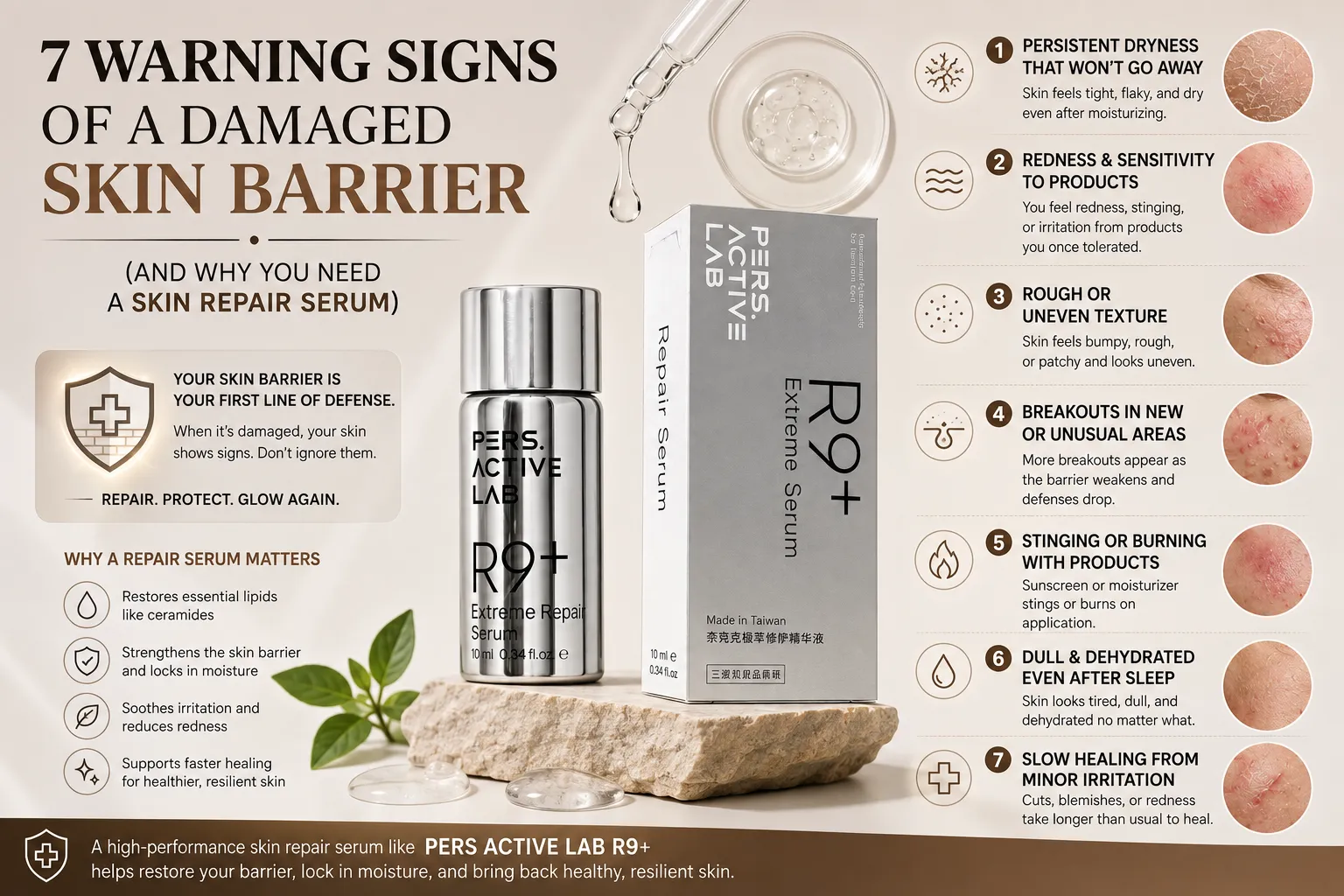

Your skin barrier works quietly in the background every day. It holds moisture in, keeps irritants out, and protects you from pollution, UV rays, and bacteria. Most people never think about it until something goes wrong. Then the redness shows up, the tightness sets in, and every product you apply seems to make things worse instead of better.
A damaged skin barrier doesn't announce itself with one obvious symptom. It builds slowly through small signals that get dismissed as "sensitive skin" or "just how my face is this week." Left unchecked, the damage compounds. Products stop working. Breakouts increase. Fine lines look deeper than they should.
This article breaks down the seven warning signs that point to a compromised skin barrier, explains why they happen, and covers what actually helps repair the damage, including when a skin barrier repair serum belongs in your routine.
What the Skin Barrier Actually Does
The skin barrier is the outermost layer of your skin, made up of skin cells held together by lipids like ceramides, fatty acids, and cholesterol. Scientists often describe it as a brick-and-mortar structure: skin cells act as the bricks, and lipids act as the mortar that holds them in place.
When this structure stays intact, your skin retains water efficiently and blocks external aggressors. When the lipid layer breaks down from over-exfoliation, harsh weather, stress, or aggressive skincare routines, moisture escapes and irritants get in. That's when the warning signs start.
Sign 1: Persistent Dryness That Won't Go Away
Normal dryness responds to moisturizer. Barrier-related dryness doesn't. If your skin still feels tight and flaky after applying cream, and the flakiness returns within hours, the barrier isn't holding moisture the way it should. This is one of the earliest and most common signals people miss because they assume they just need a heavier cream.
Sign 2: Redness and Sensitivity to Products You Used to Tolerate
A weakened barrier can no longer buffer your skin from active ingredients. Products that never caused issues a cleanser, a toner, even plain water suddenly cause stinging or a flushed appearance. This reaction happens because nerve endings sit closer to the surface once the protective layer thins out.
Sign 3: Rough or Uneven Texture
Healthy skin feels smooth to the touch. A damaged barrier often leaves skin feeling bumpy, dry in patches, and inconsistent across the face. This texture change happens because dead skin cells don't shed properly when the lipid layer is compromised, so they build up unevenly on the surface.
Sign 4: Breakouts in New or Unusual Areas
Acne along the jawline or cheeks that wasn't there before can point to barrier damage rather than a purely hormonal cause. When the barrier weakens, bacteria and debris penetrate more easily, and the skin's natural defense against clogged pores drops. This is why some people notice breakouts appearing at the same time as dryness a combination that seems contradictory but is actually a classic barrier-damage pattern. A skin barrier repair serum with soothing, hydrating actives can calm this response by restoring the lipid layer that keeps bacteria out in the first place, rather than stripping the skin further with harsh acne treatments. Skin Pal formulas are built around this idea, pairing repair-focused actives with gentle hydrators so breakouts calm down without adding more irritation to already stressed skin.
Sign 5: Stinging or Burning With Sunscreen or Moisturizer
If sunscreen or moisturizer that used to feel fine now stings on application, that's a direct sign the barrier can't tolerate exposure the way it used to. This reaction is your skin's nerve endings responding to ingredients penetrating deeper than they should, rather than staying on the surface where they belong.
Sign 6: Skin That Looks Dull or Dehydrated Even After Sleep
Dehydration and dullness that persist regardless of how much water you drink or how well you sleep often trace back to a barrier that can't hold onto moisture. Transepidermal water loss the technical term for water escaping through damaged skin accelerates when the lipid layer breaks down, leaving skin looking flat and tired no matter how well-rested you are.
Sign 7: Slow Healing From Minor Irritation
Small cuts, blemishes, or irritation that take longer than usual to calm down or heal point to reduced barrier function. A strong barrier supports faster recovery because it maintains the right internal environment for skin repair. When that environment is disrupted, healing slows and marks or post-inflammatory spots linger longer than they should.
Why the Barrier Breaks Down in the First Place
A few habits are usually responsible:
- Over-exfoliation with acids, scrubs, or retinoids used too often
- Hot water during cleansing or showering, which strips natural oils
- Harsh cleansers that disrupt the skin's natural pH
- Environmental stress from pollution, UV exposure, and dry climates
- Skipping moisturizer after active ingredients like vitamin C or retinol
- Layering too many actives in one routine without giving skin time to adjust
None of these habits cause damage overnight. The barrier weakens gradually, which is why the warning signs above are so easy to overlook until they become persistent.
Why a Repair Serum Matters More Than a Basic Moisturizer
Once the barrier is compromised, a standard moisturizer often isn't enough. Moisturizers sit on the surface and slow water loss temporarily, but they don't replace the lipids and proteins the barrier needs to rebuild itself.
A dedicated repair serum is formulated differently. It typically contains ingredients that mimic the skin's own barrier components, ceramides, ceramide-boosting actives, panthenol (vitamin B5), and soothing botanical extracts so the skin has the raw material it needs to reconstruct the lipid layer rather than just holding water at the surface.
Panthenol, in particular, is well documented for its role in supporting barrier recovery. It penetrates into the skin and gets converted into pantothenic acid, which supports the skin's natural repair processes and helps reduce transepidermal water loss. Formulas built around this ingredient tend to calm redness and tightness faster than a plain hydrating cream.
Formulas built around panthenol and botanical extracts target both hydration and long-term barrier recovery rather than offering short-term surface relief, restoring the skin's balance step by step so the barrier isn't just soothed temporarily but rebuilt over time.
How to Rebuild a Damaged Barrier
Recovery takes weeks, not days, and it works best when you simplify your routine rather than add more products to it.
Cut back on actives. Pause retinoids, strong acids, and physical scrubs until redness and sensitivity settle. Reintroduce them slowly, one at a time, once your skin stabilizes.
Switch to a gentle, low-foam cleanser. Avoid sulfates and hot water, which strip natural oils your skin needs.
Add a repair-focused serum. Look for ceramides, panthenol, niacinamide, and soothing botanicals. These ingredients rebuild the barrier rather than masking symptoms.
Lock in moisture with a barrier-supporting cream. Apply it while skin is still slightly damp to seal in hydration.
Protect with sunscreen daily. UV exposure slows barrier recovery and worsens sensitivity, even on cloudy days.
Give it time. The skin barrier regenerates on roughly a four-week cycle. Expect gradual improvement rather than overnight change, and resist the urge to add new products before the current routine has a chance to work.
When to See a Dermatologist
Most barrier damage responds well to a simplified routine and consistent care. But if redness, burning, or breakouts persist for more than a few weeks despite cutting back on actives, or if you notice cracking, weeping, or signs of infection, a dermatologist should take a look. Persistent symptoms sometimes point to an underlying condition like eczema or rosacea rather than routine-related damage.
Final Thoughts
A damaged skin barrier rarely fixes itself while you keep using the same routine that caused the problem. Recognizing the early signs dryness that won't respond to moisturizer, new sensitivity, unexpected breakouts, or slow healing gives you the chance to correct course before the damage gets worse. Simplifying your routine and adding a targeted repair serum gives your skin the materials it needs to rebuild its natural defense, rather than just papering over the symptoms.
FAQs
1. How long does it take to repair a damaged skin barrier?
Most people notice improvement within two to four weeks of simplifying their routine and using barrier-supporting products consistently. Full recovery can take six to eight weeks depending on how severe the damage is.
2. Can I still use retinol while my skin barrier heals?
It's best to pause retinol and other strong actives until sensitivity and redness calm down. Reintroduce them gradually, starting with a lower frequency, once your skin barrier stabilizes.
3. What ingredients should I look for in a skin repair serum?
Ceramides, panthenol (vitamin B5), niacinamide, and soothing botanical extracts like centella asiatica or sacred lotus are effective choices. These ingredients support the skin's natural lipid layer instead of just sitting on the surface.
4. Is a damaged skin barrier the same as sensitive skin?
Not always. Some people have naturally sensitive skin, while a damaged barrier is often triggered by external habits like over-exfoliation or harsh products. The symptoms can look similar, but barrier damage is usually reversible with the right routine.
5. Can diet affect my skin barrier?
Yes. Adequate hydration, essential fatty acids, and a balanced diet support the skin's ability to maintain its lipid layer. Chronic stress and poor sleep can also weaken barrier function over time, so lifestyle factors matter alongside topical care.
6. Should I stop using sunscreen if my skin is irritated?
No. Skip sunscreens with alcohol or fragrance if they sting, and switch to a mineral-based, fragrance-free formula instead. UV exposure slows barrier repair, so daily protection stays important even during recovery.



























Sign in to leave a comment.