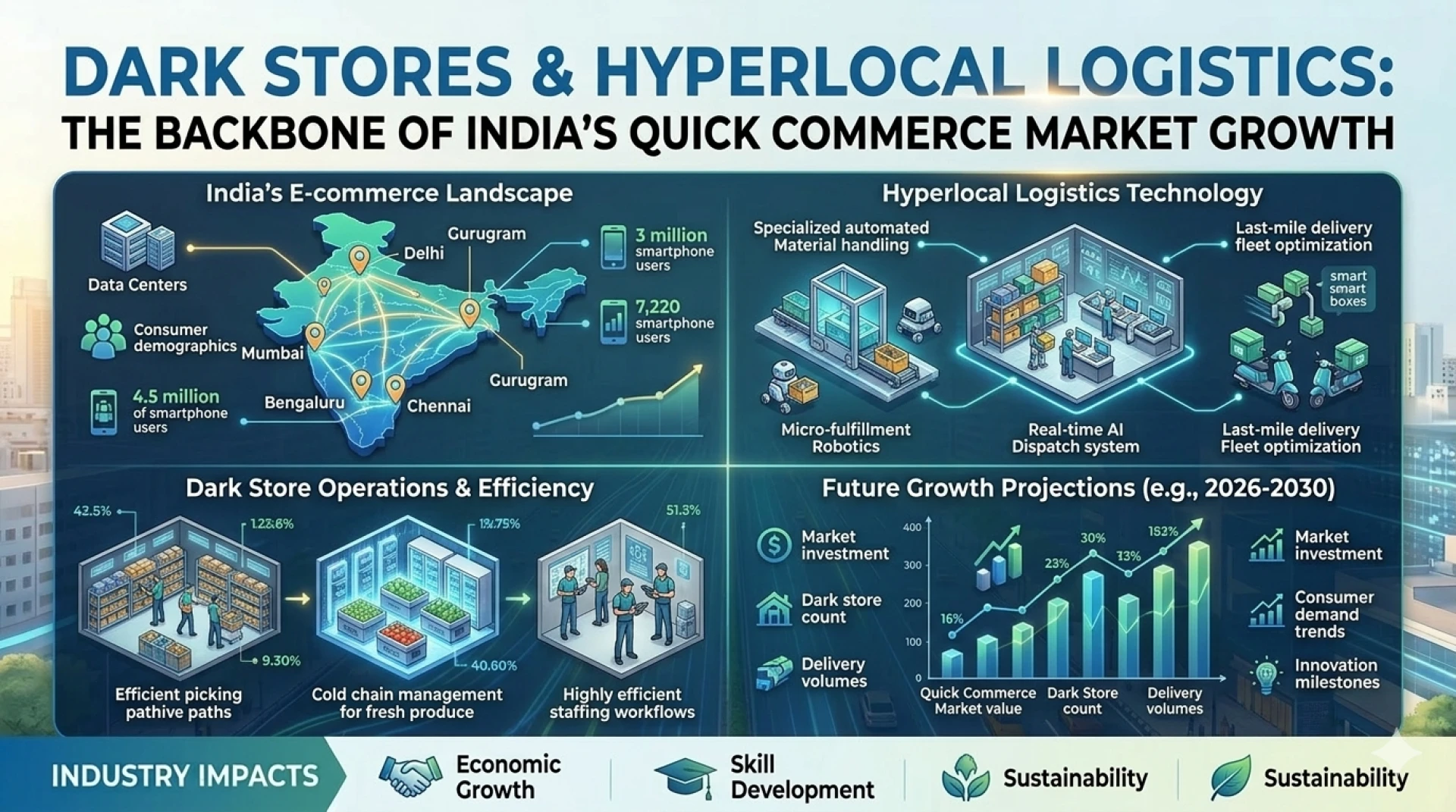

India's quick commerce market is growing from USD 3.05 billion in FY2024 toward USD 40.85 billion by 2030 at a CAGR of 39.87%, and the physical infrastructure making that growth possible is the dark store network. Dark stores, compact micro-warehouses averaging 900 square meters, positioned within delivery proximity of dense residential areas, are not a supporting element of quick commerce. They are its operational core. The India quick commerce market report identifies dark stores and hyperlocal logistics as the foundational infrastructure determining which platforms can deliver on the 10-minute promise and which cannot.
Key Data Insights
- 1,200+ dark stores operated collectively by Blinkit, Swiggy Instamart, and Zepto across major Indian cities
- Dark store space growing from 24 million sq ft (2023) to 37.6 million sq ft by 2027, reflecting rapid physical expansion
- Dark stores account for ~48% market share by fulfillment model in 2024; dominant infrastructure type
What Makes a Dark Store Work in India Quick Commerce Market Research
A dark store is not simply a small warehouse. It is a precision-optimised fulfillment environment designed around a single operational metric: pick-to-dispatch time. The average dark store in India carries between 2,000 and 8,000 SKUs curated to represent the highest-velocity items in its local demand catchment.
- Physical layout: most frequently ordered items positioned closest to the dispatch zone, with full inventory accessible within the facility footprint for rapid picker movement
- Shuttle robot systems in advanced dark stores: achieving 600 picks per hour, a rate that manual operations cannot approach within quick commerce time constraints
- Location selection: the most critical investment decision, with two-kilometer radius catchment positioning being the difference between sustainable and failing per-order economics
- SKU curation: data-driven assortment management based on local demand patterns, not standardised national catalogues, enabling higher fulfilment rates per store
Hyperlocal Logistics Architecture Driving India Quick Commerce Market Growth
Dark stores are the origin point; the delivery rider network is the execution layer. The India quick commerce market growth depends on a hyperlocal logistics architecture that connects each dark store to its demand catchment through a managed fleet of delivery riders operating on electric bikes, cycles, and in some cases on foot in high-density pedestrian areas. The economics of this model are highly dependent on order density: when riders complete eight to twelve deliveries per hour, the per-delivery economics are acceptable; when density falls below five deliveries per hour, unit economics deteriorate rapidly. This is why quick commerce has proven commercially viable in dense Tier 1 metro markets and challenging in lower-density Tier 2 cities.
Key elements of the hyperlocal logistics model:
- Rider fleet management systems assigning orders based on real-time proximity, battery capacity, and delivery time windows
- Micro-route optimization AI reducing average delivery distance per order as dark store density increases in a given area
- Rider welfare and incentive structures balancing delivery speed with sustainable working conditions
India Quick Commerce Market Competitors: Platform Dark Store Expansion Strategies
Each of the three leading platforms has pursued a distinct dark store expansion strategy, reflecting different views on how to build durable competitive advantage in this market.
- Blinkit: prioritises depth within Tier 1 cities, saturating demand catchments before expanding geographically — contributing to its 45 to 46% market share leadership
- Zepto: invests in SKU breadth with 40,000-plus SKU catalogues across household goods and technology accessories to raise average order values and improve per-delivery unit economics
- Swiggy Instamart: leverages its existing food delivery rider network to accelerate dark store launch timelines and share logistics infrastructure across the platform
- Mega-store experiments: 3,000 to 5,000 square meter facilities being piloted to serve broader radius catchments with wider SKU assortments, complementing standard dark store networks
Conclusion
Dark stores and hyperlocal logistics are not peripheral to India's quick commerce market. They are the reason the market exists at the scale it does and the reason its growth is structurally supported. With dark store space growing from 24 million square feet in 2023 to 37.6 million square feet by 2027, and the market expanding toward USD 40.85 billion by 2030, the infrastructure investment cycle is far from complete. Operators, investors, real estate providers, and logistics technology companies who access detailed India quick commerce market forecast intelligence will be best positioned to participate in this infrastructure expansion phase.
Explore more market intelligence and industry research at Ken Research, a leading provider of strategic market analytics and competitive intelligence across global sectors.
Frequently Asked Questions
Q1: What is a dark store and why is it central to quick commerce?
A: A dark store is a compact micro-warehouse averaging 900 square meters, positioned within a two-kilometer radius of dense residential demand and optimized entirely for rapid order fulfillment rather than consumer-facing retail. It is the operational foundation of the 10-minute delivery model.
Q2: How many dark stores are operating in India?
A: Blinkit, Swiggy Instamart, and Zepto collectively operate over 1,200 dark stores across major Indian cities as of 2024. Dark store space is growing from 24 million square feet in 2023 to 37.6 million square feet by 2027.
Q3: What makes quick commerce profitable in dense metro markets but challenging in Tier 2 cities?
A: Order density determines delivery economics. In dense Tier 1 metros, riders complete eight to twelve deliveries per hour, making per-delivery economics viable. In lower-density Tier 2 cities, delivery frequency falls and per-order cost rises above the threshold where platform margins are sustainable at current average order values.
Q4: How are platforms differentiating their dark store strategies?
A: Blinkit focuses on depth within Tier 1 catchments for density leadership. Zepto prioritizes SKU breadth with 40,000-plus SKUs to raise average order values. Swiggy Instamart leverages shared rider infrastructure across food and grocery delivery to accelerate dark store launch economics.
Q5: What are the main challenges for dark store expansion in India?
A: Premium dark store real estate scarcity in Tier 1 residential areas, rising rental costs, rider welfare and compensation sustainability, and the challenge of replicating Tier 1 order density economics in smaller cities are the primary expansion challenges detailed in the India quick commerce market competitors and challenges report.


























Sign in to leave a comment.