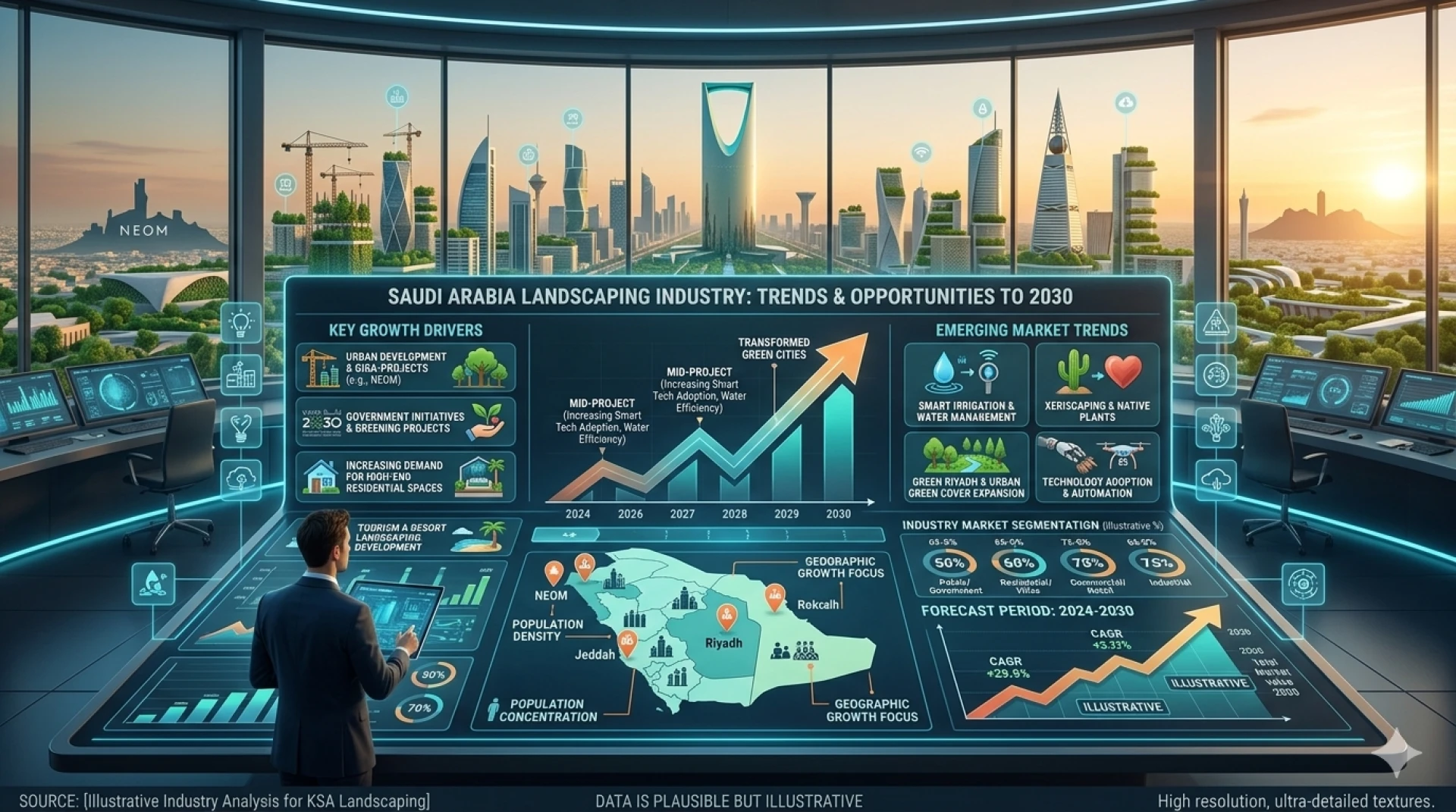

The KSA landscaping market is estimated at around USD 2.6 billion in 2024. According to Ken Research, the Saudi Arabia landscaping market is expanding steadily, supported by Vision 2030, major urban development projects, and government-led greening programs. The market is projected to grow at a high-single-digit CAGR through 2030, driven by rising demand for landscape design, irrigation systems, horticulture, and long-term maintenance services. Growth is strongest in the commercial and institutional segments, where large public, hospitality, and mixed-use projects generate higher-value contracts.
Trend 1: Vertical and Indoor Greening Becoming a Mainstream Commercial Requirement
Living walls, interior botanical installations, and vertical garden systems are transitioning from premium architectural statements to standard specification in Class A commercial buildings, luxury hotels, and corporate campuses across Riyadh and Jeddah. This category is growing at approximately 15-20% annually and generates 2-3x the revenue per square metre of conventional external landscaping. As Saudi Arabia's Vision 2030 hospitality and commercial real estate pipeline delivers over 50 new hotels and hundreds of thousands of square metres of premium office space, vertical and indoor greening procurement is scaling into a significant standalone revenue category for capable operators.
Trend 2: Technology Integration Reshaping Landscape Maintenance Economics
AI-enabled irrigation scheduling, soil health monitoring sensors, drone-based landscape condition assessment, and digital twin modelling of outdoor environments are changing the economics of landscape maintenance contracts. Operators deploying these technologies can service larger territory areas with fewer technician visits, improving margin on maintenance contracts while simultaneously delivering better plant survival rate data that institutional clients require. According to KSA landscaping market report, technology-enabled maintenance operators are achieving 15-25% lower operational costs per maintained square metre versus manual maintenance models, a competitive advantage that is driving rapid adoption among the top tier of Saudi landscape operators.
- AI irrigation optimisation: Reduces water consumption by 20-35% versus conventional scheduled irrigation, directly addressing the water scarcity cost premium that affects all Saudi landscaping projects
- Drone landscape assessment: Enables condition monitoring across large giga-project landscape areas without proportional headcount scaling, supporting the mega-scale maintenance contracts associated with NEOM and Red Sea Project
Future Opportunities in Saudi Arabia Landscaping Industry
Independent industry evaluation identifies three specific opportunity categories within the Saudi Arabia landscaping market that represent the highest near-term value creation potential for operators and investors:
- Giga-project hospitality landscape specification: The Red Sea Project, NEOM's SINDALAH island resort, and AMAALA's ultra-luxury resort cluster all require biophilic design-led landscape architecture with tropical and subtropical planting that is rare in the regional operator base. International landscape architects entering through design-only mandates on these projects represent both competition and potential channel partner opportunity for domestic installation and maintenance operators
- Municipal long-term maintenance contract consolidation: Saudi municipalities are progressively consolidating fragmented multi-vendor landscape maintenance arrangements into single integrated multi-year contracts. Operators with the scale, technology, and compliance credentials to serve consolidated municipal contracts are accessing a growing procurement segment that smaller operators cannot serve
- Landscape rehabilitation of older urban infrastructure: Riyadh's older districts and Jeddah's heritage waterfront areas have aging landscape infrastructure from the 1980s and 1990s requiring full replacement, creating a significant renovation procurement market alongside new installation demand
For detailed opportunity sizing and competitive entry analysis, the KSA landscaping market opportunities by Ken Research provides project-level intelligence.
Conclusion: KSA Landscaping Market Trends and Investment Outlook 2030
The Saudi Arabia landscaping industry future through 2030 is defined by four intersecting forces: giga-project institutional procurement, technology-enabled maintenance economics, vertical and indoor greening as a mainstream commercial requirement, and municipal contract consolidation creating scale barriers to entry. The KSA landscaping market forecast through 2030 is most constructive for integrated operators combining smart irrigation and technology deployment with the project scale, Saudization compliance, and horticultural science capability required for institutional contract qualification. Per market research insights, the competitive landscape is rapidly bifurcating between technology-enabled large integrated operators winning the premium institutional tier and fragmented smaller operators competing only in residential and small commercial segments. Operators who invest in technology capability and institutional track record development in 2025-2026 are building the competitive moat for the peak demand wave of 2027-2030.
For the complete trend analysis and competitive landscape, access the Saudi Arabia landscaping industry report by Ken Research.
Frequently Asked Questions
What are the key trends shaping the Saudi Arabia landscaping industry to 2030?
Vertical and indoor greening growing at 15-20% annually, AI-enabled maintenance technology reducing operational costs by 15-25%, giga-project hospitality landscape specification, and municipal long-term maintenance contract consolidation are the four defining trends through 2030.
What are the future opportunities in the KSA landscaping market?
Giga-project hospitality landscape specification for Red Sea Project, NEOM, and AMAALA; municipal consolidated maintenance contracts across Riyadh and Jeddah; and landscape rehabilitation of older urban infrastructure from the 1980s-1990s represent the three highest near-term value creation opportunities.
How is technology changing the competitive landscape in Saudi Arabia's landscaping industry?
AI irrigation optimisation reducing water use by 20-35%, drone-based landscape condition assessment enabling scale-efficient maintenance, and digital twin modelling are allowing technology-enabled operators to achieve 15-25% lower operational costs per maintained square metre versus traditional manual maintenance models.
What is the Saudi Arabia landscaping market forecast to 2030?
The market is on a sustained growth trajectory through 2030. The institutional and commercial segments are delivering the highest per-contract values with giga-project landscape contracts reaching SAR 50M-500M. The 2027-2030 period represents the peak delivery and maintenance wave for Vision 2030-linked landscape infrastructure.
What challenges are impacting the KSA landscaping market expansion?
Water scarcity adds 15-25% to project costs versus temperate markets. Nitaqat Saudisation requirements restructure workforce economics. Plant procurement from Europe and East Asia carries 3-6 month lead times, creating activation schedule risk for giga-project fit-out programmes.





























Sign in to leave a comment.