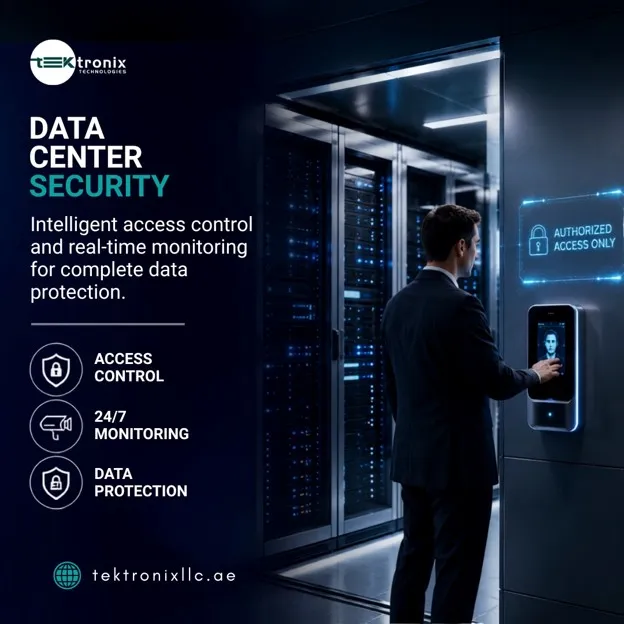

Banks, telecom operators, government entities, and cloud providers across the UAE all depend on the same foundation: robust Data Center Security that protects physical infrastructure and digital assets alike. As data centers become the operational backbone of nearly every industry, a layered security strategy spanning perimeter, access, surveillance, and network defense has become a baseline expectation rather than an optional enhancement.
Why Every Industry in the UAE Needs Layered Data Center Security
A data center breach, whether physical intrusion or a network compromise, carries consequences that ripple far beyond the facility itself: regulatory penalties, client trust erosion, and potential service outages affecting entire industries that depend on that infrastructure. Facility owners across Dubai and Abu Dhabi increasingly face pressure from insurers, enterprise clients, and regulators to demonstrate a documented, layered security posture rather than relying on a single control such as a locked door or a firewall alone.
Tektronix LLC has designed and commissioned perimeter and physical security infrastructure for developments linked to G42, DIFC, RTA Dubai, and EXPO 2020, giving the company direct, on-the-ground experience with the risk profiles and compliance expectations unique to Gulf data center environments. That experience shapes how security programs are specified today, as a coordinated strategy spanning physical barriers, access control, surveillance, and the network-level protections that IT and security teams manage in parallel.
Cybersecurity for Data Center Operations: The Digital Layer
Physical barriers alone cannot protect a facility whose primary value lies in the data it processes. Cybersecurity for Data Center operations cover the network-level protections, monitoring, and policy enforcement that defend against digital intrusion, working in parallel with the physical controls covered later in this guide.
Network Segmentation and Monitoring
Dividing a data center's network into isolated segments limits how far an intruder can move if one segment is compromised, while continuous monitoring tools flag unusual traffic patterns that might indicate a breach in progress rather than waiting for damage to surface elsewhere.
Where Physical and Cyber Security Converge
Modern facilities increasingly correlate physical access logs with network activity, so a badge swipe followed by unusual server-rack activity from that same credential raises a flag automatically, rather than treating physical and digital security as two entirely separate disciplines.
Data Center Encryption for Data at Rest and in Transit
Even with strong perimeter and network defenses, Data Center Encryption provides a critical last line of protection, ensuring that data remains unreadable to an unauthorized party even if other controls are somehow bypassed.
Encrypting Stored Data
Data at rest on servers and storage arrays is encrypted so that physical theft of a drive, however unlikely given layered physical controls, does not translate into usable information for an attacker without the corresponding decryption keys.
Encrypting Data in Transit
Traffic moving between servers, between facilities, or out to end users is encrypted in transit, preventing interception on the network from exposing sensitive information even if a segment of that network path is compromised.
Data Center Firewalls as the First Digital Perimeter
At the network boundary, Data Center Firewalls filter incoming and outgoing traffic against defined rules, blocking known malicious sources and unauthorized protocols before they ever reach internal systems.
Network-Level Traffic Filtering
Modern firewall appliances inspect traffic well beyond simple port and protocol rules, analyzing application behaviour and known attack signatures to catch threats that older, simpler filtering would miss entirely.
Firewall Placement Within a Layered Architecture
Firewalls are typically deployed at multiple points, the internet-facing perimeter, between internal network segments, and around particularly sensitive systems, rather than relying on a single boundary device to catch every threat.
Data Center Access Control for Physical Zone Restriction
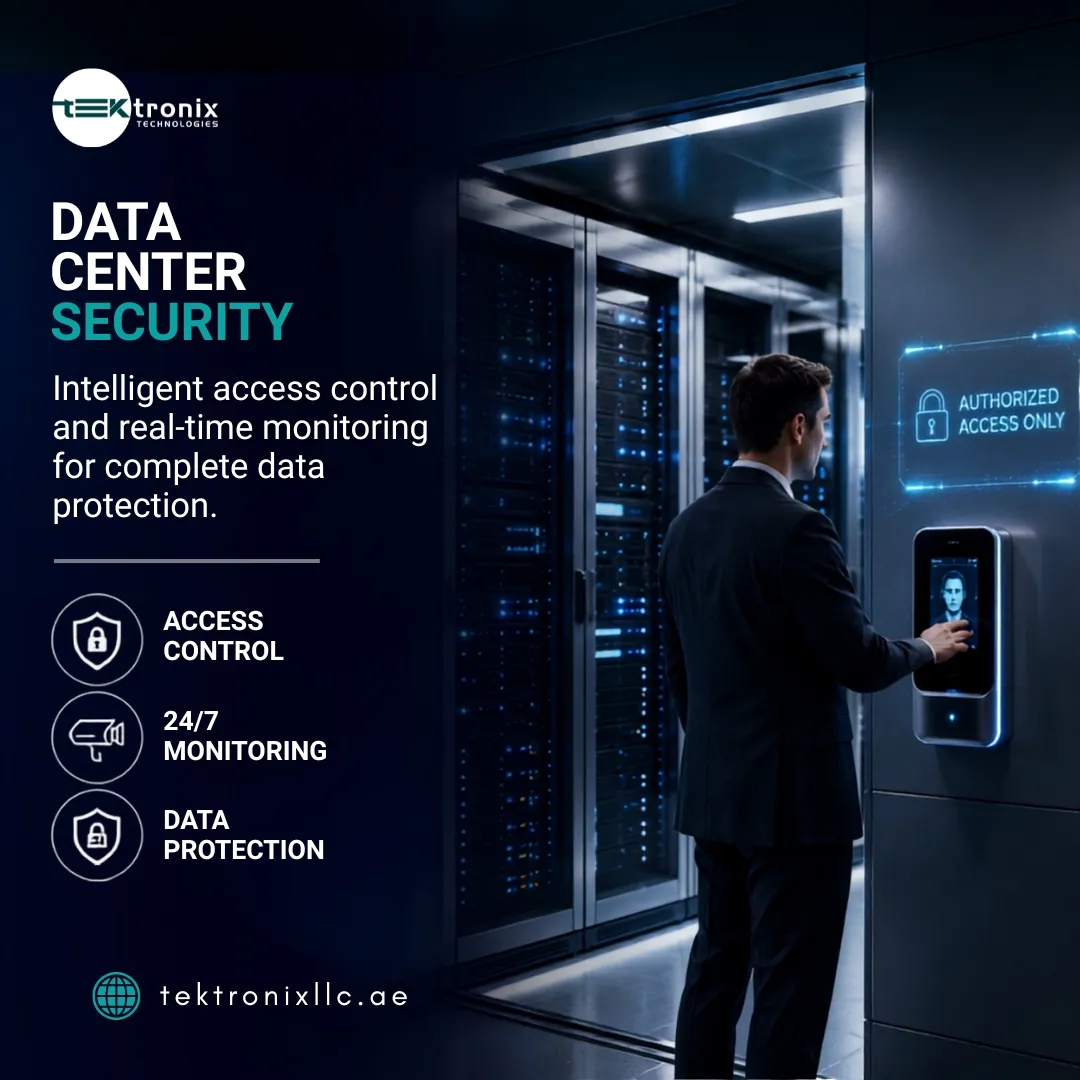
On the physical side, Data Center Access Control restricts who can physically reach server racks, control rooms, and administrative areas, using badge, biometric, or multi-factor credentials tied to a named, auditable identity rather than a shared key or generic keycard.
Biometric and Multi-Factor Entry
High-security zones commonly require a combination of factors, such as a badge tap followed by facial or fingerprint verification, creating a genuine two-factor control that a stolen credential alone cannot defeat.
Mantrap Doors and Zone Segmentation
Interlocked mantrap doors ensure only one verified individual passes at a time, while zone segmentation restricts different staff roles to only the areas relevant to their job function, limiting exposure if any single credential is compromised.
Data Center Surveillance for Continuous Visual Oversight
Complementing access control, Data Center Surveillance provides continuous visual coverage of server halls, entry points, and perimeter areas, giving security teams a recorded, reviewable record of everything happening on site around the clock.
Camera Coverage and Analytics
Modern camera systems increasingly include analytics capable of flagging loitering, unauthorized zone entry, or objects left in restricted areas automatically, rather than requiring a human operator to watch every feed continuously.
Integration with Access Events
Tying camera footage to access control logs lets security teams pull the exact video clip associated with any badge swipe or denied entry attempt in seconds, without manually cross-referencing separate systems.
Data Center Intrusion Detection for Perimeter and Interior Protection
Beyond monitoring, Data Center Intrusion Detection actively senses unauthorized attempts to breach a facility's perimeter or interior zones, triggering an alarm and alerting response teams before an intruder reaches sensitive areas.
Perimeter Sensors and Fence Detection
Fiber-optic or vibration-based fence sensors detect climbing or cutting attempts along a facility's outer boundary, giving security teams advance warning well before an intruder reaches the building itself.
Interior Motion and Tamper Sensors
Inside the facility, motion sensors and tamper-detection hardware on server racks and equipment cabinets flag any unauthorized physical interaction, even from someone who has already passed through access control.
Data Center Threat Detection Across Physical and Digital Vectors
Tying every layer together, Data Center Threat Detection correlates signals from physical sensors, access logs, network monitoring, and surveillance analytics to identify patterns that any single system alone might miss.
Correlating Physical and Network Anomalies
A combined view might flag a badge access at an unusual hour paired with abnormal outbound network traffic from the same zone, a correlation that neither the physical security team nor the network operations team would catch working in isolation.
Automated Alerting and Response
Modern platforms can automatically escalate correlated alerts to the appropriate response team, whether physical security, network operations, or both, reducing the time between an anomaly occurring and a human actually reviewing it.
Building a Unified Security Strategy for Your Data Center
No single control, however well implemented, protects a data center on its own. A genuinely resilient facility layers physical barriers, access control, surveillance, and network-level defenses so that a failure or bypass of any one layer is caught by another.
Layered Defense-in-Depth Design
Security planning should map every asset, from the outer fence line to individual server racks, against the specific controls protecting it, identifying any point where a single layer stands alone without a backup measure behind it.
Vendor Evaluation Criteria
Procurement teams should weigh a vendor's integration experience across physical and digital domains, demonstrated regional deployment history, and ongoing support responsiveness, rather than selecting individual point solutions from separate suppliers with no coordinated design.
Industry Use Cases Across UAE Sectors
Banking and Financial Services
Financial institutions apply the strictest layering to core banking data centers, combining biometric access, continuous surveillance, and network segmentation to meet both internal risk policy and external regulatory expectations.
Government and Semi-Government Data Centers
Government-linked facilities favour heavily documented, auditable security programs, often exceeding baseline commercial standards given the sensitivity of the data and services these centers support.
Healthcare and Cloud Service Providers
Facilities hosting patient records or multi-tenant cloud infrastructure require strong logical separation between clients alongside physical safeguards, since a single breach could expose data belonging to many unrelated organizations at once.
Telecommunications and Colocation Facilities
Colocation providers hosting equipment for multiple independent clients need granular zone segmentation so that one tenant's staff cannot physically or digitally access another tenant's infrastructure within the same building.
Compliance and Regional Regulatory Fit
SIRA-regulated facilities and enterprise clients across Dubai and Abu Dhabi increasingly expect documented proof of layered security controls spanning physical and digital domains, rather than a single compliance certificate covering one dimension of protection. Working with an integrator experienced in coordinating physical security design alongside a facility's IT and network security teams shortens the path to a genuinely defensible security posture and reduces the risk of gaps between the two domains.
Total Cost of Ownership: Proactive Security Versus Breach Recovery
The cost of a comprehensive security program is easy to compare unfavourably against a bare-minimum setup until the cost of an actual breach is factored in: regulatory penalties, client attrition, incident response fees, and the reputational damage that follows a publicized data center compromise. Facility operators comparing the two approaches consistently find that proactive, layered investment costs a fraction of what a single serious incident would, making the calculation less about whether to invest and more about how to sequence that investment across physical and digital priorities.
Deployment Roadmap: What to Expect
Site Assessment and Risk Profiling
A thorough assessment maps every physical and digital asset against its risk level, identifying gaps in current coverage before any new hardware or network policy changes are specified, ensuring investment targets the areas of genuine exposure.
Installation and Commissioning
Physical installation of access control, surveillance, and intrusion detection hardware typically proceeds alongside network security configuration, with integration testing confirming that physical and digital alert systems correctly correlate before the facility goes fully live. Facilities exploring a full upgrade can review Tektronix LLC's data center perimeter security solutions to see how physical security layers are typically packaged for a coordinated, enterprise-grade rollout.
Ongoing Monitoring and Support
Continuous monitoring, whether through an in-house security operations center or a managed service, keeps alerts triaged around the clock, while scheduled maintenance and firmware updates ensure hardware and software defenses remain current against evolving threats.
Common Mistakes to Avoid
The most frequent misstep is treating physical and digital security as entirely separate budgets and teams, leaving no one responsible for correlating events across both domains. A second common issue is under-investing in perimeter intrusion detection while over-investing in interior controls, leaving an intruder's earliest, most detectable movements unmonitored.
A third mistake is neglecting regular penetration testing and physical red-team exercises, which are often the only reliable way to discover a gap between a security program's design and its actual real-world effectiveness. Finally, some facilities skip a clear escalation and response plan entirely, meaning a detected threat generates an alert that no one is specifically responsible for acting on.
Regional Adoption: Data Center Security UAE and Abu Dhabi Deployments
Demand for comprehensive Data Center Security UAE wide has grown alongside the country's expanding cloud, banking, and telecommunications infrastructure, with facility operators increasingly specifying layered physical and digital security at the design stage rather than retrofitting controls after a facility is already operational. Data Center Security Abu Dhabi projects frequently emphasize government-grade compliance documentation and stricter access segmentation, reflecting the capital's concentration of government-linked and financial infrastructure, while Dubai's colocation and cloud-hosting facilities place particular emphasis on granular multi-tenant separation given the emirate's dense concentration of international service providers.
Conclusion
Every industry in the UAE depends on strong Data Center Security, combining reliable Cybersecurity for Data Center operations with robust Data Center Encryption and layered Data Center Firewalls. Physical protection depends equally on strong Data Center Access Control and continuous Data Center Surveillance across every restricted zone. Advanced Data Center Intrusion Detection and correlated Data Center Threat Detection close the gap between physical and digital defenses.




























Sign in to leave a comment.