
In today’s competitive business environment, organizations need more than intuition to improve performance. They need reliable data, measurable processes, and a structured approach to solving problems. This is where the Data-Driven Six Sigma process plays an important role.
Six Sigma is a process improvement methodology designed to reduce defects, minimize variation, improve efficiency, and increase customer satisfaction. By combining Six Sigma principles with accurate data analysis, businesses can identify the real causes of problems and make decisions based on evidence rather than assumptions.
A data-driven approach also helps organizations create sustainable improvements instead of temporary fixes. Whether used in manufacturing, healthcare, finance, logistics, technology, or service operations, Six Sigma provides a systematic framework for improving business processes.
What Is a Data-Driven Six Sigma Process?
A Data-Driven Six Sigma process is a structured improvement methodology that uses data collection, statistical analysis, process measurement, and evidence-based decision-making to improve business performance.
Instead of simply asking what went wrong, Six Sigma teams examine process data to determine:
- What is the actual problem?
- How frequently does it occur?
- What factors contribute to the problem?
- Which causes have the greatest impact?
- What changes can improve the process?
- How can the improvement be maintained over time?
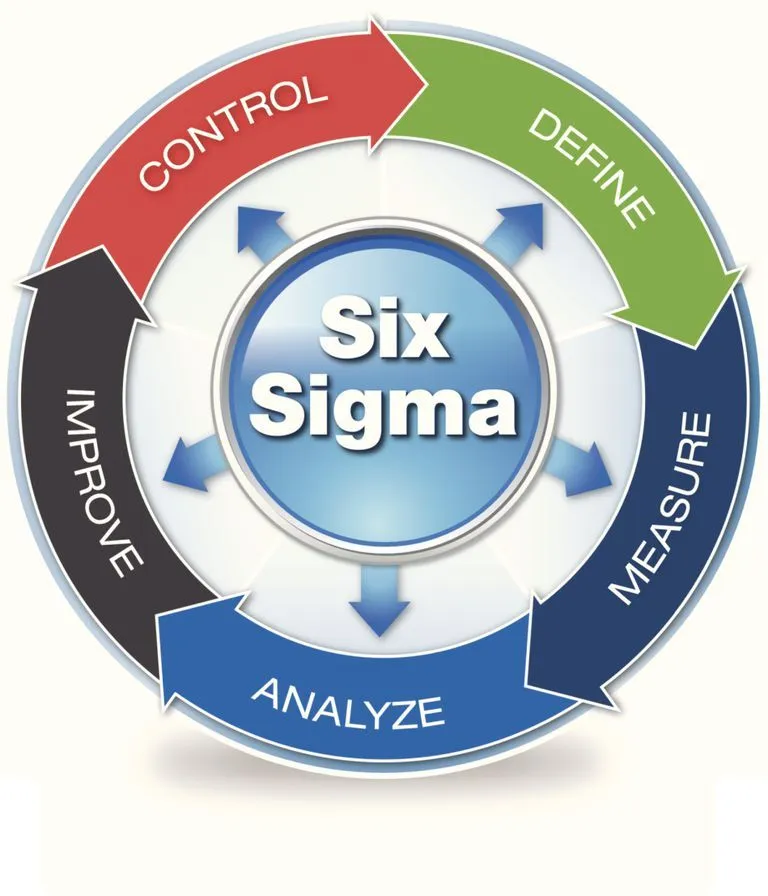
The methodology generally follows the DMAIC framework: Define, Measure, Analyze, Improve, and Control.
Why Is Data Important in Six Sigma?
Data is at the center of Six Sigma because process improvement depends on understanding what is actually happening.
Without reliable data, organizations may make decisions based on assumptions or isolated incidents. Data provides an objective view of process performance and helps teams distinguish between symptoms and root causes.
For example, if a company notices an increase in customer complaints, management may assume that employees are making more mistakes. A data-driven Six Sigma investigation could reveal that the real problem is an outdated software system, unclear procedures, supplier delays, or an inefficient approval process.
This approach helps businesses focus their improvement efforts where they will have the greatest impact.
The DMAIC Data-Driven Six Sigma Process
1. Define
The first stage is to clearly define the problem, project objectives, customer requirements, and expected business outcomes.
A well-defined problem statement should explain what is happening without immediately assuming why it is happening.
During this stage, Six Sigma teams typically identify:
- The business problem
- Customer requirements
- Project scope
- Process boundaries
- Key stakeholders
- Improvement objectives
- Expected financial or operational benefits
For example, instead of saying, “Our customer service team is inefficient,” a better problem statement could be:
“Customer requests currently require an average of 48 hours for resolution, resulting in increased complaints and lower customer satisfaction.”
A specific problem can be measured and analyzed more effectively.
2. Measure
The Measure phase focuses on understanding the current state of the process.
Teams determine which performance indicators should be measured and establish a reliable baseline. Data may come from operational systems, customer surveys, production records, financial reports, quality inspections, or other sources.
Common measurements include:
- Cycle time
- Defect rate
- Error frequency
- Processing time
- Customer complaints
- Cost per transaction
- Productivity
- First-pass yield
- Process capability
Data quality is particularly important at this stage. Poor or incomplete data can lead to incorrect conclusions.
Teams may therefore verify whether the measurement system is consistent, accurate, and capable of producing reliable results.
3. Analyze
Once sufficient data has been collected, the Analyze phase identifies the root causes of process problems.
This is one of the most important stages of Six Sigma because the objective is not simply to identify where the problem occurs but to understand why it occurs.
Several analytical tools can be used, including:
- Pareto charts
- Cause-and-effect diagrams
- Histograms
- Scatter plots
- Process maps
- Control charts
- Regression analysis
- Hypothesis testing
- Failure Mode and Effects Analysis (FMEA)
For example, a Pareto analysis may show that a small number of error categories are responsible for most customer complaints. The organization can then focus its improvement efforts on those high-impact causes.
Statistical analysis can also help determine whether an observed relationship is meaningful or simply the result of random variation.
4. Improve
After identifying the root causes, the team develops and tests potential solutions.
The Improve phase transforms analysis into action. Instead of implementing a solution immediately across the entire organization, teams may first conduct pilot tests or controlled experiments.
Potential improvements could include:
- Redesigning workflows
- Automating repetitive tasks
- Simplifying approval processes
- Updating employee training
- Removing unnecessary process steps
- Improving equipment maintenance
- Changing supplier requirements
- Standardizing procedures
- Introducing technology solutions
Data continues to play an important role. Teams compare performance before and after the improvement to determine whether the change actually produced the desired result.
If a solution reduces processing time but significantly increases errors, for example, it may not be a sustainable improvement.
5. Control
The final stage is Control. Its purpose is to ensure that the improvements remain effective over time.
Without proper controls, organizations can gradually return to their previous processes and lose the benefits achieved through the project.
Control strategies may include:
- Standard operating procedures
- Performance dashboards
- Regular audits
- Control charts
- Employee training
- Process documentation
- Automated alerts
- Ongoing performance monitoring
Key performance indicators should continue to be tracked so that teams can identify problems before they become significant.
Key Tools Used in Data-Driven Six Sigma
Six Sigma professionals use a variety of tools to understand and improve processes.
Pareto Analysis
Pareto analysis helps identify the most significant sources of problems. It is based on the principle that a relatively small number of causes often account for a large proportion of the overall problem.
Cause-and-Effect Diagram
Also known as a fishbone or Ishikawa diagram, this tool helps teams organize potential causes of a problem into categories.
Statistical Process Control
Statistical Process Control (SPC) uses statistical methods and control charts to monitor process performance and identify unusual variation.
Process Mapping
Process maps provide a visual representation of workflow. They help teams identify bottlenecks, unnecessary steps, duplication, and potential failure points.
Regression Analysis
Regression analysis can help determine relationships between variables. For example, a business might analyze whether processing time is associated with staffing levels, transaction volume, or system performance.
Failure Mode and Effects Analysis
FMEA helps organizations identify potential process failures, evaluate their risks, and prioritize preventive actions.
Benefits of a Data-Driven Six Sigma Approach
Organizations can gain several advantages by applying Six Sigma with a strong data-driven mindset.
Better Decision-Making
Data gives managers objective evidence for making operational decisions instead of relying solely on assumptions or personal experience.
Reduced Process Variation
Six Sigma focuses heavily on reducing unwanted variation. More consistent processes can lead to better quality and predictable outcomes.
Lower Costs
Reducing defects, rework, waste, delays, and inefficiencies can lower operating costs and improve profitability.
Improved Customer Satisfaction
When processes become faster, more consistent, and less error-prone, customers are more likely to receive reliable products and services.
Improved Employee Productivity
Removing unnecessary steps and addressing process bottlenecks can make employees more productive and reduce frustration.
Sustainable Improvements
The Control phase ensures that improvements are monitored and maintained rather than treated as one-time fixes.
Data-Driven Six Sigma vs. Traditional Problem Solving
Traditional problem solving may sometimes rely heavily on experience, assumptions, or individual judgment. While experience is valuable, it can introduce bias.
Data-driven Six Sigma adds structure by requiring teams to measure the problem, analyze evidence, validate root causes, and verify improvement results.
For example:
Traditional approach:
“Customers are complaining because the support team is understaffed.”
Data-driven approach:
“Complaint volume increased by 25% during peak periods. Process data shows that 70% of delays occur during the approval stage, while staffing levels remain within the established requirement.”
The second approach provides stronger evidence for deciding where improvement is needed.
Challenges in Implementing Data-Driven Six Sigma
Although the methodology can deliver significant benefits, implementation can present challenges.
Poor Data Quality
Incomplete, inaccurate, duplicated, or inconsistent data can affect analysis and lead to incorrect conclusions.
Lack of Employee Engagement
Six Sigma projects require cooperation from employees who understand the process. Without their participation, teams may overlook practical issues.
Resistance to Change
Employees may resist changes to familiar workflows. Clear communication and involvement can help organizations manage this challenge.
Incorrect Analysis
Statistical tools need to be selected and interpreted appropriately. Incorrect analysis can result in ineffective solutions.
Focusing Only on Numbers
Data is essential, but it should be combined with process knowledge and customer insights. Numbers provide evidence, while employees often provide important context.
How to Build a Successful Data-Driven Six Sigma Culture
Organizations seeking long-term improvement should make data-driven thinking part of their everyday culture.
A successful approach includes:
- Define clear business objectives.
- Identify meaningful performance metrics.
- Ensure data quality and consistency.
- Train employees in problem-solving methods.
- Use statistical analysis where appropriate.
- Test improvements before large-scale implementation.
- Monitor performance continuously.
- Document successful processes and standardize them.
- Encourage employees to identify improvement opportunities.
- Review results regularly and adjust processes when necessary.
Conclusion
The Data-Driven Six Sigma process provides organizations with a systematic way to identify problems, understand their root causes, implement effective solutions, and maintain improvements.
The DMAIC framework Define, Measure, Analyze, Improve, and Control ensures that improvement projects are based on measurable evidence rather than assumptions. By combining quality management principles with reliable data and statistical analysis, businesses can reduce variation, improve efficiency, lower costs, and deliver better customer experiences.
Ultimately, the value of Six Sigma is not simply in using statistical tools. Its real strength lies in creating a culture where organizations continuously measure performance, understand problems, make evidence-based decisions, and improve processes over time.



























Sign in to leave a comment.