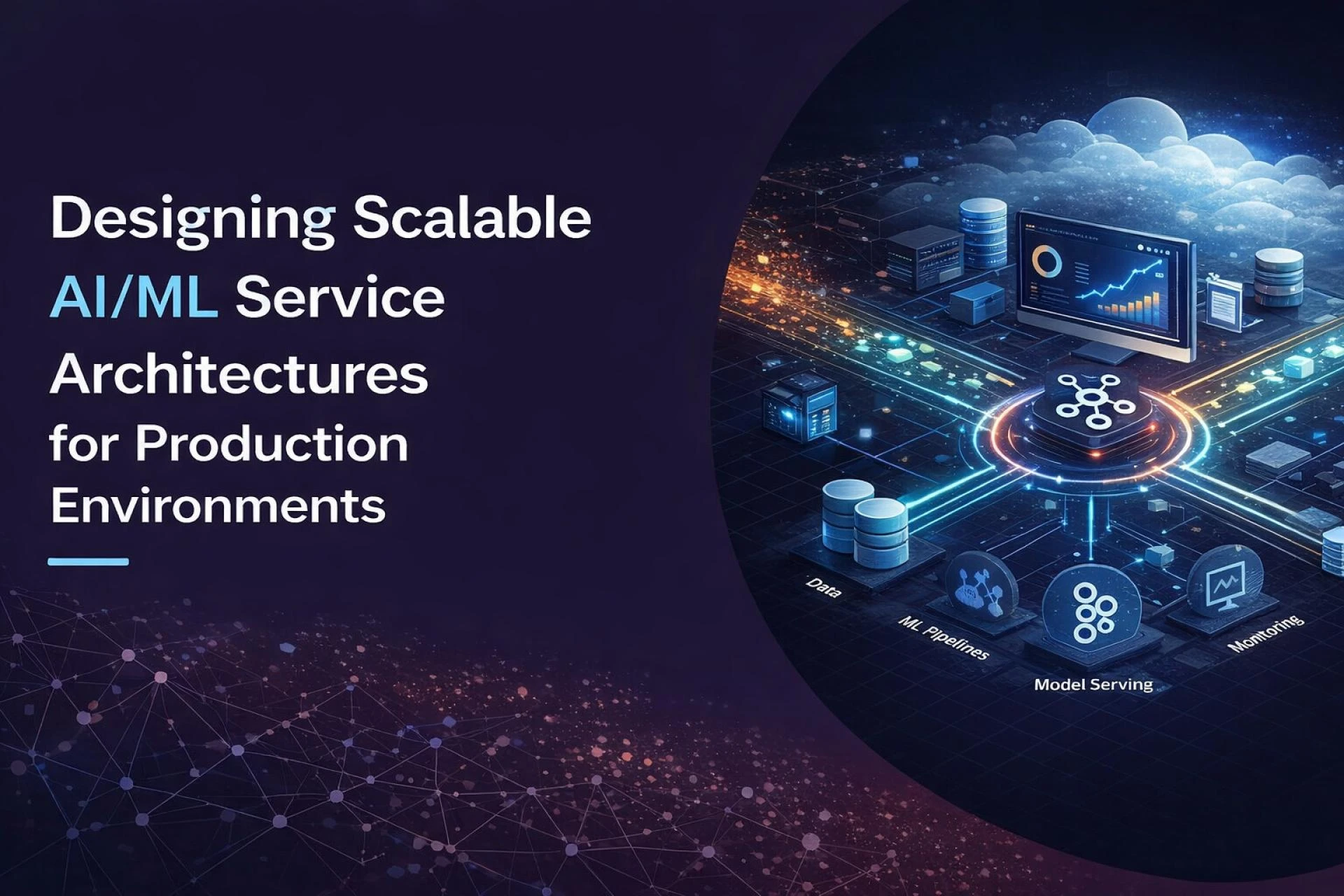

Moving a machine learning model from experimentation to production is where most AI initiatives encounter friction. Building a model is rarely the hardest part — scaling it reliably across real-world workloads is. As data volumes expand and prediction demands grow, architecture decisions begin to determine whether AI becomes a competitive advantage or an operational burden.
A thoughtfully designed AI/ML service architecture ensures models remain responsive, resilient, and maintainable even as usage intensifies. For organizations deploying AI across customer platforms, analytics engines, or automation workflows, scalability is no longer optional — it is foundational.
This guide explores how to design scalable AI/ML architectures, highlighting the components, patterns, and operational strategies that support long-term production success.
Why Scalability Matters in AI/ML Systems
Early-stage ML systems often perform well under controlled conditions. Problems emerge when models must handle:
- Millions of inference requests
- Streaming data inputs
- Multi-region deployments
- Continuous retraining cycles
Without a scalable AI/ML architecture, teams encounter latency spikes, infrastructure strain, and inconsistent predictions.
Short Case Insight
A recommendation engine built for a mid-sized eCommerce platform initially processed batch predictions overnight. When the company shifted to real-time personalization, inference traffic increased nearly tenfold. Their monolithic setup couldn’t keep pace, forcing a redesign toward distributed model serving — ultimately reducing response times by over 60%.
Scalability is not just about growth; it is about sustaining performance under unpredictable demand.
Core Principles of a Scalable AI/ML Architecture
Before diving into technical layers, successful architectures typically follow several guiding principles.
Decoupled Components
Separating data ingestion, training, inference, and monitoring prevents bottlenecks. When services operate independently, scaling one layer doesn’t destabilize others.
Elastic Infrastructure
Cloud-native environments allow compute resources to expand dynamically. This ensures cost efficiency while maintaining responsiveness.
Automation-First Mindset
Manual processes rarely survive production scale. Automated pipelines for testing, deployment, and retraining reduce operational risk.
These principles form the backbone of AI/ML architecture for enterprise applications, where uptime and predictability carry significant business impact.
Key Layers in an AI/ML Service Architecture
1. Data Ingestion and Pipeline Layer
Every production ML system begins with reliable data flow.
Modern pipelines typically include:
- Streaming ingestion for real-time signals
- Batch pipelines for historical datasets
- Data validation to prevent schema drift
- Feature engineering workflows
Organizations increasingly adopt feature stores to standardize reusable features across teams — reducing duplication and improving model consistency.
Example:
A fintech company centralized transaction features in a feature store, enabling multiple fraud detection models to operate from the same trusted dataset.
2. Model Training Environment
Training infrastructure must support experimentation without disrupting production.
Best practices include:
- Containerized training workloads
- Distributed compute for large datasets
- Experiment tracking for reproducibility
- Versioned datasets and models
This separation allows teams to iterate quickly while safeguarding deployed systems.
Many enterprises implementing advanced AI & ML Solutions treat training environments as modular platforms rather than isolated projects.
3. Model Serving and Inference Layer
Inference is where scalability becomes visible to users.
There are two dominant approaches:
Real-Time Inference:
Ideal for fraud detection, recommendations, and conversational AI.
Batch Inference:
Suitable for demand forecasting or risk scoring where immediacy is less critical.
A hybrid strategy often delivers the best balance.
Architectural Best Practices:
- Deploy models behind APIs
- Use load balancing to distribute traffic
- Enable auto-scaling policies
- Cache frequent predictions when possible
This transforms models into reliable production services rather than experimental artifacts.
4. Orchestration and Infrastructure Management
Container orchestration platforms have become central to scalable AI deployments. They simplify:
- Resource allocation
- Service discovery
- Failover handling
- Rolling updates
Infrastructure-as-code further improves consistency across environments, reducing configuration drift.
For organizations managing multiple models simultaneously, orchestration prevents operational chaos.
5. Monitoring, Observability, and Drift Detection
Many ML failures occur silently. Models degrade as data patterns evolve — a phenomenon known as model drift.
Production architectures should track:
- Prediction latency
- Data distribution changes
- Model accuracy
- Resource utilization
Automated alerts allow teams to retrain models before performance declines impact users.
Observability shifts ML from reactive troubleshooting to proactive system management.
Designing for Enterprise-Scale AI
Enterprise AI environments introduce complexities beyond technical scaling:
- Regulatory compliance
- Data governance
- Cross-functional collaboration
- Security requirements
A mature AI/ML service architecture addresses these concerns through role-based access, encrypted pipelines, and audit trails.
Comparison Snapshot
| Early ML Setup | Enterprise Architecture |
| Single model | Multi-model ecosystem |
| Manual deployment | Automated CI/CD |
| Limited monitoring | Full observability |
| Static infrastructure | Elastic scaling |
Enterprises that invest early in architecture avoid costly redesigns later.
Common Pitfalls to Avoid
Even technically strong teams encounter similar obstacles.
Over-centralization:
Trying to run everything through one pipeline creates hidden bottlenecks.
Ignoring retraining workflows:
Models age quickly without automated refresh cycles.
Underestimating infrastructure costs:
Poor scaling strategies can inflate cloud spend.
Treating ML as a side project:
Production AI demands the same rigor as any mission-critical platform.
Understanding these risks is essential when considering how to design scalable AI/ML architectures that endure beyond initial deployment.
The Strategic Value of Scalable AI Systems
When architecture supports growth, AI shifts from experimentation to operational intelligence.
Organizations gain:
- Faster decision-making
- Consistent customer experiences
- Improved automation
- Greater resilience
More importantly, scalable systems allow innovation without destabilizing existing services, a defining trait of successful digital platforms.
Conclusion: Building AI That Scales With Your Business
Designing a scalable AI/ML architecture requires more than selecting the right tools. It demands a systems-level perspective that balances performance, reliability, and adaptability.
From modular pipelines to automated deployment and continuous monitoring, each layer contributes to production readiness. Businesses investing in robust AI/ML architecture for enterprise applications position themselves to extract lasting value from intelligent systems rather than chasing short-term wins.
For organizations seeking to operationalize AI effectively, partnering with experts delivering Artificial Intelligence & Machine Learning Services can accelerate adoption while reducing architectural risk. Comprehensive AI & ML Services help transform experimental models into

































Sign in to leave a comment.