
Marketing teams ask the same frustrated question on repeat: “We're getting traffic. So why aren't we getting sales?”
Here's usually why: most businesses show everyone the same message. A “Buy Now” ad to someone who's never heard of the brand. Generic content to someone who's actively comparing them against a competitor and ready to buy today. Both people leave for completely different reasons.
Businesses that map their digital marketing funnel properly show the right message to the right person at the right moment. And they convert a lot more of the traffic they're already paying for.
So what actually separates a funnel that converts from one that just leaks visitors?
It comes down to knowing exactly where someone is in their journey and building content and offers that match that specific stage, instead of one generic pitch aimed at everyone.
What Is a Digital Marketing Funnel?
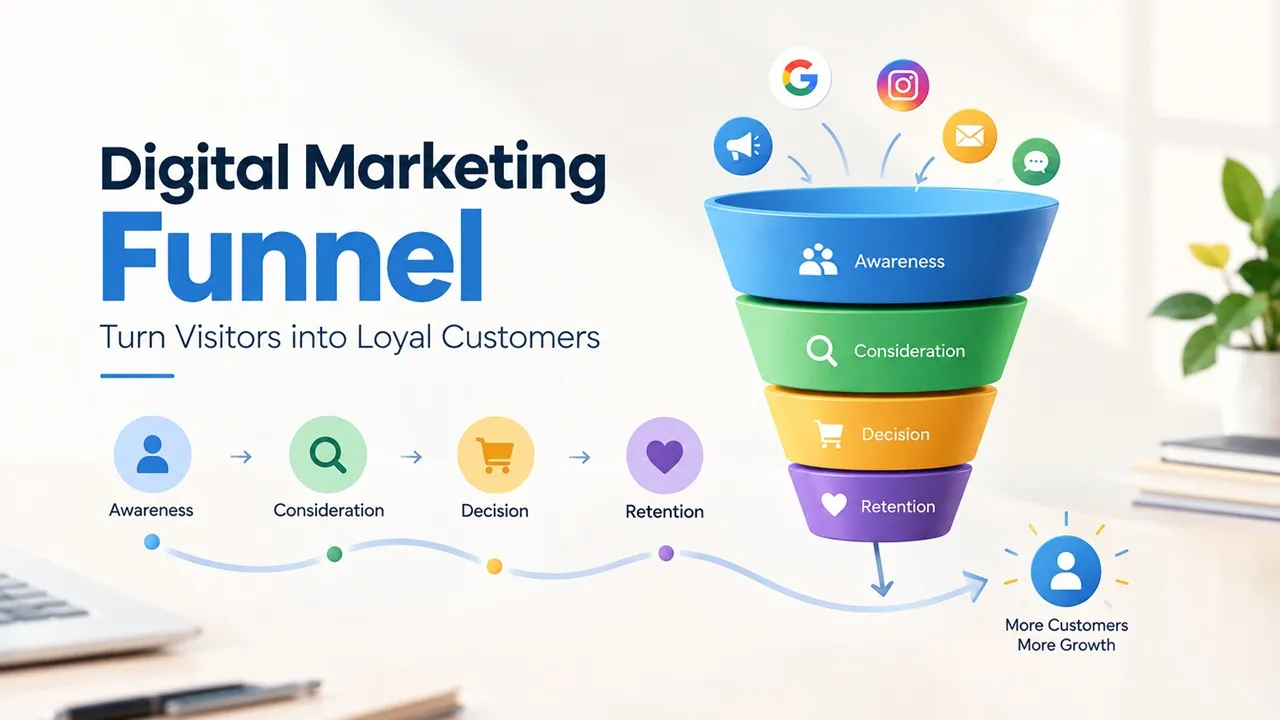
The digital marketing funnel is a model that maps how someone moves from first noticing a problem to becoming a paying ideally repeat customer. It's pictured as wide at the top (lots of people, low intent) narrowing down to the bottom (fewer people, high intent). That's where the name “funnel” comes from.
Understanding it matters because most wasted marketing budget comes down to one thing: the wrong message reaching someone at the wrong point in their decision.
The Three Core Stages
1. Top of Funnel (TOFU): Awareness
This is where someone realizes they have a problem but isn't yet looking at brands or solutions. The goal here isn't to sell it's to be genuinely useful and visible. Educational content, short-form video, and broad-reach social content all live here, measured by reach and engagement, not conversions.
2. Middle of Funnel (MOFU): Consideration
The prospect knows they have a problem and is actively comparing solutions, including yours. This calls for comparison content, case studies, and free resources that capture an email address in exchange for real value. This is also where lead nurturing begins building trust through email or retargeting until the prospect is ready to decide.
3. Bottom of Funnel (BOFU): Decision
The prospect is ready to choose. Content here should remove every last bit of friction: clear pricing pages, demos, free trials, testimonials, and direct comparisons. A small improvement to a pricing page or checkout flow at this stage routinely beats the same effort spent earlier in the funnel.
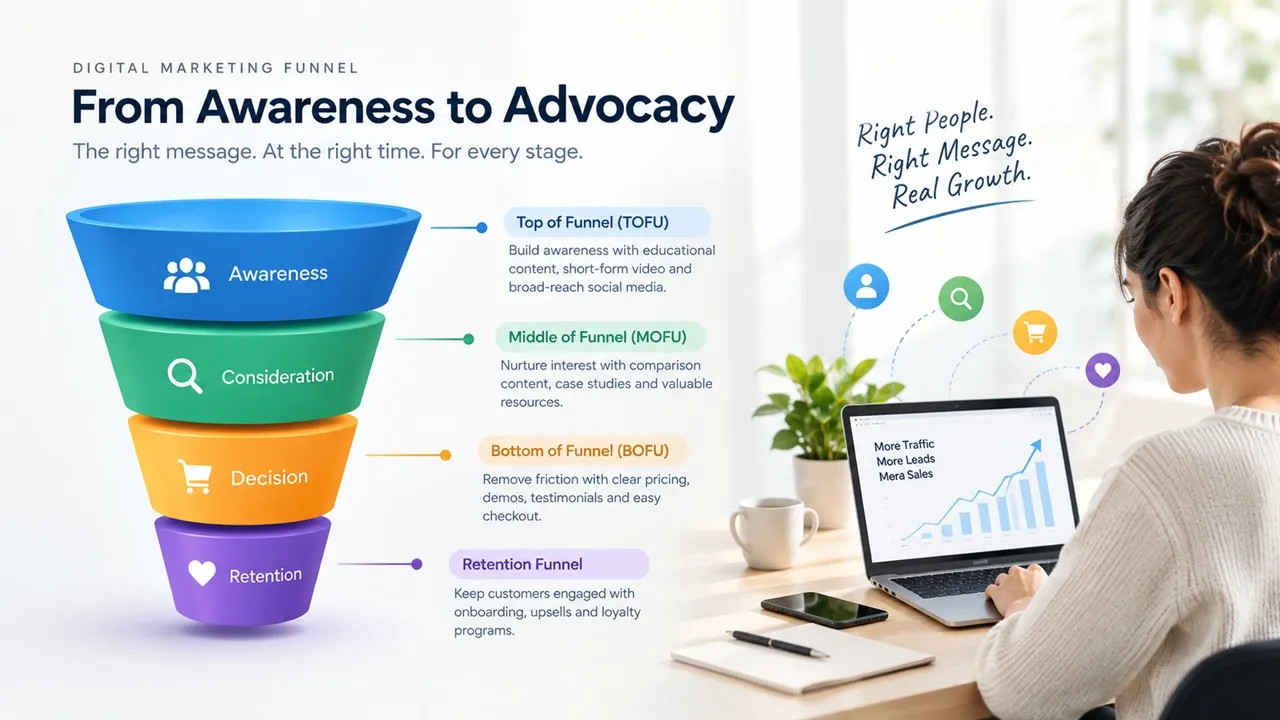
Beyond the Purchase: The Retention Funnel
Many businesses treat the sale as the finish line, but the highest-value work often happens after it. The retention funnel covers onboarding, ongoing engagement, upsells, and loyalty programs all designed to increase how much a customer is worth over time and turn buyers into advocates. Retention is typically far cheaper than acquisition, which is exactly why it deserves a real place in your overall marketing strategy, not an afterthought.
The Pieces That Make Up a Funnel
- Lead generation funnel is the structured system landing pages, free resources, forms, follow-up sequences that turns anonymous traffic into people you can actually contact. A well-built one matches the offer to the stage: a free checklist for early-stage visitors, a live demo request for someone ready to buy.
- Lead nurturing is the process of staying relevant and helpful until a lead is ready to buy, usually through automated email sequences, retargeting, and periodic useful content. Effective nurturing is paced to match how people actually buy a 50 impulse purchase needs a very different sequence than a 50,000 B2B deal.
- Conversion narrows in on the specific mechanics of turning an interested visitor into a paying customer page design, form length, pricing clarity, trust signals, and checkout friction.
- Funnel optimization is the ongoing process of finding and fixing drop-off points using analytics and testing. Fix the stage with the steepest drop-off first often the jump from awareness to consideration, or cart abandonment at the decision stage since fixing your biggest leak beats polishing an already-strong stage.
Does the Funnel Still Hold Up With AI-Assisted Buyers?
It's worth asking directly: does the funnel model still hold up when buyers increasingly research using AI chat tools instead of clicking through a linear path? The data suggests the stages still exist they just get compressed or skipped.
- AI-generated answers now appear on close to half of all Google searches. That means a growing share of early-stage research now happens inside an AI answer before someone ever visits a website so your content needs to be written in a way AI tools can actually pull into their answers, not just rank below them.
- Click-through rates for the top organic result have measurably dropped as AI-generated summaries answer questions directly. Fewer, more qualified visitors are reaching your consideration and decision-stage content so that content has to work harder per visitor.
- B2B conversion rates average around just 1.4%, among the lowest of any category, reflecting long evaluation cycles and multiple decision-makers. A strong reminder that decision-stage content in complex sales needs to convince several people, not just one.
- Email sequences matched to the right stage are known to drive hundreds of percent more revenue than generic mass sends solid evidence that matching your message to the stage matters more than sending more messages.
The Ideas Behind Every Funnel
- Customer lifecycle is the full arc from first contact through loyalty, of which the funnel is one part.
- Purchase journey is the realistic, often non-linear path a specific customer actually takes, as opposed to the tidy funnel diagram.
- User intent is what someone is actually trying to accomplish at each interaction, which should shape what content or offer they see.
- Touchpoints are every interaction a prospect has with your brand, across every channel.
- Conversion paths are the specific sequences of pages or actions that lead to a conversion.
- Customer experience is the cumulative feeling created across every touchpoint increasingly determining retention as much as the product itself.
- Sales enablement is the material that helps a sales team convert decision-stage leads, especially relevant in funnels with a human sales step.
- Revenue funnel is the version of the funnel measured explicitly in dollars, connecting marketing activity directly to revenue.
How the Funnel Connects to Everything Else
The funnel doesn't exist in isolation. It's the connective structure between three other core areas:
Funnel → Customer Journey → Channels → Strategy → Conversion
Understanding the customer journey tells you which digital marketing channels to use at each stage. Those channels get sequenced and budgeted through your digital marketing strategy, then measured through the KPIs relevant to each stage all ultimately optimizing toward conversion.
Matching Channels to Funnel Stages
| Funnel Stage | Best-Fit Channels | Primary Goal |
| Awareness (TOFU) | Social media, video marketing, display advertising, content marketing | Reach and recognition |
| Consideration (MOFU) | SEO, content marketing, email marketing, influencer marketing | Trust and lead capture |
| Decision (BOFU) | PPC, email marketing, SMS/WhatsApp marketing, affiliate marketing | Conversion |
| Retention | Email marketing, SMS/WhatsApp marketing, mobile marketing | Loyalty and repeat revenue |
Common Funnel Mistakes That Waste Budget
- Showing decision-stage offers to awareness-stage traffic. The single most common cause of low conversion rates.
- No lead nurturing between the middle and bottom of the funnel. Letting warm leads go cold from lack of follow-up.
- Treating the sale as the finish line. Under-investing in the retention funnel, which is typically far cheaper to run than acquisition.
- Writing content AI tools can't easily pull into their answers. Losing awareness and consideration visibility to competitors who structured theirs correctly.
- No stage-specific tracking. Making it impossible to tell whether a drop-off is happening at awareness, consideration, or decision.
Frequently Asked Questions About the Digital Marketing Funnel
Q1. Is the funnel model still accurate, or is the customer journey non-linear now?
Both are true. The funnel remains useful for planning content and channels, but real behavior loops back and skips stages someone might arrive with decision-stage intent directly. Use it as a planning framework, not a strict prediction.
Q2. What's the difference between a sales funnel and a marketing funnel?
A marketing funnel covers the full journey from awareness through purchase and into retention. A sales funnel is typically the narrower, later portion more focused on the direct actions a sales team takes to close a deal.
Q3. Which funnel stage should get the most budget?
It depends on where your business currently leaks the most value. Newer brands often need more awareness-stage investment; established brands with good traffic but weak conversion should invest more in consideration, decision, and conversion optimization.
Q4. How long should lead nurturing take?
It should match your natural buying cycle days for low-cost consumer products, weeks to months for high-consideration B2B purchases.
Q5. How do I know if my funnel has a problem?
Compare conversion rates between stages using analytics. A sharp drop between two specific stages points directly to where optimization effort should go see the Digital Marketing KPIs Guide for the specific metrics to track.
Where to Go From Here
The digital marketing funnel isn't a diagram to reference once and forget. It's the working model that should shape every piece of content, every channel choice, and every offer you build. In an era where a growing share of that journey happens inside an AI-generated answer before someone ever visits your site, funnel thinking matters more, not less.
If you're ready to go deeper building out the channel mix for each stage, connecting it to your broader strategy, or measuring exactly where prospects are dropping off that's the natural next step before running another campaign with no stage-matching behind it.
























Sign in to leave a comment.