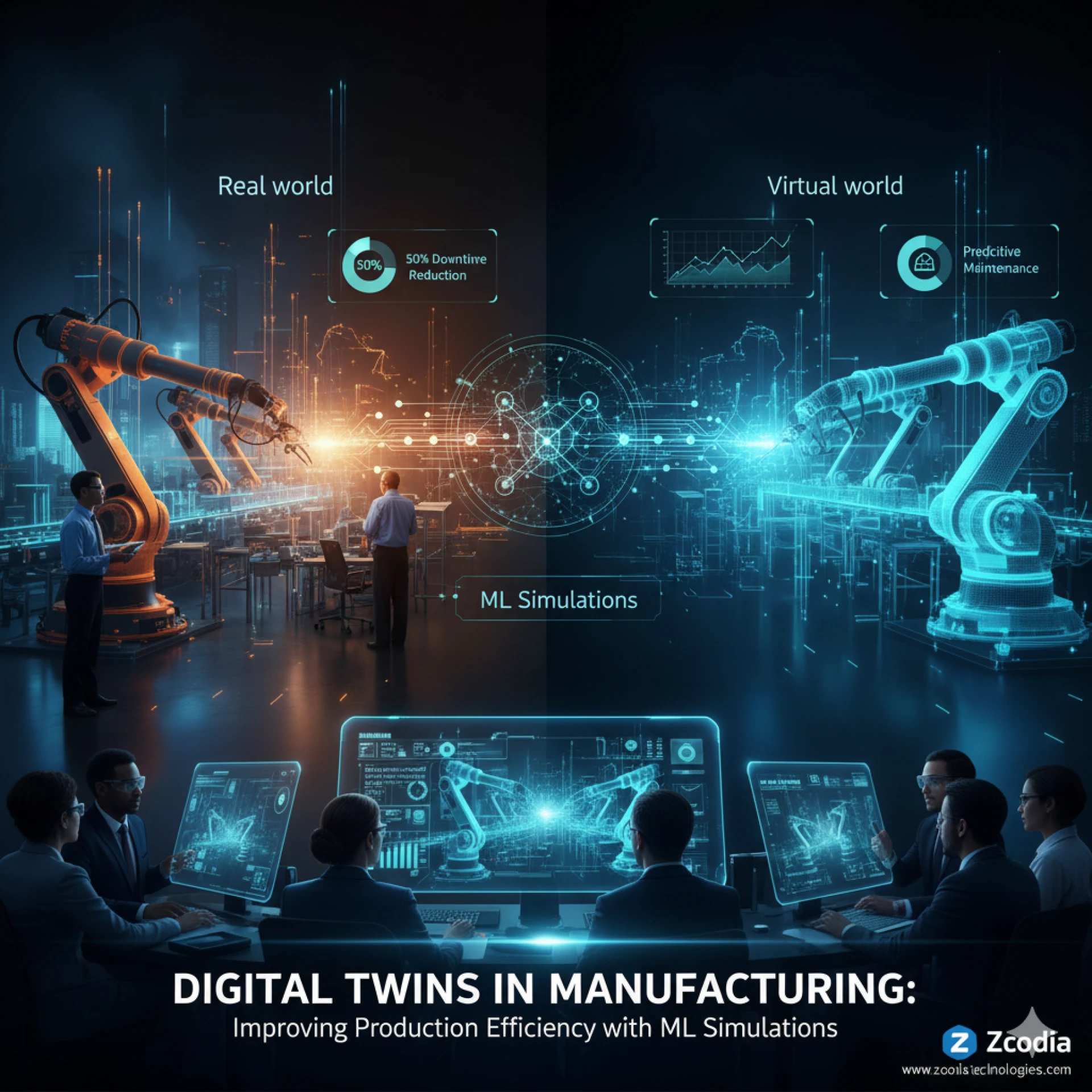

The manufacturing floor of 2026 is a symphony of steel, silicon, and AI. Gone are the days of reactive maintenance and inefficient guesswork. Today, a silent, hyper-accurate revolution is underway: the widespread adoption of Digital Twins in Manufacturing. These virtual replicas of physical assets, processes, and even entire factories, powered by real-time IoT data and advanced Machine Learning (ML) simulations, are fundamentally redefining production efficiency.
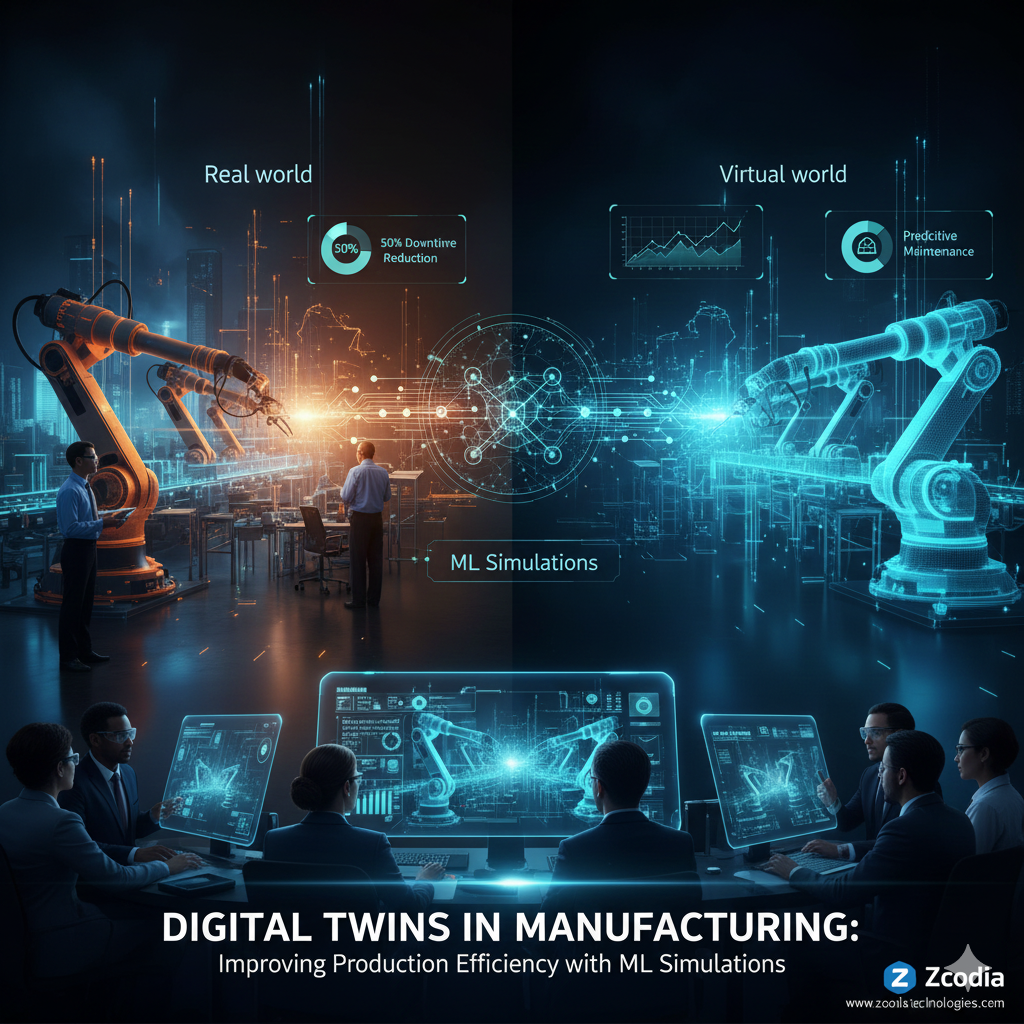
The market reflects this seismic shift. The global Digital Twin market is projected to reach an astounding $184.5 billion by 2033, with a CAGR of 38.6%. For manufacturers, this isn't just a technological upgrade; it's a strategic imperative. By deploying Digital Twins, companies are reporting up to 50% reductions in unplanned downtime, 30% cuts in operational costs, and a 15% boost in overall production yield.
1. What is a Digital Twin in Manufacturing?
A Digital Twin is a dynamic, virtual model of a physical object or system. It acts as a bridge between the physical and digital worlds, allowing for real-time monitoring, analysis, and simulation.
The Three Core Components:
Physical Asset: The real-world object (a robot, a production line, an entire factory).
Virtual Model: A software-based replica that accurately reflects the physical asset's characteristics, behaviors, and interconnections.
Data Link: Real-time data collected from IoT sensors on the physical asset (temperature, pressure, vibration, output) continuously updates and synchronizes the virtual model.
In 2026, these twins are more than just mirrors; they are predictive engines, capable of forecasting future performance and potential failures with unprecedented accuracy.
2. The Power of ML Simulations: Beyond Simple Monitoring
While early Digital Twins provided monitoring, the true revolution in 2026 comes from integrating Machine Learning Simulations. This is where the twin moves from "observing" to "predicting" and "optimizing."
Predictive Maintenance 2.0
Traditional predictive maintenance used historical data to forecast equipment failure. With ML-powered Digital Twins, this is elevated.
Dynamic Anomaly Detection: ML algorithms analyze real-time sensor data from the physical twin, identifying subtle deviations that human operators or rule-based systems would miss. For example, a slight increase in a motor's vibration frequency, too small to trigger an alarm, might be flagged by the ML model as a precursor to a bearing failure in 2 weeks.
Reduced Downtime: Companies deploying ML-driven Digital Twins report a 20-50% reduction in unplanned downtime, as maintenance can be scheduled precisely when needed, before a breakdown occurs.
Process Optimization and "What-If" Scenarios
ML simulations allow manufacturers to experiment in a risk-free virtual environment.
Throughput Optimization: A Digital Twin of a production line can simulate various operational changes (e.g., increasing robot speed, changing material flow) to identify bottlenecks and optimize the sequence of operations, leading to a 5-15% increase in production throughput.
"What-If" Analysis: Before investing millions in new equipment or layout changes, manufacturers can run hundreds of ML simulations on the Digital Twin to evaluate the impact on efficiency, cost, and quality. This reduces capital expenditure risks by 25%.
3. Real-World Applications of Digital Twins in Manufacturing (2026)
The application of Digital Twins in Manufacturing is diverse, addressing critical pain points across the production lifecycle.
A. Product Design and Prototyping
Virtual Testing: Before a physical prototype is built, a Digital Twin can simulate stress tests, aerodynamic performance, or material fatigue, drastically reducing the cost and time of physical prototyping. Companies are saving millions of dollars and months of development time on each new product iteration.
B. Production Line Optimization
Bottleneck Identification: A Digital Twin of an entire factory floor can visually highlight areas where materials are accumulating or processes are slowing down, allowing for real-time adjustments.
Energy Efficiency: ML models within the twin can recommend optimized machine run times or temperature settings to reduce energy consumption without impacting quality, contributing to a 10-20% reduction in utility costs.
C. Quality Control and Defect Prediction
Anomaly Detection: High-resolution cameras combined with ML-powered Digital Twins can identify microscopic defects in products as they are being manufactured, preventing faulty products from moving down the line.
Root Cause Analysis: If a defect is found, the twin can quickly trace it back to the exact machine or process step that caused it, often leading to a 70% faster resolution of quality issues.
D. Supply Chain Integration
Predictive Inventory: By integrating with the Digital Twin, ML can accurately forecast material demand and predict potential supply chain disruptions, optimizing inventory levels and reducing carrying costs by up to 15%.
4. Challenges and Key Implementation Strategies
While the benefits are clear, deploying Digital Twins in Manufacturing requires a strategic approach.
Data Integration: The biggest hurdle is integrating disparate data sources from legacy OT (Operational Technology) systems with modern IT (Information Technology) platforms. This requires robust custom digital transformation and advanced data engineering solutions.
Modeling Complexity: Building accurate virtual models that truly reflect complex physical processes requires specialized domain expertise and advanced simulation capabilities.
Cybersecurity: Digital Twins contain sensitive operational data. Securing these virtual environments from cyber threats is paramount.
The Phased Approach (2026 Best Practice):
Start Small: Begin with a Digital Twin of a single, critical asset (e.g., a high-value CNC machine).
Prove ROI: Quantify the benefits (e.g., reduced downtime, improved yield) to build internal support.
Expand Incrementally: Once successful, scale the initiative to larger production lines or entire factory segments.
5. The Future: Autonomous Manufacturing with Digital Twins
Looking toward 2027 and beyond, the evolution of Digital Twins is moving toward full autonomy.
Self-Optimizing Factories: Digital Twins will not just recommend changes but will autonomously implement them in real-time, adjusting machine parameters, optimizing material flow, and even ordering new parts without human intervention.
Human-Machine Collaboration: Augmented Reality (AR) will overlay Digital Twin data onto the physical world, providing technicians with real-time insights and guidance during maintenance or operational tasks.
Conclusion: The Blueprint for the Smart Factory
Digital Twins in Manufacturing, supercharged by ML simulations, are no longer a luxury—they are the blueprint for the resilient, efficient, and intelligent factory of the future. They offer an unparalleled ability to understand, predict, and optimize every facet of the production process.
By reducing costly downtime, improving product quality, and enabling predictive decision-making, Digital Twins are delivering tangible financial returns and cementing their role as a foundational technology in Industry 4.0. For manufacturing leaders seeking to transform their operations and gain a decisive competitive edge, investing in this virtual revolution is the most strategic move in 2026.
Partnering with experts in cutting-edge AI/ML development and industrial IoT solutions is crucial to unlock the full potential of Digital Twins, transforming raw data into actionable intelligence that drives unparalleled efficiency.

Sign in to leave a comment.