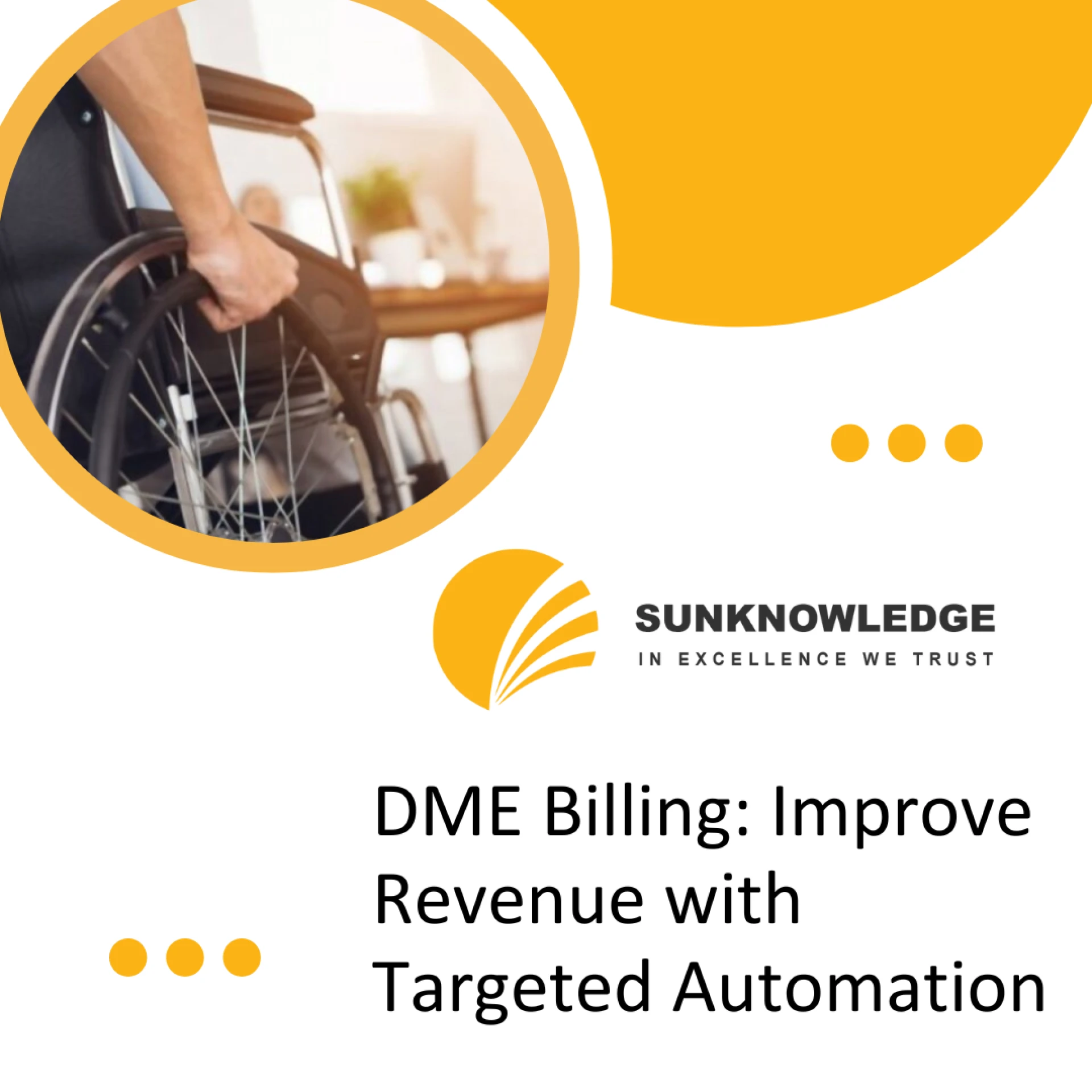

As you navigate through the durable medical equipment billing realm and your margins are likely thin, you might not have adequate resources to streamline the process. Restructuring your DME billing services can be a major challenge in this situation. However, handing an in-house staff with appropriate training and retaining staff for the long-term in this tremulous healthcare landscape might seem difficult too.
As the reimbursement landscape continues to change due to increasing aging population and changes within the insurance policies, a targeted automation within the process will be helpful for you. This blog offers insights on boosting your practice's revenue through automation in DME billing's revenue cycle management.
Key Focus Areas in DME Billing RCM
In this section, we discussed a process-by-process analysis of automation opportunities and third-party support according to the feasibility that improve the bottom line of your business.
Insurance verification: An effective DME billing workflow starts with precise insurance verification. The purpose of this step is to gather precise coverage information of the patient, including co-pays, co insurances, deductibles met, and out-of-pocket maximums. Automation of this process has been widely accepted by the DME providers. As you maintain a partial automation of this process, you might find there are still some inefficiencies. Now you must review the insurance coverage on every plan renewal, repair or maintenance of the equipment to learn about the insurance coverage of your patient. A major issue within the process is most of the providers do not follow this and gain a potential threat to lower reimbursements and even claim denials. Prior authorization: When you file a claim for Medicare or most of the commercial insurances, you must obtain prior authorization for a wide range of DMEPOS. A manual submission of the preauthorization document might result in errors that can lead to claim denials. Also, you need to reauthorize each piece of equipment annually. To instill automation in this process, consider electronic data management and constant supervision of the procedure.DME billing and coding: Streamlining the billing process is essential for effective revenue management. Before you submit any claim to the payor and the billing process is commenced, you should review the ICD-10, CPT and HCPCS coding of the rendered services. Also, ensure to review the modifier codes required for accurate DME billing and claim submission to stabilize the financial operations of your practice.
AR and denial management: The older the AR buckets the lower the chances of reimbursement you have. Once you submit the claim, it is up to the payor either to pay the claim or deny it based on the additional information required. According to the Medical Group Management Association, 65% of the denied claims left unchallenged, which has a great impact on the revenue of your practice. Along with that, if you lack a defined AR follow-up system combined with that it is fatal mistake for your practice. Focus on an automated and defined denial management and AR follow-up team to enhance the efficiency of your DME billing process.
The Bottom Line
Changes in the healthcare realm are constant and you must cope with the emerging trends in DME billing sphere. As you navigate through the complexities of revenue cycle management in your DME practice, you face barriers of higher wage and constant labor shortage. This unavailability of the resources makes it more difficult for you to automate your medical billing and coding practices. To eliminate these challenges, most of the DME providers like you are turning to an outsourced RCM partner who has an extensive knowledge and understanding regarding the issues within the process. Furthermore, you can leverage the benefits of more accurate claim submission and efficient process. Also, they can identify and analyze the process gaps within your practice and integrate comprehensive technologies to automate the overall process. With a reliable outsourced partner, you can enhance the process efficiency and navigate your ROI in a positive direction in the long-term.


























Sign in to leave a comment.