
A Small Business Owner’s Guide
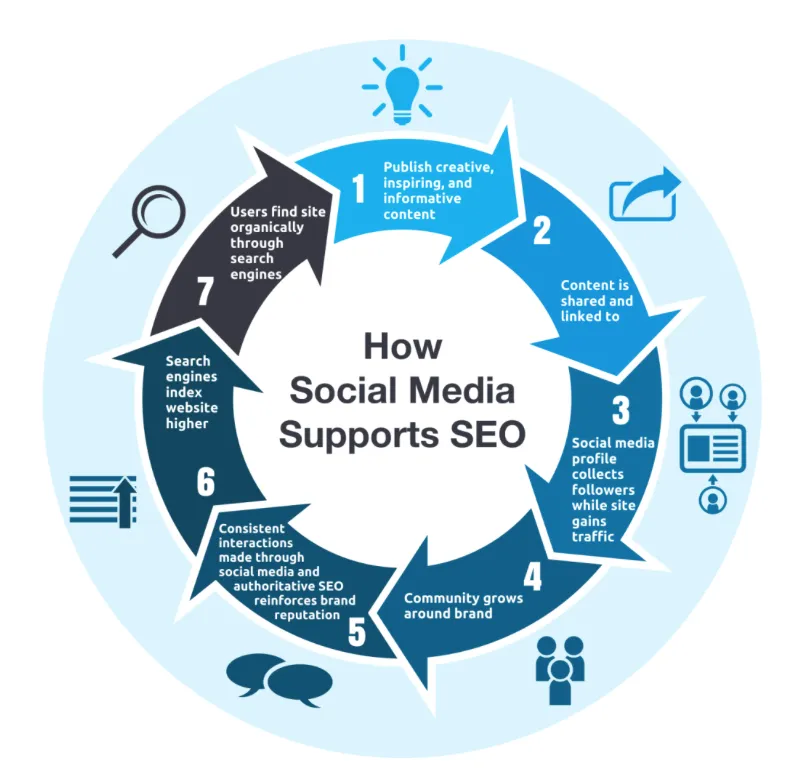
If you’re a small business owner, you’ve likely heard that social media and SEO go hand-in-hand. But how exactly does posting on Instagram or LinkedIn help your website rank higher on Google? The short answer is that social media doesn’t directly boost your rankings, but it creates a powerful ripple effect that significantly improves your SEO performance.
While Google has stated that social signals (likes, shares, and followers) are not direct ranking factors, the indirect benefits are undeniable. In fact, 81% of marketing experts report that optimizing for social search has improved their performance.
Here’s how a strong social media presence can drive traffic, increase brand visibility, and generate backlinks to supercharge your social media SEO.
The Indirect Impact: How Social Media Boosts SEO
Driving High-Quality Website Traffic
One of the most direct ways social media aids SEO is by driving traffic to your website. When you share valuable content on platforms like LinkedIn, Facebook, or TikTok, you create pathways for users to visit your site.
This matters because search engines interpret this increased traffic as a signal of relevance and quality. When visitors from social media engage with your content—reading blog posts, exploring product pages, or spending time on your site—they send positive signals to search engines. Over time, this can lead to improved rankings, especially for small businesses building their online presence.
Increasing Brand Visibility and Branded Searches
Social media is a powerful tool for increasing brand awareness. When people see your brand consistently across platforms, they become more likely to search for you directly.
This creates what experts call the "social-to-search halo effect" – when a social post generates curiosity that leads to branded searches. For example, a viral TikTok demo or a thought-provoking LinkedIn post can spark interest, prompting users to search for your brand name or products on Google.
Branded searches are powerful because they indicate trust and recognition. When people search for your business by name, it signals to Google that you are an authoritative and established entity in your space. Additionally, your social media profiles often rank prominently in search results for brand names, giving you more control over what people see when they look for you.
Generating Backlinks Through Content Amplification
Backlinks—links from other websites to yours—are one of the most important ranking factors for SEO. While links shared on social media are typically "nofollow" (meaning they don't pass direct link equity), they serve a critical purpose.
When you share your content on social media, you amplify its reach. This increased visibility means more people see your content, increasing the chances that other website owners, bloggers, or journalists will find it valuable and link to it from their own sites. This is how social media indirectly generates those high-quality backlinks that directly boost your SEO.
Practical Strategies for Small Business Owners
1. Optimize Your Social Profiles for Search
Your social media profiles themselves can appear in search results. Ensure they are complete and keyword-rich:
- Use relevant keywords in your bio, "About" section, and headlines to help both social platforms and Google understand what your business does.
- Add location details for local SEO. Including your address helps your social profiles appear in local search results for nearby customers.
- Include a link to your website on all platforms. These are "follow" links in your bio, passing some SEO value directly to your site.
- Maintain consistent branding across all platforms to build authority and trust.
2. Create Keyword-Rich Content
Social platforms like TikTok, Instagram, and YouTube are increasingly used as search engines. To get found:
- Conduct keyword research for social media. Type relevant topics into platform search bars to see what users are looking for.
- Use keywords naturally in captions, titles, and hashtags to improve discoverability.
- Add alt text to images and captions to videos. These accessibility features also help search engines understand your content and index it properly.
3. Share High-Quality Content Consistently
The foundation of success is great content. Focus on:
- Creating engaging, shareable content that provides value to your audience, such as tutorials, how-to guides, or industry insights.
- Posting regularly to keep your audience engaged and signal activity to search engines.
- Including clear calls-to-action that encourage users to visit your website for more information.
4. Build Relationships and Authority
Engage with your audience and industry leaders to build credibility:
- Respond to comments and messages to foster community and trust.
- Collaborate with other brands or influencers to extend reach and drive traffic to your site.
- Encourage user-generated content and customer reviews to build social proof and amplify your digital presence.
Conclusion: Integrating Social Media into Your SEO Strategy
For small business owners, social media is not a replacement for traditional SEO, but it is an essential complement. By driving targeted traffic, building brand visibility, and fostering opportunities for backlinks, a well-executed social media strategy directly supports your SEO goals.
The key is consistency. By making social media a core part of your marketing efforts, you create a virtuous cycle where content discovery, brand awareness, and user engagement continuously reinforce your search engine performance.
Next Steps
Ready to strengthen your online presence? Combine your social media efforts with a robust SEO strategy. For expert guidance on building a comprehensive approach that includes effective link building and on-page optimization, explore our complete SEO services to ensure your business ranks higher and attracts more customers.
Stay updated on the latest SEO strategies by visiting our SEO blog for more insights and actionable tips.

























Sign in to leave a comment.