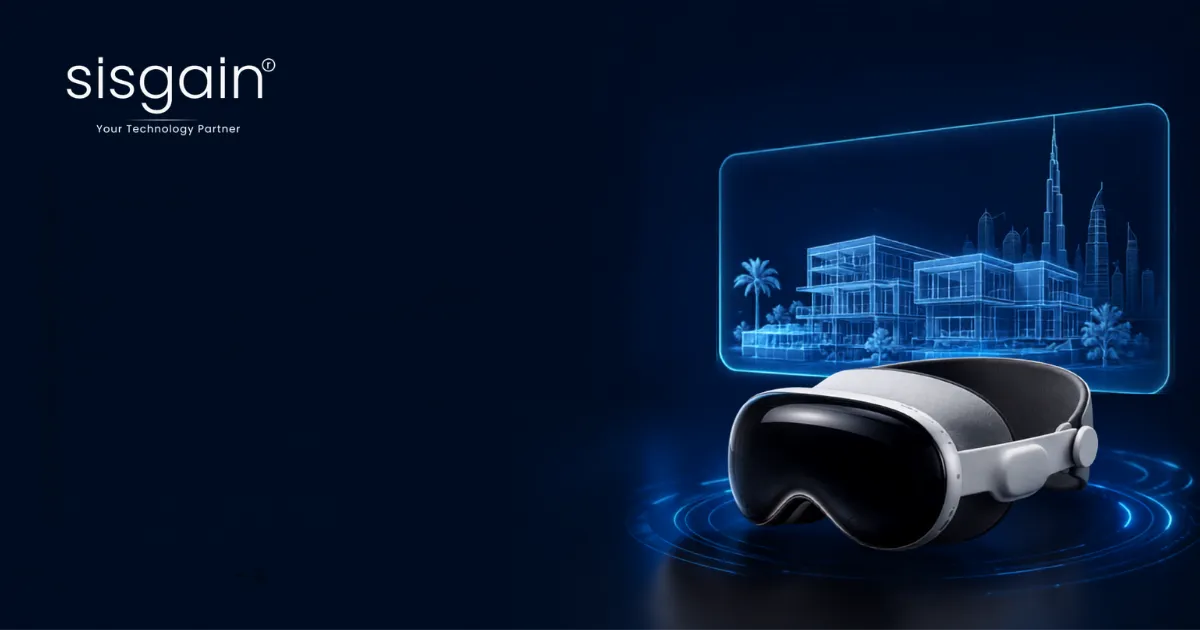

A luxury developer in Dubai used to budget $200,000–$500,000 for a single physical show flat — furniture, fittings, a unit held off inventory for months, all so one buyer at a time could walk through a space that wasn't finished yet.
That line item is disappearing. In its place: a headset.
Sales teams across the emirate now walk international buyers through fully staged, full-scale units using Apple Vision Pro, letting someone in São Paulo or London stand inside a property that exists only as a 3D model. It sounds like a gimmick until you look at the numbers — and the story behind UAE's AR/VR real estate development shift is too specific to ignore. Firms exploring AR VR development services today are the ones building the tools everyone else will be renting access to within two years.
The number that explains everything
Dubai property transactions rose 31% year-on-year in Q1 2026, hitting a record Dhs252 billion. Emaar alone posted a 16% jump, landing around Dhs22.4 billion for the quarter.
That's the entire reason the AR/VR arms race exists. A record share of this buyer pool is international and remote — people committing to seven-figure purchases without ever setting foot on site. You can't fly every serious buyer to Dubai, and you can't build a physical show flat for every off-plan tower in a portfolio. The ROI case for virtual reality property tours Dubai developers are running isn't about looking innovative — it's about closing deals with buyers who were never going to visit in person anyway.
What's actually changed on the ground
The backbone of this shift is Dubai Municipality's Digital Twin Platform, now in its third phase, unveiled at an event attended by Crown Prince Sheikh Hamdan bin Mohammed and Sheikh Ahmed bin Mohammed. It maps more than 195,000 buildings, 280,000 infrastructure assets, and 330,000 public facilities across over 1,500 geospatial data layers — meaning districts like Expo City can be modeled for zoning, transit, and land use before a foundation is even poured. Two companion platforms, Dubai Live and Dubai Here, now give professionals real-time 2D and 3D access to nearly every asset in the emirate.
This is also the physical layer underneath Dubai's Metaverse Strategy, which targets adding $4 billion to the economy and creating 40,000 virtual jobs by 2030 — positioning the emirate as a top-tier metaverse economy, with the same digital twin data feeding today's AR sales tools.
The compliance layer most sales teams skip
The part that gets missed: these tools are increasingly bundled with real financial products. At events like the Future PropTech Summit, AR/VR digital twins are being fused with fractional ownership — platforms like Magma pitch a "Digital Twin Token," while PRYPCO and Scintilla push tokenized ownership regulated by Dubai's Virtual Assets Regulatory Authority (VARA), which became the world's first government agency to open a headquarters inside the metaverse. DAMAC has already built on that credibility, pairing physical units with twinned virtual versions under one ownership record.
Once an AR/VR experience is tied to an actual ownership stake — not just a marketing tour — the data behind it falls under a stricter compliance bar. Any firm buying into this stack should be asking who owns the data pipeline and whether it was built VARA-aligned from day one, not retrofitted after a sale closes. That's the detail separating a platform institutional buyers trust from one that just looks good in a demo.
Old model vs. new model, in practice
A traditional off-plan sale means a $300,000 model unit, a buyer flying in for one walkthrough, then weeks deciding from memory and a brochure. Now that same buyer explores the unit at full scale from home, adjusts finishes, checks sightlines at different times of day, and revisits it the next evening without booking a flight. One is a single, expensive impression. The other is a repeatable, low-cost conversation that can happen as many times as it takes to close — which is exactly why brokerages that adopted VR Tours in Dubai Real Estate early are seeing shorter sales cycles and fewer wasted site visits.
Who's already doing this
Dubai brokerages, Allsopp & Allsopp among them, have been early adopters of spatial-mapped tours with real-time furniture and renovation visualization. Browser-based 3D platforms extend the same experience to buyers without Vision Pro access, so international interest isn't gated behind expensive hardware. Miami is the precedent driving urgency — luxury pre-construction projects above $2 million there are replacing physical model units entirely with full-scale AR staging.
Also worth watching: Apple's visionOS 26 introduced AI-generated spatial scenes from ordinary flat photos, and Zillow is the first confirmed adopter — a feature that removes the cost barrier keeping proptech firms from scaling immersive listings across a full portfolio instead of just flagship units.
Where this leaves developers right now
None of this is speculative. Dubai Land Department is hosting PropTech Connect 2026, part of the Dubai PropTech Hub's push to incubate 200+ startups and pull in $300 million-plus in investment by 2030. Meanwhile Cityscape Global has relocated to Riyadh for November 2026 — a reminder that Saudi Arabia is pulling on the same capital and talent pool, and standing still isn't neutral here.
The developers converting fastest aren't the ones with the flashiest demo reel — they're the ones treating their digital twin, AR sales tool, and compliance posture as one connected system, not three vendor relationships bolted together after the fact.
If your team is weighing whether to build this internally or bring in a partner who's already solved the integration side, that's worth discussing before your next off-plan launch — not after a competitor's Vision Pro gallery starts outperforming yours.























Sign in to leave a comment.