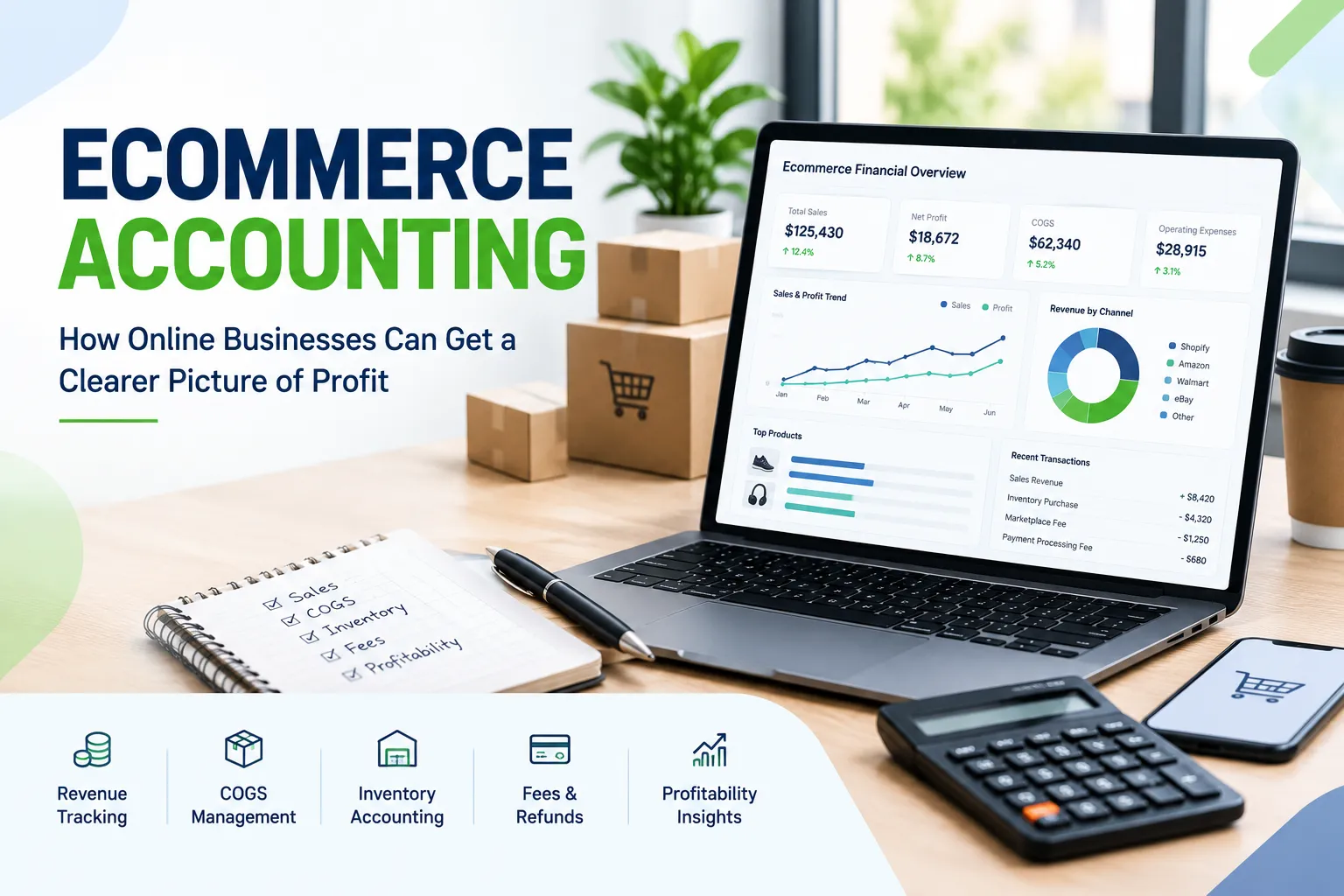

Running an ecommerce business can make revenue growth look exciting. Orders are coming in, sales are increasing, and the store dashboard shows strong numbers. But revenue alone does not tell the whole story.
An ecommerce business may generate hundreds of thousands of dollars in sales and still have much less profit than expected after accounting for inventory costs, marketplace fees, payment processing charges, advertising, shipping, refunds, returns, and other expenses.
This is why ecommerce accounting requires more than simply recording sales and expenses. Businesses need financial processes that connect sales, inventory, expenses, and cash flow so owners can understand what is actually happening with their money.
What Is Ecommerce Accounting?
Ecommerce accounting is the process of recording, organizing, reconciling, and analyzing the financial transactions generated by an online business. It covers everything from recording sales and tracking the cost of products sold to reconciling payment processors, managing inventory, monitoring expenses, and preparing financial reports.
Unlike a traditional business with a relatively straightforward sales process, ecommerce companies often receive financial information from several platforms. A single business might sell through Shopify, Amazon, Walmart Marketplace, and wholesale channels while using Stripe, PayPal, or other payment providers.
Each platform can report transactions differently, and the amount shown as sales may not match the amount ultimately deposited into the company's bank account. This makes having a structured accounting process particularly important for growing online businesses.
Why Ecommerce Accounting Is More Complicated Than It Looks
An ecommerce dashboard can show total sales in a matter of seconds. The difficult part is understanding what happens to that revenue afterward.
For example, imagine an online store generates $500,000 in sales. At first glance, that may seem like a highly successful year. But after deducting inventory costs, marketplace and payment fees, advertising expenses, shipping and fulfillment costs, refunds, returns, and other operating expenses, the actual profit could be considerably lower.
This difference between revenue and profitability is one of the biggest reasons ecommerce businesses need accurate accounting.
A business owner should be able to answer questions such as: How much did we actually earn? Which products are most profitable? How much are payment processors and marketplaces costing us? How much cash is tied up in inventory? Are advertising expenses generating profitable sales?
Without reliable financial records, these questions can be difficult to answer.
Revenue Reconciliation Is Essential
Ecommerce businesses frequently receive sales information from multiple platforms. The revenue reported by an ecommerce store or marketplace may not match the amount deposited into the company's bank account because fees, refunds, chargebacks, payment processing costs, and other adjustments can affect the final payout.
Regular revenue reconciliation helps businesses understand these differences and ensure transactions are recorded correctly.
For example, a marketplace may report a certain amount of gross sales but deduct its commission, advertising charges, fulfillment fees, or refunds before sending the remaining funds to the business. Recording only the net deposit can make it difficult to understand the company's actual sales and expenses.
A properly structured reconciliation process separates these elements and gives the business a more accurate financial picture.
Understanding Cost of Goods Sold
Cost of goods sold, or COGS, is another critical area of ecommerce accounting.
COGS represents the direct costs associated with the products a business sells. Accurate COGS information is necessary to calculate gross profit and understand product-level profitability.
This becomes increasingly important as an ecommerce company expands its product catalog. Inventory may be purchased at different prices, shipping and freight costs may change, and businesses may source products from multiple suppliers.
If COGS is inaccurate, gross margins can also be misleading. An ecommerce business may believe a product is highly profitable when its actual margin is much lower after accounting for the full cost of getting it ready for sale.
Accurate COGS tracking therefore gives owners a stronger foundation for pricing, purchasing, inventory planning, and profitability analysis.
Inventory Accounting Can Affect Cash Flow
Inventory is both an operational and financial consideration for ecommerce businesses.
Holding too much inventory can tie up significant cash, while holding too little can lead to stockouts and missed sales opportunities. Accounting records must accurately reflect inventory purchases, sales, adjustments, and the value of inventory on hand.
This is particularly important for businesses experiencing rapid growth. As order volumes increase, even relatively small inventory discrepancies can become financially significant.
Regularly comparing inventory records with operational data can help identify discrepancies and give business owners greater confidence in their financial reports.
Don't Overlook Marketplace and Payment Processing Fees
Third-party platforms are an important part of modern ecommerce, but they also introduce additional costs.
Depending on the business model, an online seller may pay marketplace commissions, payment processing fees, transaction fees, fulfillment charges, advertising costs, and other platform-related expenses.
These costs can significantly affect margins.
For example, a business might see strong sales growth but declining profitability because platform fees and customer acquisition costs rise faster than revenue.
Recording these expenses properly allows owners to understand the true economics of each sales channel rather than looking only at gross sales.
Refunds, Returns, and Chargebacks Need Proper Treatment
Returns and refunds are normal parts of ecommerce. However, they can complicate financial reporting.
When a customer returns a product, the business may need to account for the refund, returned inventory, shipping costs, restocking considerations, and any associated payment adjustments.
Chargebacks add another layer of complexity because the original transaction and the related financial adjustment must be reflected appropriately.
If these transactions are recorded inconsistently, revenue and profitability figures may become distorted. A structured accounting process helps businesses maintain more accurate records as these transactions occur.
Revenue Growth Does Not Always Mean Higher Profit
One of the most important lessons for ecommerce owners is that increasing sales does not automatically mean the business is becoming more profitable.
A company can increase revenue while its margins decline.
For example, an ecommerce brand may increase its advertising budget to generate more orders. Sales go up, but the additional customer acquisition cost may consume much of the additional revenue. Similarly, frequent discounts may increase order volume while reducing the margin earned on each sale.
This is why ecommerce businesses should look beyond top-line revenue and regularly evaluate gross profit, gross margin, operating expenses, customer acquisition costs, inventory costs, and other financial indicators.
The goal is not simply to sell more. It is to understand whether additional sales contribute to a healthier business.
Cash Flow and Profit Are Not the Same
Profitability and cash flow are closely related, but not the same.
An ecommerce company can appear profitable while experiencing cash-flow pressure. One common reason is inventory.
A business may need to purchase a large amount of inventory ahead of a major sales season. Cash leaves the business when it purchases inventory, while the related revenue may not be generated until weeks or months later.
Payment schedules can create similar timing differences. A company may record sales today but receive the corresponding marketplace or payment processor payout later.
Understanding these timing differences can help business owners make better decisions about inventory purchases, advertising budgets, hiring, expansion, and other investments.
Ecommerce Accounting for Multichannel Businesses
Selling through multiple channels can create significant growth opportunities, but it can also complicate accounting.
A multichannel business might sell through its own ecommerce website, Amazon, Walmart, eBay, wholesale accounts, and other marketplaces. Each channel can have its own reporting structure, payout schedule, fees, refunds, and transaction data.
Combining all this information manually can take substantial time and increase the risk of errors.
A consistent accounting process can bring these sources together and make it easier to reconcile sales, fees, refunds, and deposits. This gives management a more complete view of how the business is performing across its different channels.
How Technology Can Improve Ecommerce Accounting
Accounting technology and integrations can help reduce repetitive manual work. Depending on the business's systems and requirements, automation can help import transactions, categorize expenses, match bank activity, reconcile payments, and generate financial reports.
However, automation should not replace accounting oversight.
Automated processes still need correct configuration and regular review. Unusual transactions, reconciliation differences, inventory discrepancies, and other exceptions may require human judgment.
The objective should be to use technology to make accounting more efficient while maintaining appropriate financial controls and review procedures.
When Should an Ecommerce Business Consider Professional Accounting Support?
Many small ecommerce businesses initially manage their bookkeeping internally or use basic accounting software. As transaction volume increases, however, accounting can become increasingly time-consuming.
Professional ecommerce accounting support can be useful when an online business needs assistance with bookkeeping, reconciliations, inventory accounting, financial reporting, or understanding its actual profitability.
It can also be valuable when an owner spends too much time on financial administration instead of focusing on products, customers, marketing, and business growth.
Professional accounting support should go beyond simply recording transactions. A well-designed accounting process should provide business owners with timely, reliable financial information to support better decisions.
How Ecommerce Businesses Can Improve Their Accounting
Improving ecommerce accounting does not necessarily mean making the process more complicated. In many cases, businesses can make meaningful improvements by creating consistent financial routines.
One of the most important steps is establishing a regular reconciliation process. Review bank accounts, payment processors, and marketplace accounts consistently rather than waiting until the end of the year to identify discrepancies.
Businesses should also separate gross sales from fees and other deductions. Recording only the net amount deposited into a bank account can make it difficult to understand how much the business generated in sales and how much it paid in transaction-related costs.
Inventory should also receive regular attention. Businesses should compare accounting records with operational inventory data and investigate significant differences rather than letting discrepancies accumulate.
Finally, creating a consistent month-end close process can make financial reporting more reliable. This may involve reviewing bank accounts, payment processors, inventory, outstanding expenses, accounts payable, accounts receivable, revenue, and COGS before finalizing monthly reports.
What Should Ecommerce Financial Reports Tell You?
Financial reports should do more than show a collection of numbers. They should help answer practical questions about the business.
An owner should be able to determine whether sales are increasing, whether margins are improving, where cash is being spent, and which products or sales channels are contributing to profitability.
For example, revenue reports can show whether the business is growing, while gross margin can reveal whether that growth is economically sustainable. Cash-flow information can highlight large inventory purchases or increasing operating expenses.
More detailed reporting can also help owners compare products, channels, or business segments when the underlying accounting data supports that level of analysis.
The most useful financial report isn't necessarily the one with the most information. It is the one that gives decision-makers the information they need at the right time.
Final Thoughts
Ecommerce accounting is about much more than recording online sales.
As an ecommerce business grows, financial data comes from more platforms, transaction volumes increase, inventory becomes more significant, and expenses become more difficult to track manually.
Without accurate accounting, an owner may know how much the company sells without knowing how much it actually earns.
A well-structured ecommerce accounting process brings together sales, COGS, inventory, fees, refunds, expenses, and cash flow to create a clearer picture of financial performance. That visibility can help business owners control costs, understand profitability, manage cash, and make more informed growth decisions.
Ultimately, the goal of ecommerce accounting isn't simply to keep the books organized. It is to turn financial data into information that an ecommerce owner can use to run a better business.

























Sign in to leave a comment.