
⚡ Quick Answer
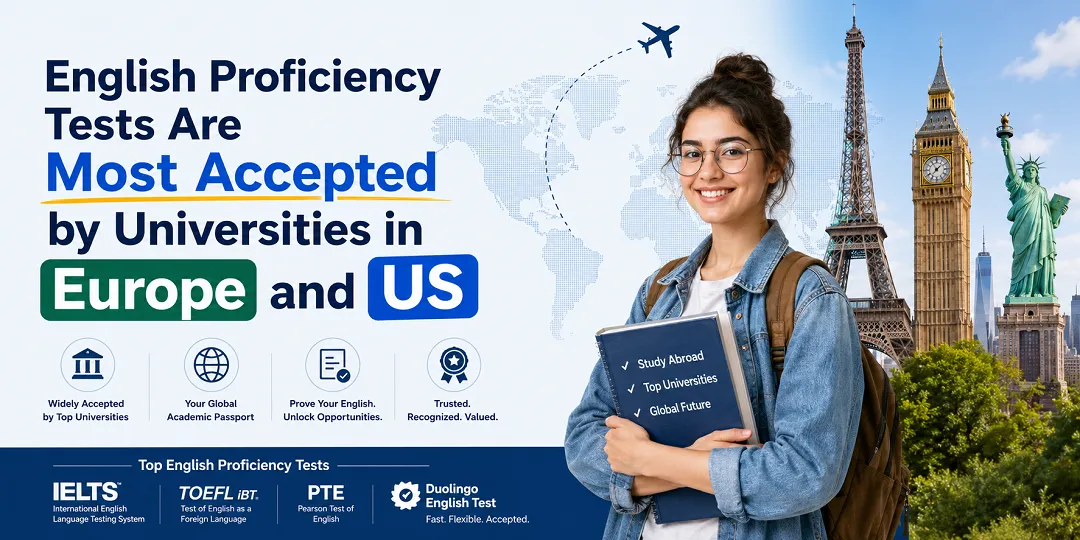
IELTS Academic and TOEFL iBT are the most widely accepted English proficiency tests by universities in both the U.S. and Europe — between them, they cover virtually every institution worldwide. TOEFL iBT is accepted by 12,000+ institutions and is the strongest choice for U.S. universities, while IELTS Academic is accepted by 11,000+ institutions globally and is strongest for the UK, Australia, Canada, and New Zealand.
The Duolingo English Test (DET) has rapidly risen as a budget-friendly third option, accepted by 95% of U.S. News Top 100 universities for undergraduate admissions. PTE Academic and Cambridge C1/C2 round out the picture, particularly for specific regions or career goals.
All information reflects 2025–2026 university policies. Always verify with the specific institution before registering for a test.
Table of Contents
- Why English proficiency tests matter
- The five major tests at a glance
- Test-by-test deep dive
- Which test is best for the U.S.?
- Which test is best for Europe?
- Score equivalency table
- How to choose the right test for you
- Frequently asked questions
1. Why English Proficiency Tests Matter
Every international student applying to an English-medium university — whether in the U.S., UK, Germany, Netherlands, or anywhere in Europe — needs to prove their language ability before they can be admitted. Universities cannot rely on self-reported English skills, so they require a standardised test score from a recognised provider.
The test you choose affects three things: how many universities you can apply to, how much you spend, and how quickly you get your result. Choosing the wrong test can cost you time, money, and even admission opportunities.
The most commonly accepted English proficiency tests include IELTS Academic, TOEFL iBT, PTE Academic, Cambridge English Qualifications (C1 Advanced and C2 Proficiency), and the Duolingo English Test. Some institutions also recognise TOEIC and OET for specific business- or healthcare-related programs.
2. The Five Major Tests at a Glance
| Test | Cost (USD) | Duration | Score Scale | Results | Best For |
|---|---|---|---|---|---|
| IELTS Academic | ~$245–$275 | 2h 45min | 0–9 (bands) | 3–5 days | UK, Europe, Australia, Canada |
| TOEFL iBT | ~$230–$255 | ~85 min | 0–120 | 72 hours | USA, Canada, worldwide |
| PTE Academic | ~$200–$280 | ~2 hours | 10–90 | 48 hours | Australia, UK visa, fast results |
| Duolingo English Test | $65 | ~1 hour | 10–160 | 48 hours | Budget option, most US schools |
| Cambridge C1/C2 | ~$200–$250 | 3.5–4 hours | 140–230 | 2–3 weeks | Europe, lifetime validity |
Fees vary by country. Check the official test provider website for pricing in your region.
3. Test-by-Test Deep Dive
🔵 TOEFL iBT — The American Standard
TOEFL iBT (Test of English as a Foreign Language, internet-Based Test) is developed by ETS and has been the benchmark for academic English assessment for decades. It is particularly favoured by institutions in the United States and Canada, with acceptance at over 11,000 universities and colleges globally.
The new TOEFL now uses a Band 1–6 scale aligned directly with CEFR levels (Band 4 = B2, Band 5 = C1, Band 6 = C2). During the transition period, which will last at least until the end of 2026, ETS reports scores on both the new band scale and the traditional 0–120 scale, allowing universities to smoothly transition to the new system. Scores are available within 72 hours. College Council
Key facts:
- Score range: 0–120 (four sections of 30 each)
- Most competitive universities require scores between 90 and 100, though top-tier institutions may expect 100 or higher.
- Available as in-person or TOEFL Home Edition
- Typical 2026 fee in major markets (US, UK, Canada, EU, India, Brazil): USD 230–255
Verdict: If the U.S. is your primary destination, TOEFL is your safest choice. It is also very widely accepted across European universities, particularly in Germany, the Netherlands, France, and Scandinavia.
🟢 IELTS Academic — The Global Benchmark
IELTS (International English Language Testing System) is co-owned by the British Council, IDP, and Cambridge Assessment English. It is the most widely recognised test in the UK, Australia, Canada, New Zealand, and much of Europe.
IELTS Academic costs approximately $245 and is accepted by 11,000+ institutions globally, with the strongest reach in the UK, Australia, Canada, and New Zealand.
Key facts:
- Score range: 0–9 in half-band increments (e.g. 6.0, 6.5, 7.0)
- A score of 6.5 to 7.0 is typically required for admission to reputable universities.
- From mid-2026, IELTS is fully computer-based. In some locations, you can still handwrite the Writing section, but the test itself is delivered digitally.
- Scores valid for 2 years
- Results in 3–5 days (computer-delivered)
Verdict: If your target institutions span the UK, Europe, Australia, and Canada, IELTS gives the broadest coverage. If your list mixes the US, UK, and Commonwealth, IELTS is the most universally accepted single test.
🟣 PTE Academic — The Fastest Results
PTE Academic (Pearson Test of English Academic) is a fully computer-based test scored entirely by AI, which gives it two significant advantages: consistent scoring without human examiner bias, and fast results.
Key facts:
- Score range: 10–90
- Cost: approximately $200–$280; results delivered in 48 hours
- A "good" score equivalent to IELTS 6.5 translates to approximately PTE 58–64.
- Accepted by thousands of universities in the UK, Australia, Europe, and the US
- PTE Academic is another strong IELTS alternative, particularly popular with European universities in Germany, France, and Eastern Europe.
Verdict: PTE Academic is ideal if you are short on time and want results in 48 hours. It is also the preferred test for Australia immigration pathways. For UK or AU visa pathways specifically, PTE Academic is increasingly common.
🟡 Duolingo English Test (DET) — The Budget Choice
The Duolingo English Test has disrupted the industry with its $65 price point and fully online, at-home format. At just $65 USD, completable from home in under an hour, and accepted by more than 5,000 universities and programs worldwide, the DET has matured from a niche workaround into a mainstream choice for English proficiency testing in 2026.
Key facts:
- Score range: 10–160
- Cost: $65 — the cheapest major English proficiency test
- Duration: approximately 1 hour, taken at home
- Results delivered in 48 hours
- 95% of U.S. News Top 100 universities accept the DET for undergraduate admissions. Ivy League schools including Harvard, Yale, Princeton, and Stanford all accept the DET for undergraduate programmes.
- As of 2025, more than 6,000 institutions have accepted the DET, including Ivy League universities and top Canadian schools.
Important caveat: A DET score of 110 is sufficient for many strong universities in the USA, Canada, UK, and Germany, roughly equivalent to IELTS 6.5. However, it falls short of the 115–125+ range expected by highly selective institutions such as Ivy League graduate programs and competitive Russell Group departments.
Verdict: Outstanding value for budget-conscious students, especially those applying to a wide range of U.S. universities. Always verify your specific target school accepts it before registering.
🔴 Cambridge C1 Advanced / C2 Proficiency — The Lifetime Certificate
Cambridge English qualifications (C1 Advanced / CAE, and C2 Proficiency / CPE) are produced by Cambridge Assessment English and are particularly popular in continental Europe and among students who want a qualification that never expires.
Key facts:
- Score range: 140–230 on the Cambridge English Scale
- Cambridge English qualifications such as C1 Advanced (CAE) or C2 Proficiency (CPE) are accepted by many European universities and are valid for life.
- C1 Advanced aligns with CEFR C1; C2 Proficiency aligns with CEFR C2
- Widely accepted across the UK, Europe, Australia, and increasing numbers of U.S. institutions
- Cambridge English exams are a globally recognised suite of English language tests covering all levels from beginner (A1) to proficient (C2), aligned with the Common European Framework of Reference for Languages (CEFR). Study International
Verdict: The lifetime validity is a major advantage — if you score well once, you never need to retake it. Particularly strong for European university applications.
4. Which Test Is Best for U.S. Universities?
TOEFL iBT is the traditional leader for U.S. admissions, but Duolingo has closed the gap dramatically.
US universities strongly prefer TOEFL or Duolingo. Most US schools now accept the Duolingo English Test. IELTS and PTE are also accepted by the vast majority of U.S. universities, though a handful of programs still give preference to TOEFL.
U.S. university score benchmarks (2026):
| Institution Tier | TOEFL iBT | IELTS | Duolingo (DET) |
|---|---|---|---|
| Ivy League / Top 20 | 100–110+ | 7.0–7.5+ | 120–135+ |
| Competitive programs | 90–100 | 6.5–7.0 | 110–120 |
| Most universities | 79–90 | 6.0–6.5 | 100–110 |
| Minimum threshold | ~60–79 | 5.5–6.0 | 95–105 |
Practical advice for the U.S.:
- If applying to 10+ schools across a wide range of tiers, take TOEFL or IELTS for guaranteed coverage.
- If applying to a focused list of schools you have already confirmed accept it, DET at $65 saves you $165–$210 per attempt.
- Graduate programs are more variable — always check program-specific requirements, not just university-wide policies.
5. Which Test Is Best for European Universities?
Europe is more heterogeneous than the U.S. — each country and university sets its own requirements. That said, IELTS and TOEFL between them cover virtually every English-medium program in Europe.
By country:
United Kingdom: IELTS is strongly preferred and is required for the UK Student Visa (Secure English Language Test standard). UK universities strongly prefer IELTS; many also accept TOEFL and PTE. Most Russell Group universities require IELTS 6.5–7.0, with Oxford and Cambridge departments typically requiring 7.0–7.5+.
Germany: German universities usually accept a TOEFL or IELTS certificate for English-taught programs. Universities can independently decide whether to accept other official language tests such as Cambridge Assessment C1 Advanced, BULATS, TOEIC, or TELC English B2-C1. Typical requirements are TOEFL iBT 80–100 or IELTS 6.5–7.5.
Netherlands: TOEFL is accepted across almost all Dutch universities. Institutions like the University of Amsterdam, Delft University of Technology, and Erasmus University Rotterdam accept TOEFL iBT scores. IELTS 6.5–7.0 is equally accepted. University of Amsterdam starts at TOEFL 80, though some programs require 92. Maastricht University accepts TOEFL from 80.
Switzerland: Top technical institutions set higher bars. Oxford, Cambridge, and the highest departmental thresholds require C1+/C2 level — TOEFL 100 (some departments 110) or IELTS 7.0+. ETH Zurich requires IELTS 7.0+ or equivalent.
Italy: Politecnico di Milano accepts TOEFL from 78 points for English-taught engineering programs. IELTS 6.0–6.5 is the common threshold across Italian universities. College Council
France: TOEFL is widely accepted across Europe, especially in Germany, France, the Netherlands, and Sweden. For English-medium programs in France, IELTS 6.0–7.0 or TOEFL 80–100 is the typical requirement.
General European benchmark: The most common threshold required by European universities is TOEFL 80–100 / IELTS 6.0–7.0 — which corresponds to CEFR level B2/C1.
Pro tip: Aim 10 points above the TOEFL minimum, or 0.5 bands above the IELTS minimum. A minimum score says "you're at the threshold" — a score above it signals genuine competence.
6. Score Equivalency Table
Use this table to understand how your score on one test translates to another. All conversions are based on official concordance research from ETS, Pearson, and Cambridge.
| CEFR Level | IELTS | TOEFL iBT | PTE Academic | Duolingo (DET) | Typical Requirement |
|---|---|---|---|---|---|
| B2 (Upper-Intermediate) | 5.5–6.5 | 72–93 | 50–64 | 100–115 | Many European universities |
| C1 (Advanced) | 7.0–7.5 | 94–109 | 65–79 | 120–135 | Top US/UK universities |
| C2 (Proficient) | 8.0–9.0 | 110–120 | 80–90 | 140–160 | Oxbridge, elite programs |
Key equivalencies to remember:
- IELTS 7.0 is equivalent to TOEFL iBT 94–101, PTE Academic 65–72, Duolingo 120–129, and CEFR C1. This is the most common threshold for top universities and skilled migration programs. Ielts
- A "good" score equivalent to IELTS 6.5 translates to roughly TOEFL 79–93, PTE 58–64, and DET 110–120. Langmitra
7. How to Choose the Right Test for You
Work through these four questions to find your answer:
Question 1: Where are you applying?
- Primarily U.S. → TOEFL or Duolingo
- UK, Australia, Canada, New Zealand → IELTS
- Mixed list spanning US + UK + Europe → IELTS (broadest coverage) or TOEFL
- Continental Europe only → TOEFL or IELTS; Cambridge C1/C2 for lifetime validity
Question 2: What is your budget?
- Tight budget → Duolingo ($65), but verify each school accepts it first
- Standard budget → TOEFL ($230–$255) or IELTS ($245–$275)
- Willing to invest once and never retake → Cambridge C1/C2 (lifetime validity)
Question 3: How quickly do you need results?
- Urgent (applying in the next 2–3 days) → Duolingo or PTE (48-hour results)
- Standard timeline → TOEFL (72 hours) or IELTS (3–5 days, computer-based)
- Long-term, no rush → Cambridge (2–3 weeks, but lasts a lifetime)
Question 4: Which format suits you?
- Prefer home-based testing → Duolingo or TOEFL Home Edition or PTE Online
- Prefer test-centre accountability → IELTS, TOEFL at a test centre, PTE at a test centre
- Want human examiner for speaking → IELTS (face-to-face speaking option still available in some centres)
If you are still undecided: If you're applying to a broad range of institutions and want maximum flexibility, take IELTS or TOEFL — you can't go wrong with either.
8. Frequently Asked Questions
Which English proficiency test is most accepted by universities worldwide? TOEFL iBT and IELTS Academic are jointly the most accepted. TOEFL iBT and IELTS are the most widely accepted English language proficiency tests. Together, they cover virtually every English-medium university program in the world.
Is Duolingo English Test accepted by top universities in the US and Europe? The DET is almost universally accepted across US universities — 95% of U.S. News Top 100 universities accept it for undergraduate admissions. In Europe, acceptance is growing but less consistent. Always verify individual programs, especially at top-ranked European institutions.
Which test is preferred for UK university applications? IELTS Academic is strongly preferred for UK applications and is the required test for the UK Student Visa (it must meet the Secure English Language Test standard). Most Russell Group universities set requirements of IELTS 6.5–7.5 depending on the program.
Does Cambridge C1 expire? Cambridge English qualifications such as C1 Advanced and C2 Proficiency are valid for life. IELTS, TOEFL, and PTE scores are valid for 2 years.
What is the minimum IELTS score for European universities? Germany requires IELTS 6.5+, France requires 6.0–7.0, ETH Zurich requires 7.0+, TU Delft requires 7.0, and Italy requires 6.0–6.5. Aim for 7.0 to be competitive at 95%+ of European universities.
Which is easier — IELTS or TOEFL? Neither is objectively easier — they test the same skills through different formats. IELTS uses a face-to-face speaking interview and paper/computer mix; TOEFL is entirely computer-based with integrated academic tasks. Students who are comfortable with digital interfaces often find TOEFL more manageable; those who prefer natural spoken conversation often prefer IELTS. Take practice tests for both and choose based on your stronger performance.
Is PTE Academic accepted in the US? Yes, most U.S. universities accept PTE Academic, though it is less prominently listed than TOEFL or IELTS. Check your specific program's requirements page, not just the university's general admissions policy.
What is the cheapest English proficiency test for university admissions? The Duolingo English Test at $65 is the most affordable formally recognised option — significantly cheaper than IELTS ($245–$275), TOEFL ($230–$255), or PTE ($200–$280). Its growing acceptance across 5,000+ institutions makes it a genuinely viable choice for most applicants.
Summary
| Your situation | Best test |
|---|---|
| Applying primarily to U.S. universities | TOEFL iBT |
| Applying to UK, Australia, Canada, NZ | IELTS Academic |
| Mixed global list | IELTS (widest single-test coverage) |
| Budget-conscious, most US/UK schools | Duolingo English Test |
| Fastest results needed | PTE Academic or Duolingo |
| European universities, want lifetime validity | Cambridge C1 Advanced |
| Australia immigration + university | PTE Academic |
The right test depends on your destination, budget, and timeline — not on which one sounds most impressive. All five tests are respected credentials at the institutions that accept them. Pick the one that matches your goals and that you are most likely to score well in.























Sign in to leave a comment.