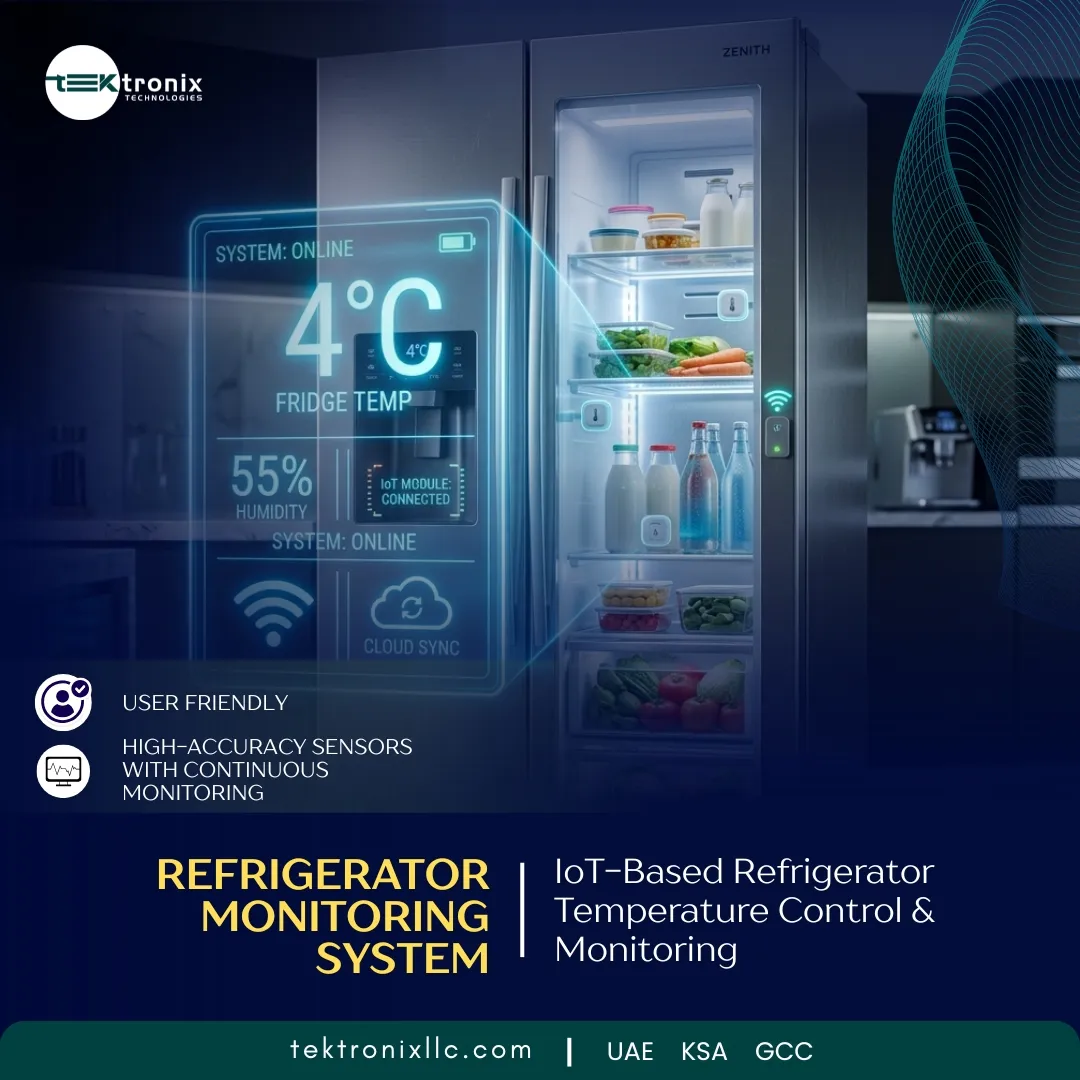

Refrigerator Monitoring is no longer a luxury for enterprise operations in Kuwait — it is a regulatory and operational necessity. From pharmaceutical cold chains and hospital blood banks to food-service giants and petrochemical laboratories, Kuwait-based organizations face extreme ambient temperatures (frequently exceeding 45 °C outdoors) that put every refrigeration asset under constant thermal stress. A single undetected failure can cost millions in spoiled inventory, patient safety incidents, or regulatory fines. This guide provides a definitive, expert-led walkthrough of enterprise refrigerator monitoring solutions built for Kuwait's unique climate, infrastructure, and compliance landscape.
1. Why Kuwait Demands Specialized Cold-Chain Oversight
Kuwait sits at the convergence of three demanding realities: an extremely hot and humid coastal climate, a rapidly expanding pharmaceutical and healthcare sector, and stringent GCC-aligned food-safety regulations. Standard off-the-shelf monitoring hardware rated for temperate climates routinely fails here — sensors drift, wireless signals attenuate in reinforced concrete warehouses, and cloud platforms are latency-sensitive across trans-regional links.
For enterprises operating across multiple facilities in Kuwait City, Ahmadi, or Salmiya, the stakes include:
- KFDA (Kuwait Food and Drug Administration) compliance for pharmaceutical cold storage at 2 °C to 8 °C
- Ministry of Health (MOH) standards for hospital blood bank and vaccine storage
- HACCP and ISO 22000 requirements for food manufacturing and hospitality chains
- OSHA-aligned laboratory refrigerant safety protocols for petrochemical R&D
Without calibrated, enterprise-grade Temperature Monitoring Solutions, organizations risk not only inventory loss but regulatory suspension and reputational damage.
2. Core Components of an Enterprise Monitoring Architecture
2.1 Smart Sensors — The Sensing Layer
Smart Sensors are the foundation of any modern monitoring system. Unlike passive thermometers, today's IoT-enabled sensors perform multi-parameter measurement — simultaneously capturing temperature, relative humidity, door-open events, and vibration — while transmitting data in near-real time over LoRaWAN, Wi-Fi, or cellular (4G/5G LTE) backbones. For Kuwait deployments, sensors rated IP67 or higher are recommended to withstand dust ingress common in desert-adjacent facilities.
Key selection criteria for enterprise-grade smart sensors in Kuwait:
- Operating range: -40 °C to +70 °C (covers both ultra-low freezers and ambient Kuwait heat)
- Calibration traceable to international metrology standards (NIST/PTB)
- Battery life of 3–5 years to reduce maintenance overhead in large deployments
- Redundant sensing elements (dual probes) for mission-critical assets like blood banks
2.2 Temperature Data Loggers — The Compliance Record
Temperature Data Loggers serve as the immutable audit trail that regulators, auditors, and quality managers rely upon. Modern loggers combine onboard flash storage (storing months of readings even without connectivity) with encrypted cloud sync, ensuring data integrity even during network outages — a realistic scenario in Kuwait's remote industrial zones and offshore facilities.
Enterprise data loggers deployed by Tektronix LLC offer:
- 21 CFR Part 11-compliant electronic records for pharmaceutical clients
- PDF and CSV export formats accepted by KFDA inspection teams
- LIMS integration via open APIs for laboratory information management systems
- Tamper-evident audit logs with role-based access controls
2.3 Remote Temperature Monitoring — Visibility without Boundaries
Remote Temperature Monitoring extends oversight beyond the four walls of a facility. Operations managers in Kuwait can view live temperature readings, excursion histories, and asset health dashboards on any device — desktop, tablet, or smartphone — whether they are in the office, at home, or traveling abroad for a business trip.
A centralized remote monitoring platform provides:
- Multi-site visibility: One dashboard covering refrigeration assets across all Kuwait facilities simultaneously
- Historical trend analysis: Identify gradual compressor degradation weeks before failure
- Predictive maintenance triggers: Machine-learning models flag anomalous temperature curves for proactive service scheduling
- Role-based dashboards: Custom views for facility managers, quality teams, and executive stakeholders
3. Intelligent Temperature Alerts — Acting Before Losses Occur
Temperature Alerts are the critical response layer that converts passive monitoring into active risk management. An enterprise alert framework must be far more sophisticated than a simple email notification — it needs tiered escalation, intelligent alarm suppression, and multi-channel delivery to be operationally effective.
Tektronix LLC's alert architecture follows a proven three-tier escalation model:
- Tier 1 — Advisory Alert: Sensor reading approaches the threshold boundary (±1 °C of set point). Notification sent to on-site technician via SMS and in-app push message.
- Tier 2 — Action Alert: Threshold exceeded for a configurable dwell time (e.g., 15 minutes). Automated work order created; secondary contact (quality manager) simultaneously notified.
- Tier 3 — Escalation Alert: Sustained excursion or sensor failure detected. Executive and third-party maintenance contractor simultaneously paged; photographic evidence log initiated.
Intelligent suppression logic eliminates nuisance alerts during scheduled defrost cycles, approved door-open maintenance windows, and planned shutdown events — a major pain point that causes alert fatigue and desensitises response teams.
4. Refrigerator Monitoring Kuwait: Industry-Specific Applications
4.1 Healthcare & Pharmaceutical Sector
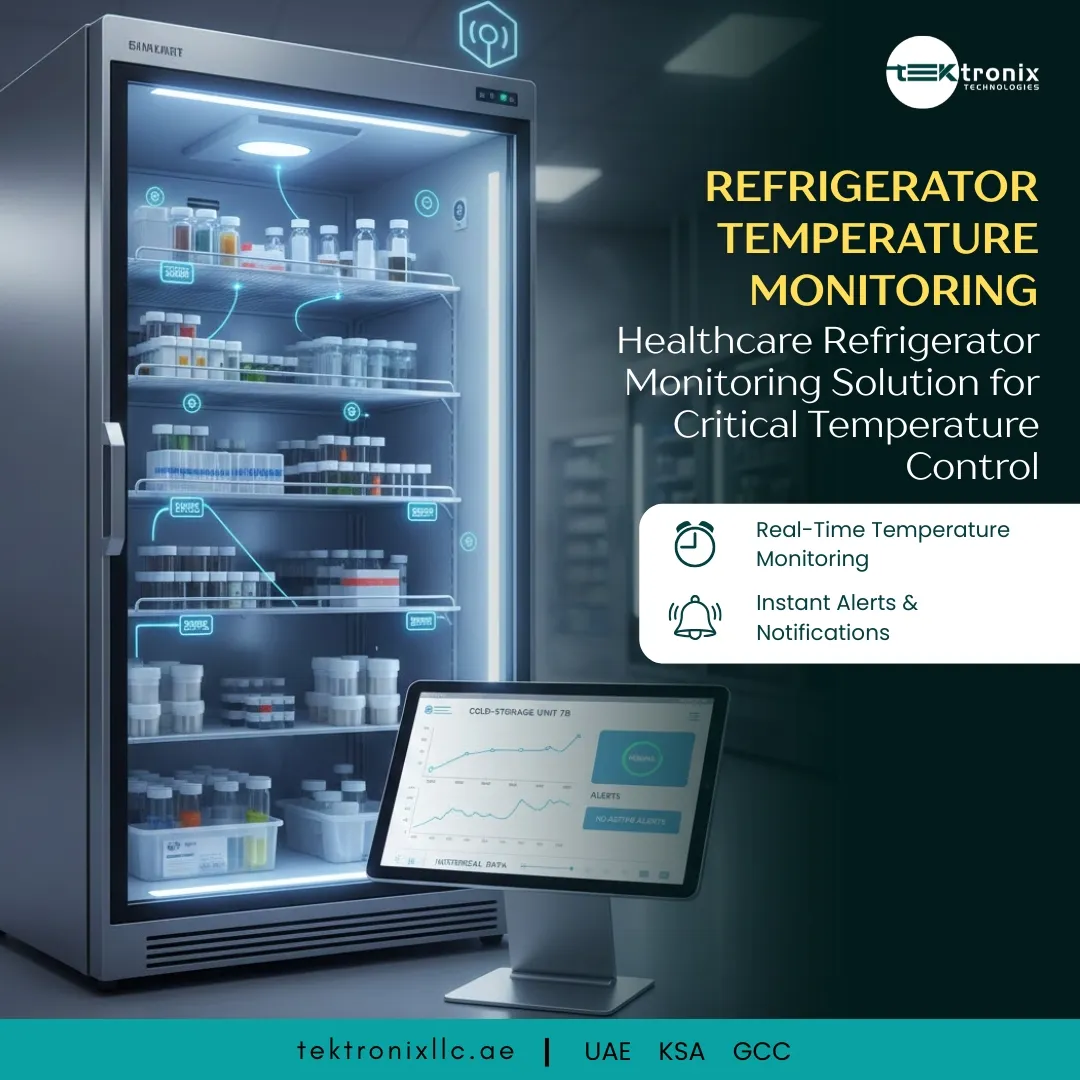
Hospitals, private clinics, and pharmaceutical distributors throughout Kuwait City rely on verified cold-chain integrity for vaccines, biologics, and blood products. Tektronix LLC's Refrigerator Monitoring Kuwait deployments in healthcare environments include wireless probes inside each unit, a secondary ambient sensor in the room, and direct integration with hospital building management systems (BMS) — ensuring unified facility oversight from a single pane of glass.
4.2 Food & Beverage and Hospitality
Kuwait's thriving hospitality sector — from five-star hotels on the Gulf to large-scale catering operations serving oil-field workers — must demonstrate continuous HACCP compliance. Automated temperature logging eliminates manual clipboard checks, reduces human error, and provides the documentary evidence required during Ministry of Commerce food-safety inspections.
4.3 Laboratories & Research Facilities
Research laboratories in universities and petrochemical R&D centers store reagents, samples, and reference standards at precise temperatures. Any excursion can irreversibly invalidate months of experimental work. Smart sensor networks with sub-1-minute sampling intervals provide the resolution needed to detect transient temperature spikes caused by power fluctuations or door seal failures.
4.4 Logistics & Cold-Chain Distribution
Last-mile pharmaceutical and food distribution across Kuwait's urban and industrial zones introduces the highest excursion risk. In-transit data loggers with GPS tagging provide proof-of-condition that protects both the distributor and the end customer, and are increasingly required by international export partners.
5. Refrigerator Monitoring GCC: Scaling Across Borders
Refrigerator Monitoring GCC strategies must account for the regulatory patchwork across Saudi Arabia (SFDA), UAE (MOHAP, ESMA), Qatar (QCHP), and Bahrain. While Kuwait's KFDA requirements closely mirror GCC Pharmaceutical Guidelines, organizations operating across multiple Gulf States benefit from a single, scalable monitoring platform with country-specific alert thresholds and regulatory report templates built in.
Tektronix LLC's GCC-wide deployments typically leverage:
- AWS Middle East (Bahrain) or Azure UAE North cloud regions for data residency compliance
- Multilingual (English and Arabic) dashboards and regulatory reports
- Unified KPI benchmarking across GCC sites with site-level drill-down capability
- Standardized sensor hardware with country-specific telecommunications certification (TRA UAE, CITC KSA, CRA Kuwait)
6. Why Partner Selection Matters
Experience, Expertise, Authoritativeness, Trustworthiness framework applies equally to your technology partner selection. When evaluating a Temperature Monitoring Solutions provider for mission-critical Kuwait deployments, look for:
- Experience: Demonstrated GCC deployments with verifiable case studies and customer references in Kuwait
- Expertise: Engineering team with IEC 62443 (industrial cybersecurity), ISO 17025 (calibration), and GxP qualification backgrounds
- Authoritativeness: ISO 9001-certified quality management system; participation in KFDA and Gulf Standardization Organization (GSO) technical working groups
- Trustworthiness: Transparent SLA commitments, locally domiciled support team, and independently audited cybersecurity posture
Tektronix LLC has served critical facility operators across Kuwait and the broader GCC region with over a decade of refrigeration monitoring projects spanning healthcare, industrial, and hospitality verticals. Our locally based engineering team provides on-site sensor calibration, commissioning, and 24/7 Arabic-language technical support.
7. Implementation Roadmap: From Assessment to Go-Live
A successful enterprise monitoring deployment follows a structured five-phase methodology:
- Phase 1 — Asset Discovery & Risk Stratification: Enumerate all refrigeration assets by criticality tier, map connectivity infrastructure, and identify regulatory reporting requirements.
- Phase 2 — Solution Design: Select sensor types, communication protocols, and cloud architecture. Define alert thresholds, escalation matrices, and integration touch-points with ERP, BMS, or LIMS systems.
- Phase 3 — Pilot Deployment: Deploy and validate on a subset of high-risk assets. Gather baseline data over a minimum 30-day period to tune alert sensitivity and eliminate false positives.
- Phase 4 — Full Rollout & Qualification: Expand to all assets. Complete IQ/OQ/PQ validation documentation required for pharmaceutical clients. Conduct staff training on dashboard operation and escalation procedures.
- Phase 5 — Continuous Improvement: Quarterly calibration verification, annual third-party audit support, and ongoing platform updates incorporating regulatory changes.
8. ROI and Business Case
The financial justification for enterprise refrigerator monitoring in Kuwait is compelling across multiple vectors:
- Inventory protection: A single vaccine cold-room failure in a Kuwait hospital can expose KWD 50,000–200,000 in spoiled biologics. One prevention event per year yields a 10–40x ROI on monitoring infrastructure.
- Labour efficiency: Automated logging eliminates 2–4 hours per day of manual temperature checks across a multi-unit facility, freeing staff for value-add clinical or operational tasks.
- Energy optimisation: Trend data identifies underperforming compressors before catastrophic failure, reducing emergency maintenance call-out costs and preventing energy overconsumption.
- Insurance and audit readiness: Documented continuous monitoring data reduces insurance premiums and accelerates regulatory inspection cycles.
Conclusion
Enterprise Refrigerator Monitoring in Kuwait is a multidimensional discipline that intersects IoT engineering, regulatory compliance, cloud infrastructure, and operational process design. The combination of Smart Sensors, calibrated Temperature Data Loggers, and intelligent Temperature Alerts delivered through a unified Remote Temperature Monitoring platform represents the gold standard for Kuwait's most demanding cold-chain environments.
As Kuwait's pharmaceutical, food-safety, and research sectors continue to grow and align with Vision 2035 economic diversification goals, investment in certified Temperature Monitoring Solutions is not merely prudent — it is strategically essential. Whether your organisation requires a single-site deployment or a Refrigerator Monitoring GCC-wide rollout, the right technology partner will ensure that every degree is documented, every alert is actionable, and every audit is effortless.
FAQs
FAQ 1: What wireless protocols are most reliable for Smart Sensors deployed in Kuwait's industrial facilities?
For large-footprint facilities such as pharmaceutical warehouses or petrochemical complexes in Kuwait, LoRaWAN operating in the 915 MHz ISM band delivers the best balance of range (up to 5 km line-of-sight), wall penetration, and battery longevity. For smaller healthcare deployments within a single floor, Wi-Fi 802.11n/ac or Zigbee mesh networks are preferred. Tektronix LLC performs an RF survey prior to deployment to select the optimal protocol and eliminate dead zones before sensors are installed.
FAQ 2: How do Temperature Data Loggers support KFDA audit inspections in Kuwait?
KFDA inspectors typically request continuous temperature records covering a minimum of 12 months, excursion logs with corrective action evidence, and sensor calibration certificates traceable to international standards. Tektronix LLC's loggers generate inspection-ready PDF reports with facility-specific header information, calibration traceability statements, and cryptographic data integrity seals — reducing audit preparation from days to minutes.
FAQ 3: Can Remote Temperature Monitoring integrate with our existing Building Management System (BMS)?
Yes. Integration with leading BMS platforms — including Honeywell EBI, Siemens Desigo CC, and Schneider Electric EcoStruxure — is supported via BACnet/IP, Modbus TCP, or REST API. This enables facilities teams to consolidate refrigeration monitoring alongside HVAC, power, and access control data in a single operational interface, which is particularly valuable for large Kuwait hospitals and hotel complexes managing hundreds of assets.
FAQ 4: What defines an acceptable Temperature Alert response time for pharmaceutical cold storage in Kuwait?
For WHO PIC/S-compliant pharmaceutical cold storage (2 °C to 8 °C), industry best practice recommends that a Tier 1 advisory alert be delivered within 60 seconds of threshold breach and that a Tier 2 action alert trigger corrective response within 15 minutes. Kuwait's MOH guidelines for vaccine storage align with these WHO benchmarks. Tektronix LLC's monitoring platform achieves average alert delivery latency under 45 seconds via dual-channel notification (SMS plus push), with documented escalation audit trails for GMP compliance.
FAQ 5: Is Refrigerator Monitoring GCC pricing standardised, or does it vary by country?
Pricing varies based on asset count, sensor type, connectivity infrastructure, regulatory validation requirements, and the level of managed service support selected. For GCC-wide deployments, Tektronix LLC offers a unified enterprise agreement that simplifies procurement, standardises SLA terms across all Gulf states, and provides preferential pricing for scale. A detailed return-on-investment model is provided as part of every proposal to help finance and operations stakeholders build an internal business case.
Contact Us:
00971 58 8899612





























Sign in to leave a comment.