

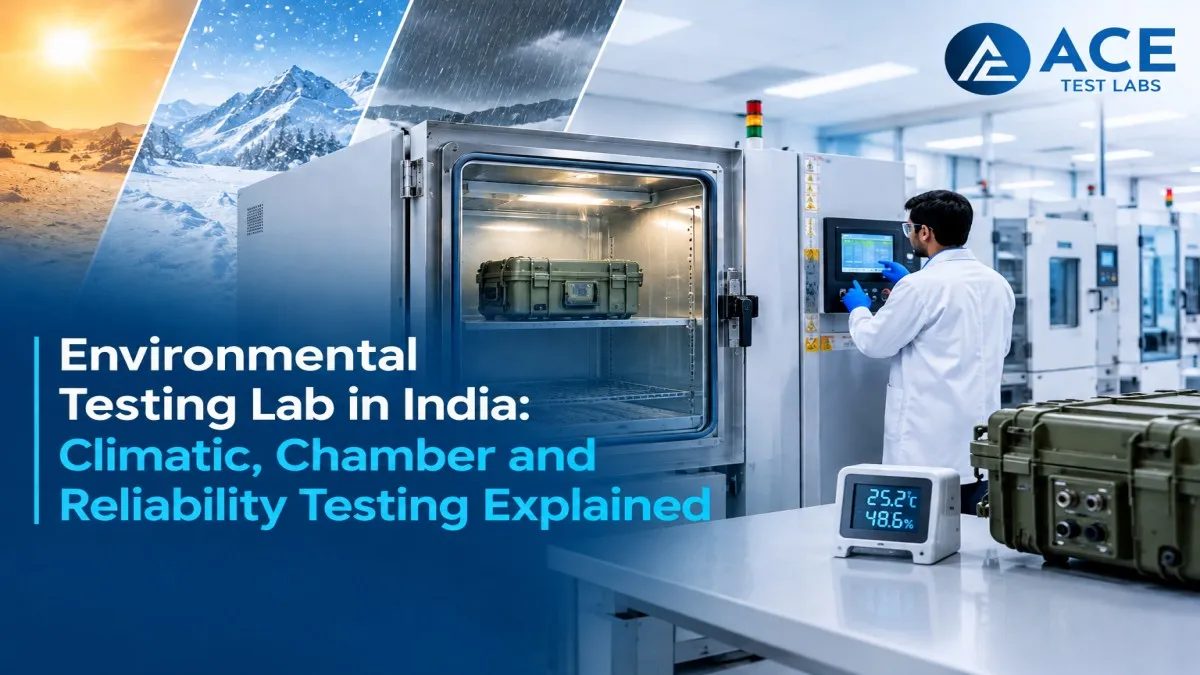
A product can pass every functional check on the bench and still fail within months of reaching the field. It powers on, meets spec, looks solid, until it sits in a hot vehicle cabin, a humid coastal warehouse, or a transport container that swings between temperature extremes overnight. That's the gap an Environmental Testing Lab in India is built to close: finding out how a product behaves under real environmental stress before that stress finds it in the field.
Why Environmental Testing Decides Whether a Product Survives in the Field
Products in actual use face conditions a functional test bench never replicates, high and low temperatures, humidity, condensation, rapid temperature swings, vibration during transport, and handling stress. An electronics assembly that works fine in a 22°C lab can behave very differently at 55°C with 90% humidity. A battery pack that performs normally at room temperature can lose capacity or safety margin in cold storage.
Environmental testing isn't about making a product pass. It's a diagnostic process that surfaces design weaknesses, material limitations, component problems, and sealing issues before they become field failures. This is exactly where dedicated environmental testing services come in: for electronics, that might mean condensation reaching a circuit board. For automotive components, it might mean a connector that loosens under vibration. For defence and appliance products, the stresses differ, but the underlying question is the same: does the design hold up outside the lab’s control conditions?
What Environmental Chamber Testing Covers?
Environmental chambers reproduce specific conditions in a controlled, repeatable way, so a product's response can be measured against defined criteria rather than guessed at.
● Damp Heat, Dry Heat and Cold Testing
Temperature and humidity exposure checks how a product holds up under sustained heat, cold, or moisture. These conditions can affect electronics, insulation, batteries, displays, connectors, seals, and mechanical assemblies differently, a display might fog, a seal might harden and crack, a battery might degrade faster than expected. Not every product needs every one of these tests; which conditions apply depends on where and how the product will actually be used.
● Thermal Shock Testing
Thermal shock testing moves a product rapidly between hot and cold extremes, which can expose weaknesses that gradual temperature change doesn't reveal. Rapid expansion and contraction can stress solder joints, seals, connectors, and material interfaces in ways a slow temperature ramp never triggers.
Climatic and Simulation Testing for Real Operating Conditions
There's a difference between exposing a product to a single environmental condition and simulating the combination of conditions it will actually encounter in use. Environmental Simulation Testing reproduces expected operating environments in a controlled chamber. For products used in electronics and IT services and the test profile itself should be built around the product's application, intended environment, applicable standard, customer requirement, and any regulatory need, not applied as a generic, one size fits all sequence.
● Vibration and Combined Environment Testing
Vibration testing matters particularly for products used in vehicles, defence systems, industrial machinery, and transportation, where mechanical stress is a constant rather than an exception. Where the applicable requirement calls for it, combined environmental testing exposes a product to more than one stress at once, heat and vibration together, for instance, since that combination can behave differently than either stress tested in isolation.
Environmental Testing Standards in India
The IS/IEC 60068 series is the major family of environmental testing methods referred in India. Different parts of the series deal with different stresses and test procedures. Another framework, MIL-STD-810, is more widely quoted and generally used for defence and ruggedized equipment. Neither standard applies universally, the right standard and test method will depend on the product, its application, the customer requirement and the relevant regulatory context so these needs confirming for your specific product rather than assumed by category.
What Manufacturers Should Be Looking for in Testing
Before you ship any samples over, a few things need to be nailed down first. What's the right standard and test method for your product? What environmental profile does it actually need to go through? How many samples, and in what configuration? What operating conditions apply, how long will testing take, what's the pass/fail criteria, and what documentation will you get at the end? It's also worth asking whether the lab is even accredited or recognised for that specific test, what kind of turnaround they're realistically working with, and whether they'll talk things through with you before testing starts. Honestly, most delays and retests don't come from the testing itself and they come from a sample that wasn't configured properly or a requirement nobody bothered to clarify upfront. And once that happens, you can end up with a report that's technically complete but useless for what you actually needed it for.
Sample and Turnaround Requirements
There's no fixed answer for how long environmental testing takes - it depends on too many moving parts. How many cycles are involved, what temperature and humidity levels you're testing at, how the thermal transitions are structured, how long the vibration testing runs, how many samples you're sending, and whether several tests are being run together as one sequence. Because of all that, it's not really something you can assume going in. The smarter move is to talk to the lab directly, walk through the exact test sequence with them, and get a realistic timeline before anything gets submitted - rather than banking on some "standard" duration that may not apply to your product at all.
Why Choose ACE Test Labs for Environmental Testing
Picking the right environmental testing lab in India isn't just about a certificate on the wall - it comes down to real technical capability, accreditation scope, and whether the lab's infrastructure can actually handle your product's testing needs. At ACE Test Labs, we run environmental, climatic, and reliability testing built around standards that hold up to scrutiny across Indian industry. Our lab carries as an NABL accreditation lab, we work within the framework of ISO/IEC 17025:2017.
What this means for you is straightforward: reports that regulators and export authorities actually accept, without added back-and-forth. Our environmental test chambers are built for precision work, covering dry heat, damp heat, cold exposure, thermal shock, and vibration testing. Every test is run against recognised standards, including the IS/IEC 60068 series, applicable IS standards, and MIL-STD-810 frameworks where relevant to the product.
Frequently Asked Questions
What is environmental testing for products?
Environmental chamber testing puts a product through its paces inside sealed chambers built to mimic real climate conditions - blistering humidity, freezing temperatures, or bone-dry heat, depending on what the product needs to survive. Engineers run it through precise temperature and humidity cycles and watch closely for what changes: how performance shifts, where materials start to degrade, and which components are likely to fail first. Because the conditions are controlled, the whole process can be repeated reliably, giving manufacturers results they can actually trust and compare.
What is testing in an environmental chamber?
Environmental chamber testing is a controlled laboratory process that replicates specific climate conditions such as high humidity, freezing cold or dry heat in sealed test chambers. Engineers can take a product, put it in a chamber, and run exact temperature and humidity cycles to see how performance changes, how materials degrade, and where a component may fail in a repeatable environment.
What is the distinction between climatic testing and environmental testing?
Environmental testing is a general term which covers all the physical stresses that a product may be subjected to. These include mechanical forces such as vibration, shock and pressure. Climatic testing is a specific form of environmental testing that only addresses atmospheric factors including temperature extremes, thermal shock, damp heat, solar radiation, and relative humidity exposure.
Which products require environmental testing?
Products that are exposed to different temperatures, outdoor conditions or transport stresses need environmental testing. Common categories include automotive parts, industrial machinery, aerospace and defence equipment, outdoor lighting, consumer electronics, IT hardware and lithium-ion batteries. Testing also guaranties that the product meets industry safety standards and prevents costly field failures or product recalls.

























Sign in to leave a comment.