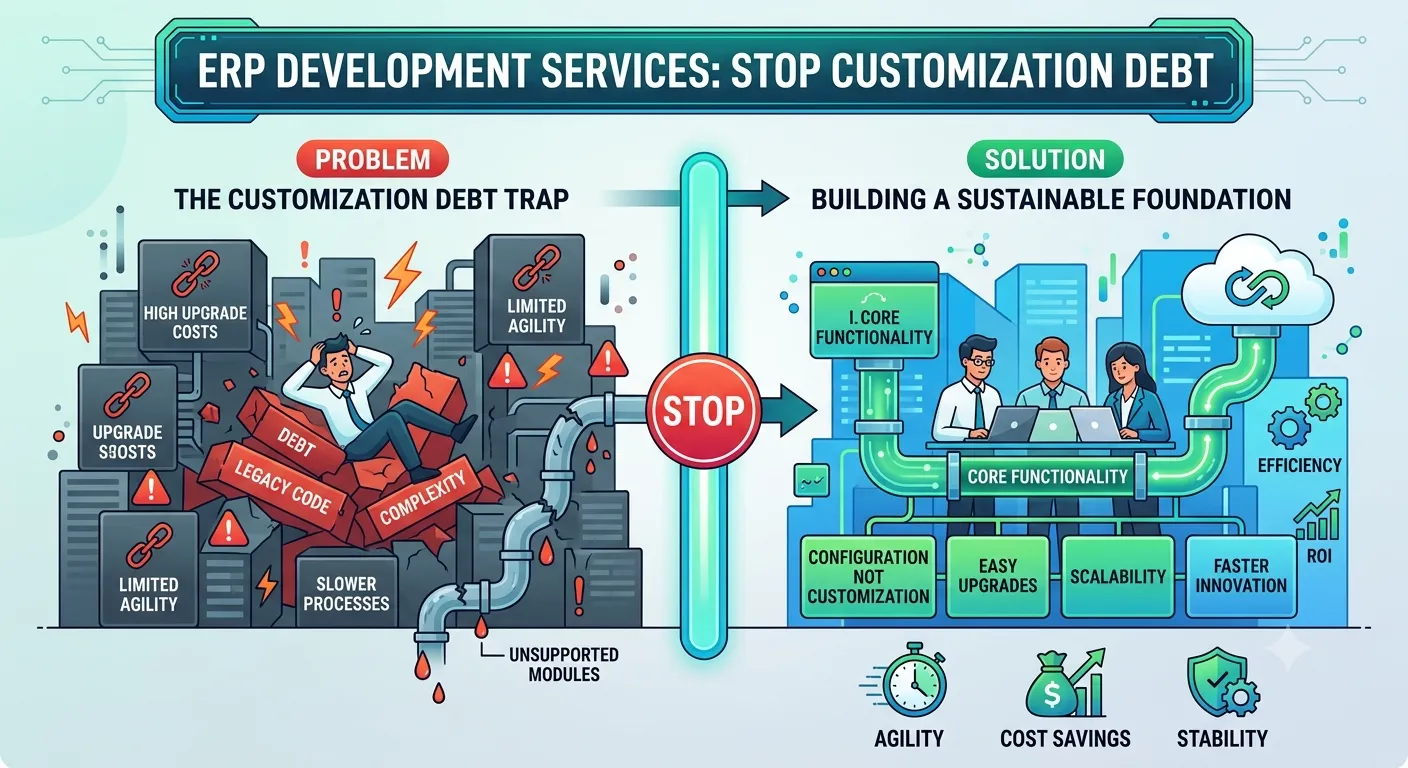

The overlooked ERP problem is not whether customization is expensive, but whether each customization creates another dependency that future teams must maintain.
An ERP can look successful at launch and become expensive two years later.
A finance rule gets customized. Then a reporting requirement needs another modification. A warehouse workflow requires a third extension. Soon, every upgrade requires regression testing across years of business-specific code.
This is where ERP Development Services need a different discipline. The goal is not to customize everything users request. The goal is to identify where customization creates business value and where it creates avoidable technical debt.
For CTOs and operations leaders, that distinction matters because enterprise systems rarely stay static. Acquisitions add processes. Regulations change. New sales channels appear. Cloud platforms evolve. Your ERP must absorb those changes without turning every improvement into a development project.
Our approach starts with that principle: preserve the standard ERP core where possible and customize the areas where business differentiation actually demands it. See how ERP Development Services support custom enterprise workflows.
Why ERP Customization Debt Keeps Growing
The problem starts when every operational exception becomes a software requirement.
A department requests a special approval path. Another wants a custom report. A third asks for a separate inventory rule. Individually, each request seems reasonable. Collectively, they can create an ERP that only a few developers understand.
Panorama Consulting's 2026 research notes that ERP software typically handles about 60% to 70% of processes well, leaving the remainder for configuration or selective customization. That is a useful distinction because not every process gap deserves custom code.
The second problem is timing. Teams often evaluate customization after selecting the ERP platform. By then, stakeholders are already attached to workflows that may not fit the chosen architecture.
PMI-hosted ERP research found that 54% of implementations took longer than expected, while 56% exceeded budget. The research also identified inadequate planning and failure to account for business-process changes among recurring causes.
Customization becomes expensive when its dependencies remain invisible.
A Better ERP Development Services Decision Framework
Those numbers point to a practical question: how do you decide which ERP changes deserve custom development?
Separate configuration from custom code
The first filter should be technical, not political.
Configuration uses capabilities already provided by the ERP. Custom development changes code, data models, workflows, or system behavior beyond those capabilities.
We recommend exhausting configuration options before introducing custom code. This keeps future upgrades simpler and makes the system easier for new developers to understand.
Score customization by business value
The second filter is financial.
Ask four questions before approving a custom requirement:
- Does this process create competitive differentiation?
- Does it affect revenue, compliance, risk, or operational capacity?
- How frequently will the process change?
- What will this customization cost during future upgrades?
IBM's 2026 research found that 69% of executives said technical debt can add 15% to 22% to delivery timelines. That makes technical debt a business planning issue, not simply a developer concern.
A custom feature that saves hundreds of employee hours may justify its maintenance cost. A custom button that only changes a screen layout probably does not.
Build an upgrade budget into the architecture
The third filter is longevity.
Every custom module should have documentation, ownership, test coverage, dependency mapping, and an upgrade strategy.
This matters particularly for open-source ERP platforms. A business may own its custom code, but it still depends on framework changes, database upgrades, third-party integrations, and evolving security requirements.
The objective is not zero customization. It is controlled customization.
What We Learned from a Real ERP Implementation
That principle became important in our Alpex Solar implementation, where we at Oodles had to address manufacturing requirements that could not simply be handled through generic ERP workflows.
Alpex needed production planning, inventory management, quality control, and traceability for photovoltaic module manufacturing. We customized Odoo around those requirements rather than creating unrelated standalone workflows.
We also implemented barcode-based tracking to record material and IV curve data for individual modules. Quality controls were built into the ERP workflow, with the documented outcome of delivering 100% qualified modules.
The lesson was straightforward: customization made sense where the manufacturing process required specialized controls. The customization supported an operational requirement instead of compensating for poor process design.
That distinction is what separates useful custom ERP software development from customization debt.
Key Takeaways
- Customization should solve a measurable business problem, not satisfy every user preference.
- Configuration should come before custom code whenever the ERP can support the process.
- Every custom module should have an owner, documentation, tests, and an upgrade plan.
- Technical debt should appear in ERP investment calculations before development begins.
- Industry-specific workflows often justify customization when they affect revenue, compliance, quality, or operational capacity.
- The best ERP architecture balances standard functionality with carefully governed business-specific extensions.
If you are evaluating ERP Development Services and want to determine where customization creates value versus long-term technical debt, ERP Development Services can start with a review of your current workflows and ERP roadmap.
FAQ
What are ERP Development Services?
ERP Development Services cover the design, customization, development, integration, migration, testing, and maintenance of enterprise resource planning systems. They can include custom modules, workflow automation, dashboards, APIs, data migration, and industry-specific business logic.
How much customization should an ERP have?
There is no universal percentage because the right level depends on the business. A better approach is to keep standard functionality wherever it meets requirements and customize only processes that create measurable operational, regulatory, or competitive value.
When does ERP customization become technical debt?
ERP customization becomes technical debt when custom code creates dependencies that make upgrades, testing, maintenance, or future development increasingly difficult. Poor documentation, duplicated logic, tightly coupled modules, and unsupported modifications are common warning signs.
Can ERP Development Services reduce technical debt?
Yes. ERP Development Services can reduce technical debt through modular architecture, configuration-first implementation, automated testing, documented integrations, dependency management, and planned refactoring. The goal is to make future changes predictable rather than repeatedly rebuilding fragile workflows.
Is custom ERP software development better than standard ERP?
Not automatically. Custom ERP software development is valuable when standard platforms cannot support critical business requirements. For common processes, standard ERP functionality usually reduces maintenance and upgrade complexity. The strongest approach often combines standard modules with selective customization.






















Sign in to leave a comment.