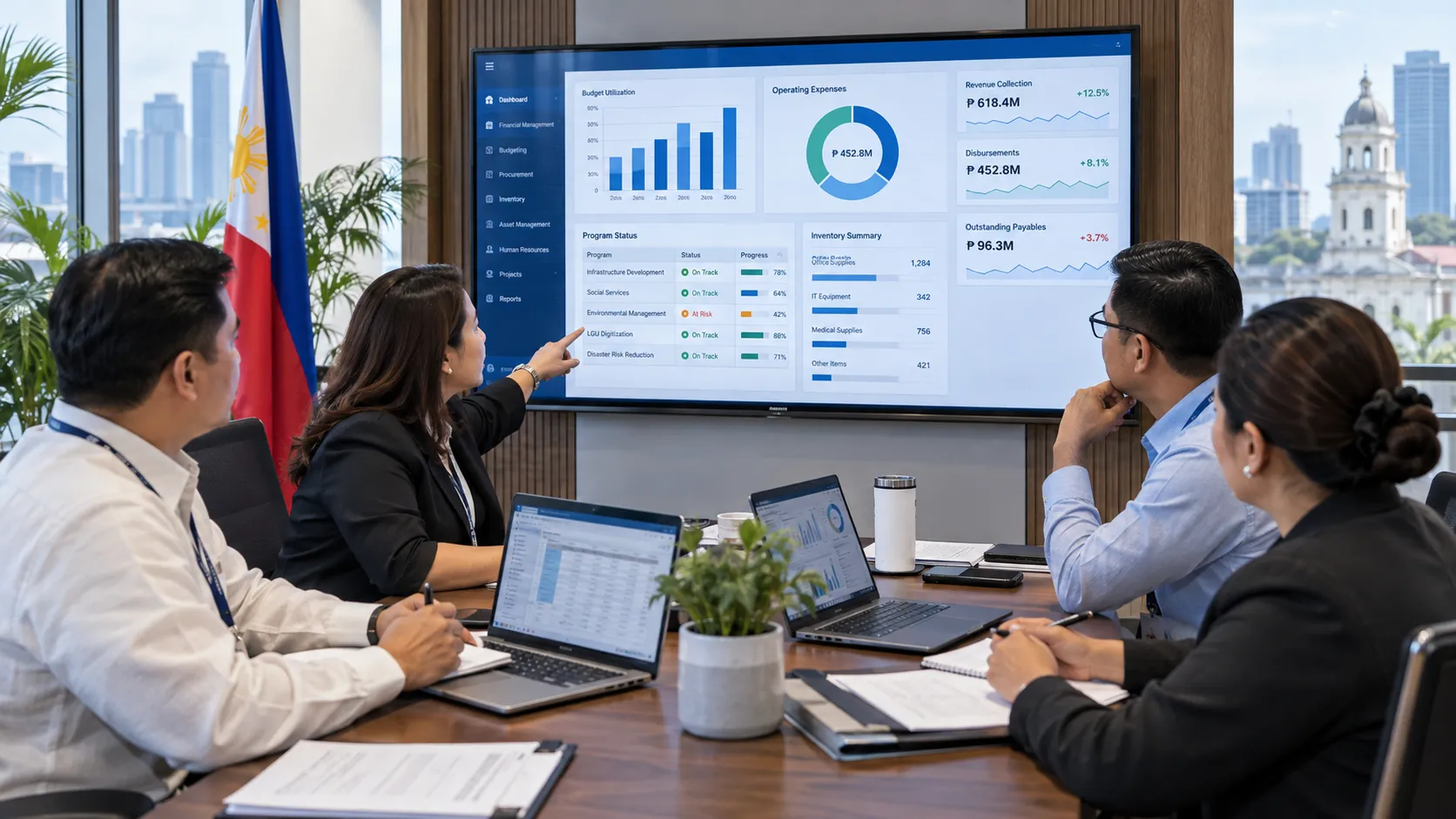

LGU leaders should prioritize ERP reports for digital transformation that address specific management decisions: financial position and collections, budget and obligation status, service-processing delays, transaction status, procurement activity, inventory utilization, and required compliance outputs. A useful report should show the reporting period, relevant source records, current condition, and the comparison needed for action. Not every LGU needs the same dashboard, and not every report type is available in every ERP configuration. GoLGU publicly documents several financial, transaction-monitoring, inventory-utilization, compliance, and real-time reporting capabilities, while other reporting requirements should be confirmed during configuration or a demo.
The GoLGU Digital Government Transformation page frames digitalization around improving government operations, services, employee experience, and resource use. The GoLGU ERP System also publicly describes centralized data, traceability, dashboards, reports, and real-time reporting. Those capabilities are useful only when leaders connect each report to a decision that someone is responsible for making.
Why should LGUs start with the decision instead of the dashboard?
A dashboard can display many numbers without helping a department decide what to do next. Before selecting a report, leaders should identify the management question. Is the LGU trying to understand cash position, spending pressure, service delays, procurement status, inventory use, or a required government submission? This keeps LGU ERP reporting focused.
Governance matters as well. Leaders need clear ownership for the information being reviewed and for the action that follows. The related guide on setting governance rules before digital transformation starts explains why decision rights and accountability should be established before digital workflows expand.
What should management decision reports show?
Management decision reports should show enough context to explain the current condition without forcing leaders to reconstruct the transaction from separate files. Depending on the report, useful elements may include the reporting period, office or fund, transaction status, amount, source record, responsible unit, comparison period, and unresolved exception.
Which financial reports can support executive and department decisions?
Financial reports are among the strongest verified GoLGU examples. Current GoLGU module descriptions publicly identify Treasury and Cashier reports such as the Statement of Revenues and Expenditures, Statement of Receipts and Sales, and quarterly reports. The Accounting module also lists balance sheets, income statements, and cash flow statements.
These reports can help leaders review financial position, receipts and expenditures, cash movement, and changes across reporting periods. They provide structured information; authorized officials still interpret the figures under applicable rules.
Why is SRE reporting relevant to digital transformation decisions?
The Bureau of Local Government Finance continues to publish local fiscal data, including current quarterly FY 2026 Statement of Receipts and Expenditures data by LGU. That makes SRE reporting more than a generic software example. It remains part of the current Philippine local-finance reporting environment.
GoLGU publicly lists SRE report generation under Treasury and Cashier. One SRE output, however, should not be treated as an automatic judgment on an LGU's financial condition or a particular spending decision.
What should real-time financial reporting help leaders review?
Real-time financial reporting is useful when leaders need timely visibility before the end of a reporting cycle. GoLGU currently describes real-time financial visibility in Treasury and Cashier, along with cash-flow monitoring and forecasting-related capabilities.
"Real time" should not be interpreted as a substitute for reconciliation, validation, or official financial reporting procedures. Timely visibility and formally validated reports serve related but different purposes.
Which budget and obligation reports support resource-allocation decisions?
Budget and obligation information can help leaders see where resources are already committed and where planned allocations may need review. GoLGU's current Finance module description includes obligation requests, budget allocation, spending control, reporting, and data-driven resource-allocation support.
Leaders may need to distinguish allocation, obligation, spending, and the office or program connected to each amount. The exact report layout should match the configured finance process and approved controls.
How can procurement status reports support operational decisions?
Procurement delays can affect service delivery even when the budget itself is available. GoLGU publicly describes real-time tracking of procurement activities from the initial request through issuance. Its ERP service page also gives an example in which procurement status helps a department decide whether another request may be needed to avoid insufficient stock.
A procurement-oriented report may support questions about pending requests, current stage, items not yet issued, or the responsible office. It should not replace procurement rules or required procurement documents.
What service processing reports can LGUs use?
Service processing reports can help an LGU identify requests that remain pending longer than expected, but this category requires a careful product boundary. Republic Act No. 11032 requires government offices, including LGUs, to act on applications and requests within the processing times stated in the Citizen's Charter, subject to the law's applicable rules and exceptions.
An LGU may therefore find it useful to review request dates, status, responsible office, and elapsed processing time against the applicable service standard. However, GoLGU's public materials do not establish one universal named "service turnaround report" across all modules. Treat this as a reporting requirement to confirm during configuration, not a feature assumed to exist in every implementation.
How can transaction-status reports reveal workflow bottlenecks?
Some decisions require status visibility rather than a financial total. GoLGU's current module descriptions include examples such as real-time Planning and Development transaction monitoring, procurement activity tracking, application-status tracking for Training Center records, and real-time accounts receivable tracking under Economic and Investment.
If an LGU wants a broader consolidated view across modules, confirm the exact report, fields, permissions, and aggregation logic rather than assuming them from individual status functions.
Which inventory reports support operational planning?
Inventory-utilization reports can help managers review how supplies or medications are being used and whether patterns require operational attention. GoLGU explicitly documents inventory-utilization reporting under both Health and Safety and Veterinary, together with inventory-management functions.
Historical usage can inform planning, but reorder decisions may also depend on lead time, program activity, expiration, budget, and locally approved thresholds. GoLGU should not be described as automatically predicting every future stock requirement.
What role do compliance reports play?
Compliance reports answer a different management question: whether required information can be produced for an applicable reporting obligation. GoLGU currently states that its Business Permit Licensing module generates compliance reports required by national offices such as DTI and BLGF.
This article does not prescribe the evidence package behind an official report or who reviews changes before submission. The management question is narrower: which compliance outputs require attention, and can the responsible office produce them when needed?
How should leaders use reports across departments?
Cross-department reporting should connect information only where the business process justifies it. A procurement request may relate to a budget obligation, while a collection may affect Treasury and Accounting records.
GoLGU publicly describes an integrated module structure connected to a centralized core system. That supports a connected-data model, but it does not mean every department should see every record. Report access and data visibility should still follow configured roles, responsibilities, and applicable information-handling rules.
What does the 2026 E-Governance framework add?
The 2026 Implementing Rules and Regulations of the E-Governance Act apply to covered government entities and emphasize evidence-based digital governance, interoperability, data use, and performance information. The underlying law also calls for informed, data-driven decision-making, while the government's integrated financial-management direction focuses on timely information for financial control and decisions.
For LGUs, the practical principle is that digitalization should improve the use of reliable information, not merely convert paper forms into electronic copies.
How should leaders choose ERP reports for digital transformation?
Start with the decision and work backward. Identify the office responsible for the decision, the source records needed, the reporting period, the comparison that matters, and the action that may follow. Then confirm that the configured ERP can produce the required information with the right access controls and data quality.
Useful ERP reports for digital transformation may include verified GoLGU financial statements, SRE and quarterly reporting, budget and obligation information, procurement-status data, module-specific transaction monitoring, inventory-utilization reports, and compliance reports. Treat service-processing or broader executive reporting as requirements to verify when the exact configuration is not publicly documented.
What should LGUs verify before relying on a report?
Before using a report for management action, confirm that source records are current, the reporting period is clear, exceptions are visible, and access to the underlying information is appropriately controlled.
A polished dashboard does not correct incomplete source records. If the report does not reconcile with the operational records that should feed it, leaders should investigate the data and workflow before using the result as the basis for a major decision.
How does GoLGU fit this reporting approach?
GoLGU's public product information supports a reporting approach built around centralized records, traceability, real-time reporting, financial outputs, transaction tracking, inventory utilization, procurement visibility, and selected compliance reports. Current module descriptions also identify specific outputs such as SRE, SRS, quarterly reports, balance sheets, income statements, and cash flow statements.
Public materials do not establish every possible management report, executive scorecard, department productivity ranking, service-turnaround dashboard, or predictive recommendation. LGUs should confirm those requirements during scoping and configuration rather than assume that a broadly described ERP capability guarantees a specific report.
Conclusion
ERP reports for digital transformation should help LGU leaders answer defined management questions rather than fill dashboards with disconnected numbers. Financial position, receipts and expenditures, budget and obligations, procurement status, service processing, transaction status, inventory utilization, and compliance outputs can each support different decisions when their source records and ownership are clear.
GoLGU publicly documents several of these capabilities, including real-time reporting, SRE and quarterly reports, financial statements, procurement tracking, inventory-utilization reports, and selected compliance reporting. If a desired report isn't specifically documented, the safer approach is to treat it as a requirement to confirm. If your LGU wants to review which reports fit its actual workflows and decision needs, request a GoLGU demo and bring representative reports or management questions for discussion.
Frequently Asked Questions
Which ERP reports are most useful for LGU digital transformation?
The most useful reports depend on the decision. Common categories include financial position, receipts and expenditures, budget and obligations, procurement status, transaction status, service processing, inventory utilization, and required compliance outputs.
Is an ERP dashboard the same as an ERP report?
No. A dashboard is a visual presentation that may combine multiple reports or indicators. A report is a structured output prepared for a specific review, transaction set, period, or decision.
Does GoLGU generate SRE and quarterly financial reports?
Yes. GoLGU's current public Treasury and Cashier description explicitly lists SRE, SRS, and quarterly report generation, together with real-time financial visibility.
Can GoLGU automatically identify every delayed LGU service?
Public GoLGU materials do not establish one universal service-delay report across every module. LGUs should define the required service-processing fields and confirm whether the configured implementation can produce the desired report.
Should LGUs rely on real-time reports without validation?
No. Timely visibility is useful, but leaders should still confirm source-record completeness, reporting periods, exceptions, reconciliation requirements, and the applicable accounting or operational review before relying on a report.
Do all LGUs need the same set of ERP reports?
No. Report requirements depend on the LGU's services, offices, financial processes, management responsibilities, reporting obligations, and configured ERP scope. The report set should follow actual decisions and authoritative requirements.
References
- Lawphil, 2026 Implementing Rules and Regulations of Republic Act No. 12254, E-Governance Act
- Lawphil, Republic Act No. 11032, Ease of Doing Business and Efficient Government Service Delivery Act of 2018
- Bureau of Local Government Finance, Current LGU Fiscal Data and SRE Reporting
- GoLGU, Current Module and Reporting Capabilities
Disclaimer
This article provides general operational information for Philippine LGUs. It is not accounting, audit, legal, budgeting, procurement, regulatory, data-governance, or technical implementation advice. Each LGU should follow current laws, Commission on Audit requirements, Department of Budget and Management rules, Bureau of Local Government Finance requirements, approved local policies, official reporting instructions, and its configured system controls before using ERP reports for management or official decisions.


















Sign in to leave a comment.