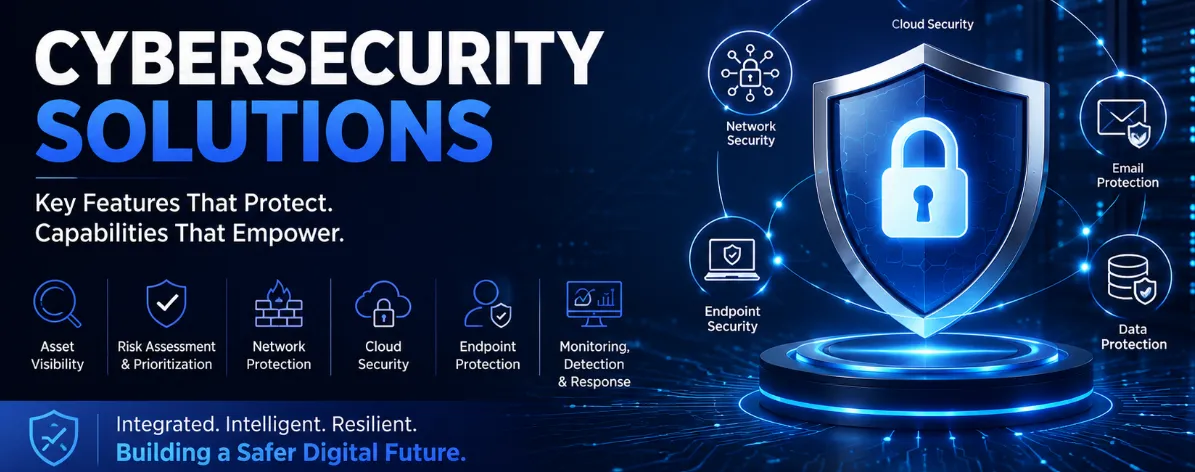

Cybersecurity has moved far beyond firewalls and antivirus tools. Today’s organizations operate across branch offices, cloud platforms, remote endpoints, mobile devices, SaaS applications, third-party integrations, and increasingly complex supply chains. Every connection creates opportunity, but it also expands the attack surface.
Effective cybersecurity solutions are not defined by one product or a single control. They are built through a coordinated combination of technology, process, monitoring, governance, and response capability. For business leaders, IT heads, CISOs, and operations teams, the challenge is not simply “buying security.” It is choosing the right capabilities that reduce risk, support compliance, and keep the business moving.
This guide explains the core features that make cybersecurity solutions effective, how they work together, and what organizations should look for when evaluating vendors, platforms, or managed security partners.
Why Cybersecurity Solutions Need to Be Integrated
Many organizations still manage security in silos: one tool for endpoint protection, another for email filtering, another for firewall management, another for cloud access, and yet another for backups. While each tool may serve a purpose, fragmented security creates blind spots.
Attackers rarely operate in a straight line. A phishing email may lead to credential theft. Stolen credentials may provide access to a cloud application. From there, an attacker may move laterally into the network, escalate privileges, exfiltrate data, or deploy ransomware.
An effective cybersecurity strategy connects visibility, prevention, detection, and response across the entire environment. This is where experienced IT and cybersecurity partners, such as Trace Network & Engineering Pvt Ltd, can add value by helping organizations align cloud, networking, managed services, and security operations into one practical operating model rather than a disconnected set of tools.
Strong cybersecurity solutions should help answer five critical questions:
- What assets, users, devices, and applications are we protecting?
- Where are our highest-risk exposures?
- How quickly can we detect suspicious behavior?
- How effectively can we contain and respond to incidents?
- Can we prove security and compliance to customers, auditors, and stakeholders?
The best solutions do not just block threats. They improve confidence, resilience, and decision-making.
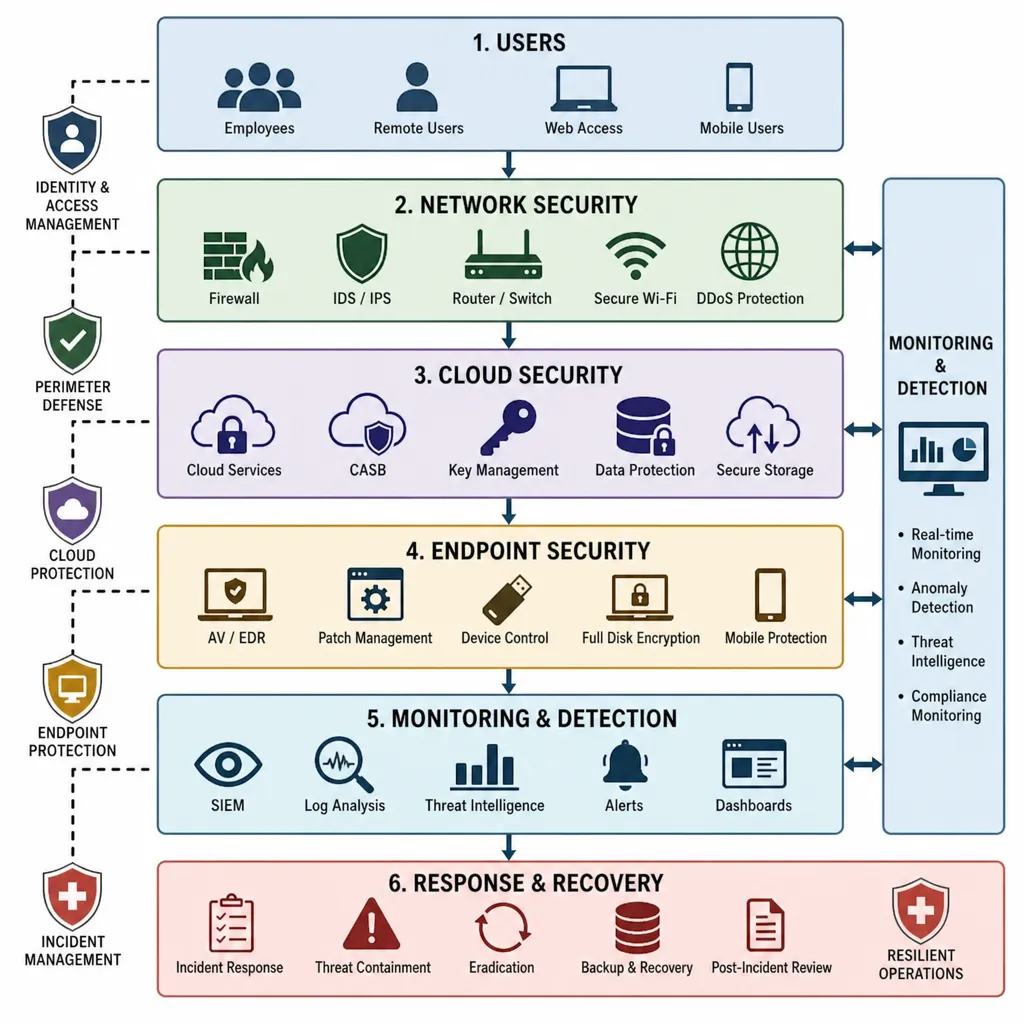
1. Comprehensive Asset Visibility
You cannot protect what you cannot see. Asset visibility is one of the most important foundations of cybersecurity.
A complete cybersecurity solution should identify and monitor:
- Servers, laptops, desktops, and mobile devices
- Network devices such as switches, routers, wireless access points, and firewalls
- Cloud workloads, containers, and virtual machines
- SaaS applications and user accounts
- Databases and storage environments
- IoT, OT, and unmanaged devices
- Third-party integrations and external-facing assets
Visibility should also include ownership, business criticality, software versions, configuration status, and known vulnerabilities. Without this context, security teams may waste time fixing low-priority issues while high-risk exposures remain open.
For example, an unpatched internal test server may matter less than an internet-facing VPN appliance with known exploit activity. Asset visibility enables prioritization.
Effective platforms often include automated discovery, continuous inventory updates, tagging, and integration with configuration management databases. In managed environments, this visibility becomes even more valuable because it allows internal teams and external providers to work from the same source of truth.
2. Cyber Risk Assessment and Prioritization
A cyber risk assessment helps organizations understand where they are most exposed and which actions will reduce risk most effectively. It is not a one-time checklist. It should be a recurring process that reflects changes in business operations, technology, compliance needs, and threat behavior.
A strong cyber risk assessment typically evaluates:
- Critical assets and business processes
- Existing security controls
- Network architecture and access pathways
- Vulnerability exposure
- Identity and privilege risks
- Data storage and handling practices
- Cloud configuration posture
- Third-party and vendor access
- Incident response readiness
- Regulatory or industry compliance gaps
The outcome should not be a long report that sits unused. It should produce an actionable roadmap: what to fix first, what to monitor more closely, what policies need improvement, and where investment is justified.
Prioritization is essential because most organizations cannot fix every issue immediately. Risk-based programs focus on the vulnerabilities and misconfigurations most likely to be exploited and most likely to affect business continuity.
For mid-sized and enterprise organizations, independent testing through VAPT, or Vulnerability Assessment and Penetration Testing, can strengthen this process. It validates whether weaknesses are theoretical or actually exploitable. Trace Network & Engineering Pvt Ltd supports VAPT along with broader security services, helping businesses translate findings into practical remediation steps across networks, cloud infrastructure, and endpoints.
3. Strong Network Security Architecture
Network security remains central to cybersecurity, even as cloud and remote work reshape infrastructure. Modern network security solutions must protect traffic flowing between users, applications, branches, data centers, and cloud environments.
Effective network security should include:
- Next-generation firewall protection
- Secure routing and switching architecture
- Network segmentation
- Intrusion prevention and detection
- Secure wireless access
- VPN or zero trust access controls
- DNS security
- Web filtering
- Traffic monitoring and anomaly detection
Segmentation is especially important. If every system can freely communicate with every other system, one compromised device can become a launchpad for wider damage. Segmentation limits lateral movement by separating sensitive systems, user groups, servers, and operational environments.
For example, finance systems should not be on the same unrestricted network zone as guest Wi-Fi. Backup infrastructure should not be easily reachable from standard user devices. Administrative access should be isolated and monitored.
Modern network security solutions should also support encrypted traffic inspection where appropriate, application-level controls, user-based policies, and integration with identity systems. Security should follow the user and workload, not just the IP address.
Partnerships with established technology providers can also matter. Organizations often benefit when cybersecurity partners can design, deploy, and support enterprise-grade networking and security ecosystems involving vendors such as HPE Aruba, Sophos, Dell, Palo Alto, and similar platforms.
4. Identity and Access Management
Many cyberattacks begin with compromised credentials. Passwords are stolen through phishing, malware, data leaks, brute-force attacks, or social engineering. Once an attacker has valid login details, traditional perimeter security may not be enough.
Identity and access management, often called IAM, ensures that only the right users can access the right resources under the right conditions.
Key IAM capabilities include:
- Multi-factor authentication
- Single sign-on
- Role-based access control
- Privileged access management
- Conditional access policies
- User lifecycle management
- Password hygiene and policy enforcement
- Access reviews and certification
- Detection of impossible travel or suspicious login behavior
Privileged accounts require special attention. Administrator credentials, service accounts, cloud root accounts, and database admin accounts can cause significant damage if misused. Effective cybersecurity solutions should reduce standing privileges, monitor administrative activity, and require stronger authentication for sensitive actions.
Identity security is also a key part of zero trust. Instead of assuming users are safe once they are inside the network, zero trust continuously validates identity, device posture, location, behavior, and access context.
5. Endpoint Protection and Detection
Endpoints remain one of the most common entry points for cyber threats. Laptops, desktops, mobile devices, and servers are exposed to phishing links, malicious attachments, infected websites, unauthorized software, and credential-stealing malware.
Traditional antivirus tools are no longer enough on their own. Modern endpoint security should include endpoint detection and response, behavioral analysis, exploit prevention, ransomware rollback where available, device control, and automated isolation.
A strong endpoint security solution should help teams:
- Detect malware and suspicious behavior
- Block ransomware activity
- Identify unauthorized applications
- Monitor script execution
- Track lateral movement attempts
- Isolate compromised devices
- Collect forensic evidence
- Support automated remediation
Endpoint security should also integrate with SIEM, SOC, and threat intelligence platforms. When endpoint alerts are correlated with firewall logs, identity events, email alerts, and cloud activity, security teams can identify attack patterns faster.
For organizations with distributed teams, endpoint management should include patching, configuration enforcement, remote support, disk encryption, and device compliance checks. Security cannot depend on every user being physically present in the office.
6. Cloud Security and Configuration Management
Cloud adoption has changed the security model. Cloud providers secure the underlying infrastructure, but customers remain responsible for securing their configurations, identities, workloads, data, applications, and access policies.
Common cloud risks include:
- Publicly exposed storage buckets
- Overly permissive identity roles
- Unrestricted administrative access
- Misconfigured security groups
- Lack of logging
- Insecure APIs
- Unpatched workloads
- Weak secrets management
- Poor visibility across multi-cloud environments
Effective cloud cybersecurity solutions should provide continuous posture management, workload protection, identity risk detection, encryption controls, compliance monitoring, and automated alerts for misconfigurations.
Cloud security should begin during architecture planning, not after deployment. Security-by-design includes secure network zones, private connectivity, least-privilege access, centralized logging, backup planning, and strong governance over who can create or modify cloud resources.
A practical differentiator is the ability to connect cloud security with networking and managed operations. For instance, a business expanding across branches and cloud workloads may need secure connectivity, firewall policy design, endpoint protection, cloud access controls, and ongoing monitoring. Trace Network & Engineering Pvt Ltd brings these areas together through cloud, networking, SOC, SIEM, and managed services capability, which can reduce operational friction for teams that do not want to manage each layer separately.

7. Data Protection Services and Encryption
Data is often the ultimate target of cyberattacks. Whether attackers want to steal customer records, intellectual property, financial information, credentials, or operational data, organizations need strong controls around where data lives, how it moves, and who can access it.
Effective data protection services should include:
- Data classification
- Encryption at rest and in transit
- Data loss prevention
- Access controls
- Backup and recovery
- Database activity monitoring
- Secure file sharing
- Retention and deletion policies
- Insider threat monitoring
- Compliance reporting
Data classification is a useful starting point. Not every file requires the same level of protection. Public marketing content, internal process documents, customer financial records, and regulated personal data all carry different levels of risk. Classification helps apply controls intelligently.
Encryption is essential, but it must be implemented correctly. Encryption keys should be protected, rotated, and access-controlled. Backups should also be encrypted and protected from deletion or tampering.
Data loss prevention can help detect or block sensitive information from leaving the organization through email, cloud storage, removable media, web uploads, or unauthorized applications. However, DLP programs work best when policies are carefully tuned. Overly aggressive rules create friction and alert fatigue, while weak rules miss critical events.
Backup strategy is also part of data protection. Ransomware has made backup resilience a board-level issue. Organizations should maintain tested backups, ideally with offline, immutable, or logically isolated copies. Recovery testing is just as important as backup creation.
8. Security Monitoring with SIEM and SOC
Prevention matters, but no organization can assume it will block every threat. Security monitoring provides the visibility needed to detect suspicious activity quickly and respond before an incident becomes a business crisis.
A SIEM, or Security Information and Event Management platform, collects and correlates logs from systems such as firewalls, endpoints, servers, cloud platforms, identity providers, databases, and applications. A SOC, or Security Operations Center, uses this data to monitor alerts, investigate threats, and coordinate response.
Effective SIEM and SOC capabilities include:
- Centralized log collection
- Real-time alerting
- Correlation rules
- User and entity behavior analytics
- Threat intelligence enrichment
- Incident triage
- Escalation workflows
- Reporting and compliance dashboards
- Root cause analysis
- Continuous tuning
Monitoring must be actionable. A SIEM that generates thousands of unprioritized alerts can overwhelm teams. The value comes from thoughtful use cases, correlation logic, escalation procedures, and skilled analysts who understand the environment.
For many organizations, 24/7 monitoring is difficult to build internally. Staffing a SOC requires analysts, tools, processes, shift coverage, threat research, and incident response procedures. This is why managed SOC services are increasingly important for businesses that need continuous vigilance without building a full security operations team from scratch.
With 20+ years’ experience, 1000+ clients, ISO 27001 certification, a strong South India presence, and 24/7 support, Trace Network & Engineering Pvt Ltd is positioned as a mature cybersecurity and IT solutions partner for organizations that need both strategic guidance and operational continuity.
9. Vulnerability Management and Patch Governance
Vulnerability management is not just scanning systems and exporting reports. It is an ongoing program that discovers weaknesses, prioritizes risk, assigns ownership, tracks remediation, and verifies closure.
A complete vulnerability management process should include:
- Authenticated scanning
- External attack surface scanning
- Cloud vulnerability checks
- Application security testing
- Network device assessment
- Patch prioritization
- Risk-based remediation timelines
- Exception handling
- Validation and rescanning
- Executive reporting
Patch governance is a major part of this process. Many breaches exploit known vulnerabilities for which patches already exist. The problem is often not awareness but execution: systems are too critical to reboot, ownership is unclear, applications depend on outdated components, or teams fear downtime.
A mature program defines severity-based timelines and balances security urgency with operational risk. Critical internet-facing vulnerabilities may need emergency response, while lower-risk internal findings can follow standard maintenance cycles.
Penetration testing adds another layer by simulating real-world attacker behavior. It helps validate whether vulnerabilities can be chained together to reach sensitive systems or data.
10. Email, Web, and Phishing Protection
Email remains one of the most common delivery channels for malware, credential theft, business email compromise, and social engineering. Effective cybersecurity solutions must protect users before, during, and after email-based attacks.
Email security should include:
- Anti-phishing detection
- Malware and attachment scanning
- URL rewriting and link protection
- Domain authentication checks
- Impersonation protection
- Business email compromise detection
- Sandboxing for suspicious files
- User reporting tools
- Awareness training integration
Web security is equally important. Users may accidentally visit malicious sites, download unwanted software, or submit credentials to fake login pages. DNS filtering, secure web gateways, browser isolation, and endpoint controls can reduce this risk.
Technology alone is not enough. Security awareness training helps employees recognize suspicious behavior, report potential threats, and follow safe practices. Training should be continuous, practical, and role-based rather than a once-a-year formality.
Phishing simulations can help measure risk, but they should be used constructively. The goal is to build a culture of reporting and caution, not to shame users.
11. Incident Response and Recovery Planning
A cybersecurity incident can unfold quickly. Without a plan, teams lose time deciding who should act, what systems to isolate, whether to notify stakeholders, and how to preserve evidence.
Incident response planning defines the process before a crisis occurs.
A strong incident response program should include:
- Defined roles and responsibilities
- Severity levels and escalation paths
- Communication plans
- Legal and compliance involvement
- Technical containment procedures
- Evidence preservation steps
- Backup and recovery processes
- External support contacts
- Post-incident review
- Lessons learned and control improvements
Response plans should be tested through tabletop exercises and technical simulations. These exercises reveal practical gaps, such as outdated contact lists, unclear decision authority, missing logs, or untested recovery systems.
Recovery planning is equally important. The ability to restore operations safely can determine whether an incident causes a temporary disruption or a prolonged outage. Recovery should prioritize critical business processes and verify that restored systems are clean before reconnecting them.
12. Compliance, Governance, and Audit Readiness
Cybersecurity is not only a technical function. It is also a governance responsibility. Customers, regulators, insurers, investors, and business partners increasingly expect organizations to demonstrate security maturity.
Effective cybersecurity solutions should support compliance and governance through:
- Policy management
- Access reviews
- Audit logs
- Risk registers
- Evidence collection
- Compliance mapping
- Data handling controls
- Vendor risk management
- Security metrics and reporting
- Board-level risk communication
Compliance requirements vary by industry and geography, but common expectations include access control, data protection, incident response, vulnerability management, logging, and business continuity.
Good governance connects cybersecurity with business priorities. Instead of presenting technical metrics alone, security leaders should communicate risk in terms of operational impact, financial exposure, customer trust, and regulatory obligations.
Security dashboards should help answer questions such as:
- Are critical vulnerabilities being remediated on time?
- Which business units carry the most cyber risk?
- Are privileged accounts reviewed regularly?
- Are backups tested and recoverable?
- Are security incidents decreasing in frequency or severity?
- Are third-party risks being monitored?
Governance makes cybersecurity measurable and accountable.
13. Scalability and Business Alignment
Cybersecurity solutions should support where the business is going, not only where it is today. A solution that works for one office and fifty users may fail when the organization expands to multiple branches, cloud environments, remote teams, or new compliance obligations.
Scalable security should be:
- Modular enough to grow over time
- Compatible with existing infrastructure
- Manageable with available internal resources
- Integrated across cloud, network, identity, and endpoint layers
- Flexible enough to support mergers, expansion, and new applications
- Supported by clear reporting and operational processes
Business alignment is critical. Security controls that slow productivity excessively may be bypassed. Controls that are too loose may expose the organization to unnecessary risk. The best programs find a practical balance between protection, usability, cost, and operational resilience.
For example, zero trust access can improve security for remote users, but it must be designed around real workflows. Data protection services can reduce leakage, but they must account for how teams collaborate. Network security solutions can segment environments, but they must avoid disrupting legitimate application traffic.
Security works best when it is embedded into business operations rather than added as an afterthought.
14. Automation, Orchestration, and Threat Intelligence
Security teams face too many alerts, assets, users, vulnerabilities, and attack methods to rely only on manual processes. Automation helps reduce repetitive work and improves response speed.
Useful cybersecurity automation may include:
- Automatic endpoint isolation
- Phishing email removal from inboxes
- User account lockout after confirmed compromise
- Ticket creation for vulnerabilities
- Patch deployment workflows
- Alert enrichment with threat intelligence
- Automated evidence collection
- Cloud misconfiguration remediation
- Notification and escalation workflows
Automation should be carefully designed. Poorly tuned automation can disrupt operations, block legitimate users, or create confusion. The most effective approach begins with high-confidence, low-risk actions and expands over time.
Threat intelligence adds context about attacker infrastructure, malware indicators, exploit trends, and emerging tactics. When integrated into SIEM, endpoint, firewall, and email systems, threat intelligence can improve detection and prioritization.
However, threat intelligence is only useful when it is relevant and actionable. Organizations should focus on intelligence that relates to their industry, geography, technology stack, and risk profile.
15. Managed Services and Operational Support
Many organizations invest in strong security tools but struggle to operate them effectively. Tools require configuration, monitoring, updates, tuning, reporting, and skilled interpretation. Without the right people and processes, even advanced platforms can underperform.
Managed services can help bridge this gap by providing ongoing operational support across cybersecurity and IT infrastructure.
A managed security or IT services model may include:
- Firewall and network management
- Endpoint security monitoring
- SIEM and SOC operations
- Vulnerability scanning and reporting
- Cloud infrastructure support
- Backup monitoring
- Patch coordination
- Incident response support
- Compliance reporting
- User and device support
The value of managed services is not only technical. It also includes consistency, accountability, escalation support, and access to specialized skills. For growing businesses, this can be more practical than hiring separate experts for every security domain.
A short example illustrates the point: a multi-location organization experiencing inconsistent network performance and rising security alerts may not need only a firewall upgrade. It may need wireless redesign, branch segmentation, endpoint hardening, SIEM visibility, cloud access review, and a support model that responds after business hours. A partner with networking, cloud, security, and managed services depth can address the root architecture rather than treating each symptom separately.
How to Evaluate Cybersecurity Solutions
When comparing cybersecurity solutions, organizations should look beyond product feature lists. The right choice depends on risk profile, existing infrastructure, internal skills, compliance expectations, and business priorities.
Use the following evaluation criteria:
Coverage
Does the solution protect endpoints, networks, cloud environments, identities, email, applications, and data? Are there blind spots in remote users, unmanaged devices, or third-party access?
Integration
Can the solution integrate with existing firewalls, identity providers, cloud platforms, ticketing systems, SIEM tools, and reporting workflows?
Usability
Will internal teams be able to manage the solution effectively? Are dashboards clear? Are alerts prioritized? Is reporting useful for both technical and executive audiences?
Scalability
Can the solution grow with the organization? Will it support additional branches, users, cloud workloads, or compliance requirements?
Support
Is expert support available when incidents occur? Are escalation paths clear? Is 24/7 assistance available if needed?
Risk Reduction
Does the solution directly address the organization’s most important risks? Does it support cyber risk assessment, remediation tracking, and measurable improvement?
Total Operating Effort
What will it take to run the solution effectively? Consider staffing, training, maintenance, alert tuning, reporting, and ongoing governance.
Common Mistakes to Avoid
Even well-intentioned cybersecurity initiatives can fall short. Watch for these common mistakes:
- Buying tools without defining security outcomes
- Focusing only on prevention and ignoring detection and response
- Treating compliance as a substitute for security
- Failing to inventory assets and data
- Overlooking identity and privileged access risks
- Ignoring cloud misconfigurations
- Running scans without remediation ownership
- Allowing alert fatigue to weaken monitoring
- Neglecting backup testing
- Underinvesting in user awareness
- Choosing solutions that internal teams cannot operate
Cybersecurity maturity is built through consistency. A smaller set of well-managed controls often delivers more value than a large stack of poorly configured tools.
Building a Practical Cybersecurity Roadmap
A strong roadmap helps organizations move from reactive security to structured improvement. It does not need to solve everything at once. It should define priorities, owners, timelines, and measurable outcomes.
A practical roadmap may follow these steps:
- Identify critical assets, systems, users, and data.
- Conduct a cyber risk assessment to understand exposure.
- Strengthen identity controls, especially MFA and privileged access.
- Improve network segmentation and firewall policy governance.
- Deploy or optimize endpoint protection and detection.
- Review cloud configurations and access controls.
- Implement reliable backup and recovery testing.
- Centralize logs through SIEM and define SOC workflows.
- Establish vulnerability management and patch governance.
- Develop and test an incident response plan.
- Improve governance reporting for leadership.
- Review and refine the program regularly.
This phased approach helps security teams show progress while reducing the most meaningful risks first.
Final Thoughts
Effective cybersecurity solutions combine technology, expertise, process, and continuous improvement. They protect networks, endpoints, identities, cloud workloads, applications, and data while giving leaders the visibility needed to make informed decisions.
The most important features include asset visibility, cyber risk assessment, network security solutions, identity protection, endpoint detection, cloud security, data protection services, SIEM and SOC monitoring, vulnerability management, incident response, governance, and operational support. Together, these capabilities create a layered defense that is harder to bypass and easier to manage.
For organizations modernizing security across cloud, networking, managed services, and threat monitoring, Trace Network & Engineering Pvt Ltd offers a practical path to strengthen resilience without overcomplicating operations. To explore how the right cybersecurity approach can support your business goals, consider starting a conversation with Trace’s team for guidance tailored to your environment.

























Sign in to leave a comment.