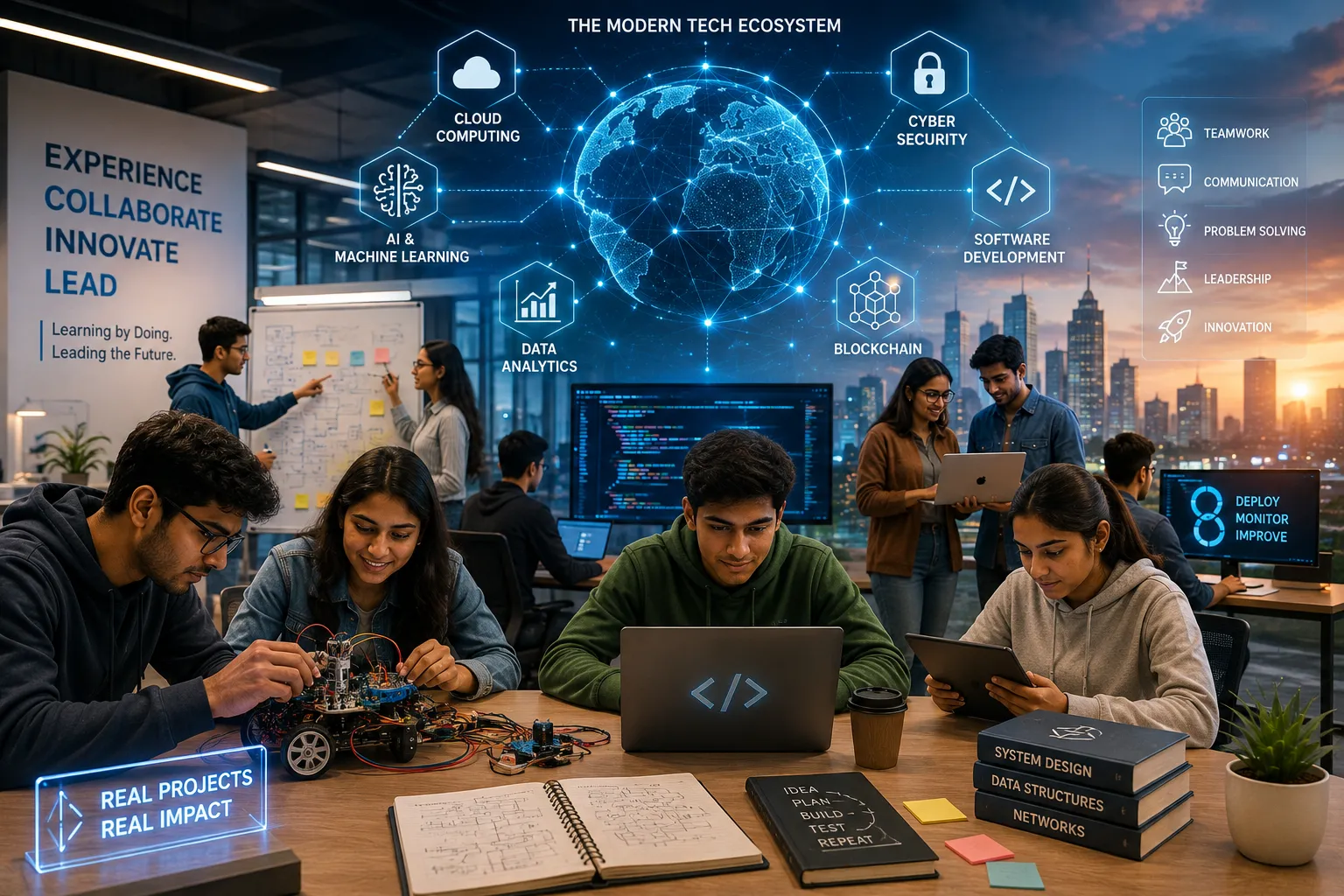

We are living in an era where technology doesn't just support businesses—it is the business. With the relentless rise of Artificial Intelligence, Big Data, and the Internet of Things (IoT), the traditional "chalk and talk" method of computer science education is rapidly becoming obsolete. Today’s tech industry doesn't just want programmers; it demands agile problem-solvers, innovators, and digital architects.
So, how do educational institutions bridge the gap between textbook theory and real-world industry demands?
A perfect case study of this transformation can be found at the Department of Information Technology at Kumaraguru College of Technology (KCT). Established in 1998, this department has continuously evolved, building an ecosystem that treats students not just as learners, but as early-stage tech professionals. Here is a deep dive into how modern IT education is being redefined.
1. A Curriculum Driven by Emerging Tech
To stay relevant, a technology curriculum must be as dynamic as the industry itself. Rather than sticking solely to foundational coding, modern IT education must embrace the frontier of technology.
At KCT, the academic framework is rigorously updated to reflect global trends. Students are immersed in highly specialized domains that dictate today’s digital economy, including:
- Artificial Intelligence & Deep Learning
- Data Science and Visualization
- Cybersecurity & Network Defense
- Internet of Things (IoT) and Cloud Computing
By integrating these advanced subjects directly into the core learning experience, the department ensures its graduates are fluent in the technologies shaping tomorrow.
2. The Shift to 'Experiential' Learning
The days of learning software engineering exclusively in a lecture hall are over. True technological mastery requires getting your hands dirty.
This philosophy is championed through state-of-the-art Hands-on Learning Centres, often established in partnership with global industrial giants like Bosch, Siemens, Fluke, and Yokogawa. Beyond traditional labs, students have access to dynamic innovation incubators like Protosem, iQube, and Garage. These platforms allow students to experiment, build prototypes, and participate in Innovation Practicums, transforming abstract ideas into tangible technological products.
3. Faculty: From Teachers to Tech Mentors
In a rapidly shifting digital landscape, the role of an educator transitions from a traditional lecturer to an industry mentor.
The faculty within this department are active researchers and industry consultants. With specializations ranging from Medical Image Analysis and Fuzzy Vault Authentication to Big Data Analytics and Service-Oriented Architecture, these professors lead by example. They actively publish in top-tier journals, hold patents, and guide students through complex, real-world consultancy projects. This mentorship fosters a culture of lifelong learning, ethics, and professional resilience.
4. Technology with a Social Conscience
Innovation means little if it doesn't positively impact society. One of the most unique aspects of this IT ecosystem is its heavy emphasis on community outreach and constructive research.
Students and faculty actively collaborate on high-impact projects. A prime example is the "Smart Agriculture for Sustainable Food Production" project, sponsored by the IEEE foundation, which leverages IoT and IT techniques to help farmers optimize crop yields based on soil conditions. Furthermore, the department routinely conducts IT technical training and coding awareness programs for rural school students. This blend of high-tech research and grassroots social work has earned the department numerous accolades, including recognition from the Tamil Nadu State Council for Science and Technology.
5. Cultivating Industry-Ready Professionals
When an institution perfectly aligns its curriculum with industry needs, the results speak for themselves. The department boasts a staggering annual placement rate of over 95%.
This isn't achieved by chance. It is the result of a holistic approach that combines rigorous technical training with leadership development initiatives like the Super 60 Leadership Council. By the time students graduate, they possess the technical acumen to develop complex software, the communication skills to lead teams, and the entrepreneurial mindset to drive innovation within global tech giants.
The Takeaway
As the digital landscape continues to evolve, the blueprint for successful IT education is clear: it requires a blend of cutting-edge curricula, hands-on industrial partnerships, visionary mentorship, and a commitment to social impact. The Information Technology ecosystem at Kumaraguru College of Technology stands as a powerful testament to this model, actively forging the innovators and tech leaders who will define our digital future.
If you are passionate about the future of tech and education, exploring how such progressive ecosystems operate offers a fascinating glimpse into the future of the IT industry.

























Sign in to leave a comment.