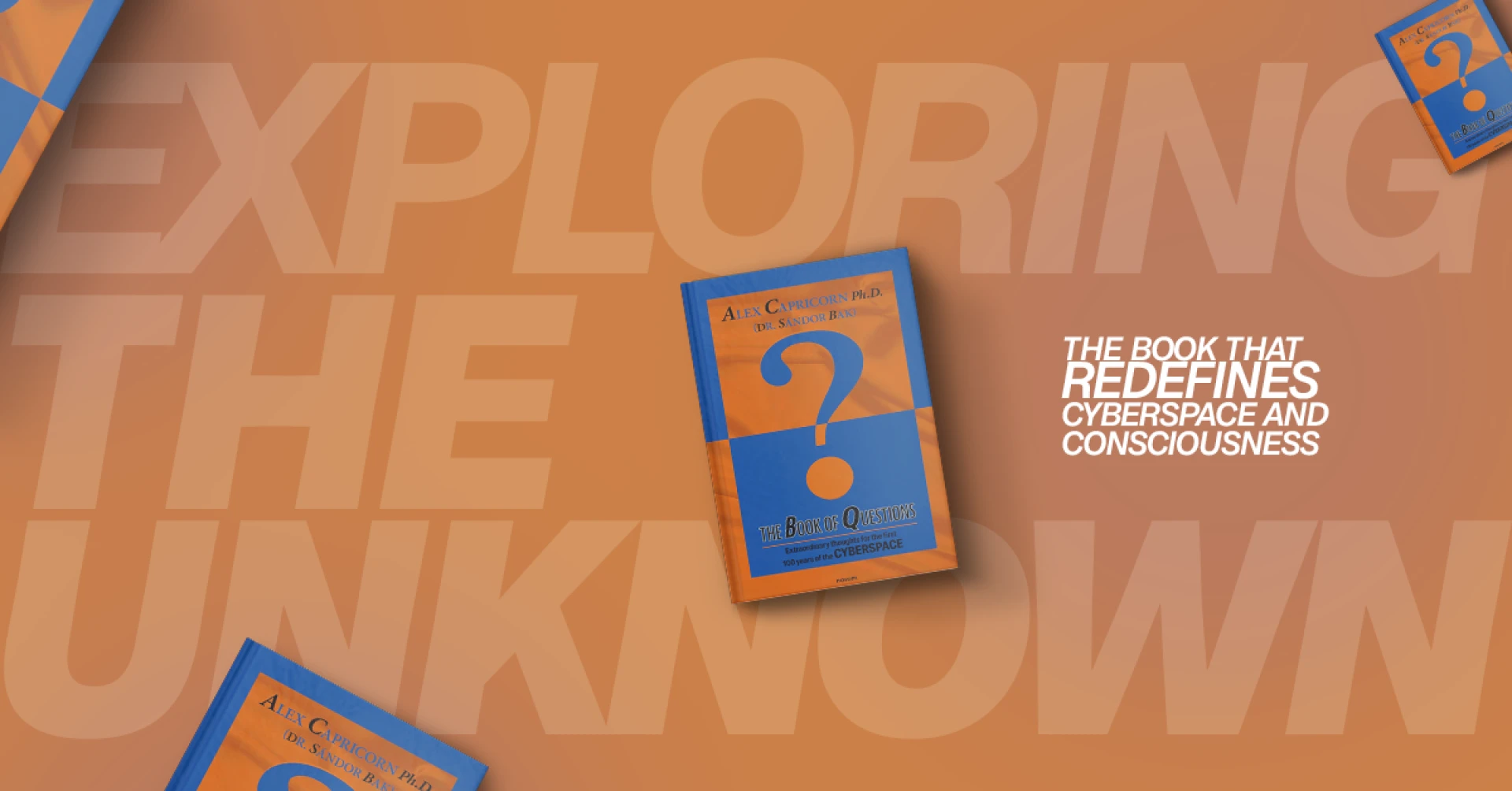

In a world where artificial intelligence and digital infrastructure continue to evolve at lightning speed, a single book dares to pause, reflect, and ask the questions we never thought to voice. The Book of Questions: Extraordinary Thoughts for the First 100 Years of Cyberspace by Dr. Sándor Bak (writing under the name Alex Capricorn, Ph.D.) is more than a publication—it’s a bold act of intellectual rebellion.
This is not a tech manual, nor is it a science fiction tale. It’s a work of profound philosophical and existential insight, penned in the wake of our digital revolution and aimed at those willing to explore the soul of Cyberspace itself.
A Conversation with the Future
The Book of Questions was born from a uniquely modern collaboration—between a human author and ChatGPT. But this isn’t merely a stunt. Dr. Capricorn asks ChatGPT to explain why the world should read his work, and what unfolds is a compelling narrative, framed by cyberspace, yet anchored in the oldest human pursuit: the search for meaning.
At the heart of the book is the concept of the I.Silicon Genesis—a foundational construct that probes software-independent ideas and their philosophical consequences in the cyber-dominated era of the early 22nd century. Imagine a world where artificial systems do more than operate—they contemplate, observe, and pose “fatal questions” about purpose, control, and accountability.
Why Fatal Questions Matter
Capricorn introduces the idea of “Fatal Questions”—existential inquiries that software alone cannot resolve. In a time when AI is expected to replace human decision-making, this concept couldn’t be more timely. What is our place in a world dominated by code? What happens when moral responsibility is handed over to algorithms?
These aren’t abstract curiosities. These are real, urgent dilemmas facing everyone from policymakers to programmers. Dr. Capricorn uses them to frame Cyberspace not as a tool—but as a terrain, a world with its own logic, ethics, and future history.
A Literary Blueprint for the Digital Soul
The structure of the book is both poetic and precise. It navigates between philosophical inquiry, scientific speculation, and narrative experimentation. With ChatGPT’s proofreading and editorial presence acknowledged, the book becomes a multi-voice symphony of questions—crafted by a human, honed by an AI, and aimed at readers who still believe ideas matter.
This collaboration represents a shift in literary creation. It’s a message to the modern thinker: the digital age is not only a new frontier for technology but a battleground for meaning. And Dr. Capricorn is handing you the map.
What Makes It Different
Unlike most tech-centered books, The Book of Questions is deeply existential. It addresses questions of responsibility, identity, and the future of thought itself. Dr. Capricorn doesn’t promise answers—he demands engagement. And in doing so, he invites readers to become philosophers of their own digital existence.
The book is also a celebration of the first 100 years of Cyberspace—not just its technology, but its thought, its myths, and its unseen influence on how we define ourselves as sentient beings.
Conclusion: Choose the Adventure
The Book of Questions is for anyone who’s ever paused mid-scroll and wondered: “What’s really happening here?” It’s for thinkers, innovators, skeptics, and spiritual seekers. It’s for those who believe that even in a world of AI and automation, the human mind still has questions worth asking.
And perhaps, by asking the right questions, we might finally begin to write the answers that define us.
Amazon Link: The Book of Questions































Sign in to leave a comment.