
Keeping a reptile enclosure clean is a key part of responsible reptile care. Waste, food remains, and organic material can build up on surfaces, bowls, hides, and other habitat equipment. Regular cleaning helps maintain a cleaner environment for reptiles and makes routine enclosure care easier.
F10 reptile disinfectant is used by reptile keepers, breeders, veterinarians, and animal-care professionals as part of habitat cleaning and disinfection. The F10 range is based on F10SC, a concentrated veterinary disinfectant that is diluted according to the intended use and the manufacturer's directions.
Choosing the right dilution, cleaning surfaces properly, and following the product label are important steps when using any veterinary disinfectant around reptiles.
What Is F10 Veterinary Disinfectant?
F10 is a veterinary disinfectant product based on quaternary ammonium compounds. F10SC Veterinary Disinfectant is a concentrated formulation that can be diluted for different cleaning and disinfection applications.
The product is used in veterinary, animal-care, and laboratory settings. It is also used for cleaning animal housing and equipment when applied according to the manufacturer's instructions.
For reptile owners, this makes F10 disinfectant useful for routine enclosure-cleaning tasks. It can be used on suitable hard surfaces and equipment when the product directions allow it.
However, disinfecting a habitat is more than simply spraying a product on a dirty surface. Organic debris should be removed first so the disinfectant can work as intended.
Why Reptile Enclosure Disinfection Matters
Reptiles live in enclosed environments where waste and moisture can accumulate. Food bowls, water dishes, hides, flooring, and enclosure walls can all become contaminated during normal use.
A regular cleaning routine can help reduce unwanted buildup. Disinfection is one part of that routine.
A practical cleaning process usually includes:
- Remove the reptile from the enclosure when appropriate.
- Remove old substrate, feces, shed skin, and leftover food.
- Clean visible dirt and organic material from surfaces.
- Apply the disinfectant according to the product directions.
- Allow the required contact time.
- Rinse surfaces if required by the label.
- Allow surfaces to dry before returning the reptile.
The exact procedure depends on the product instructions, enclosure material, and type of cleaning being performed.
Understanding F10 SC Veterinary Disinfectant
The term F10 SC veterinary disinfectant refers to the concentrated F10SC formulation used for veterinary and animal-care applications.
Because it is a concentrate, users need to follow the manufacturer's dilution instructions rather than guessing the amount of product needed. Using a stronger mixture does not automatically make a cleaning routine safer or more effective.
The label should be the main reference for:
- Dilution instructions
- Contact time
- Approved surfaces
- Application method
- Rinsing requirements
- Storage instructions
- Safety precautions
Always check the product packaging before preparing a solution.
How to Use F10 Disinfectant for a Reptile Enclosure
Step 1: Remove Waste and Debris
Start by removing feces, old substrate, shed skin, leftover food, and other visible debris.
This step matters because disinfectants work best when surfaces have already been cleaned. Dirt and organic material can interfere with the disinfection process.
Step 2: Clean the Surface
Wash or wipe the enclosure and removable equipment as appropriate. Pay attention to corners, seams, feeding areas, and places where waste commonly collects.
Do not skip the cleaning stage and expect a disinfectant to replace physical cleaning.
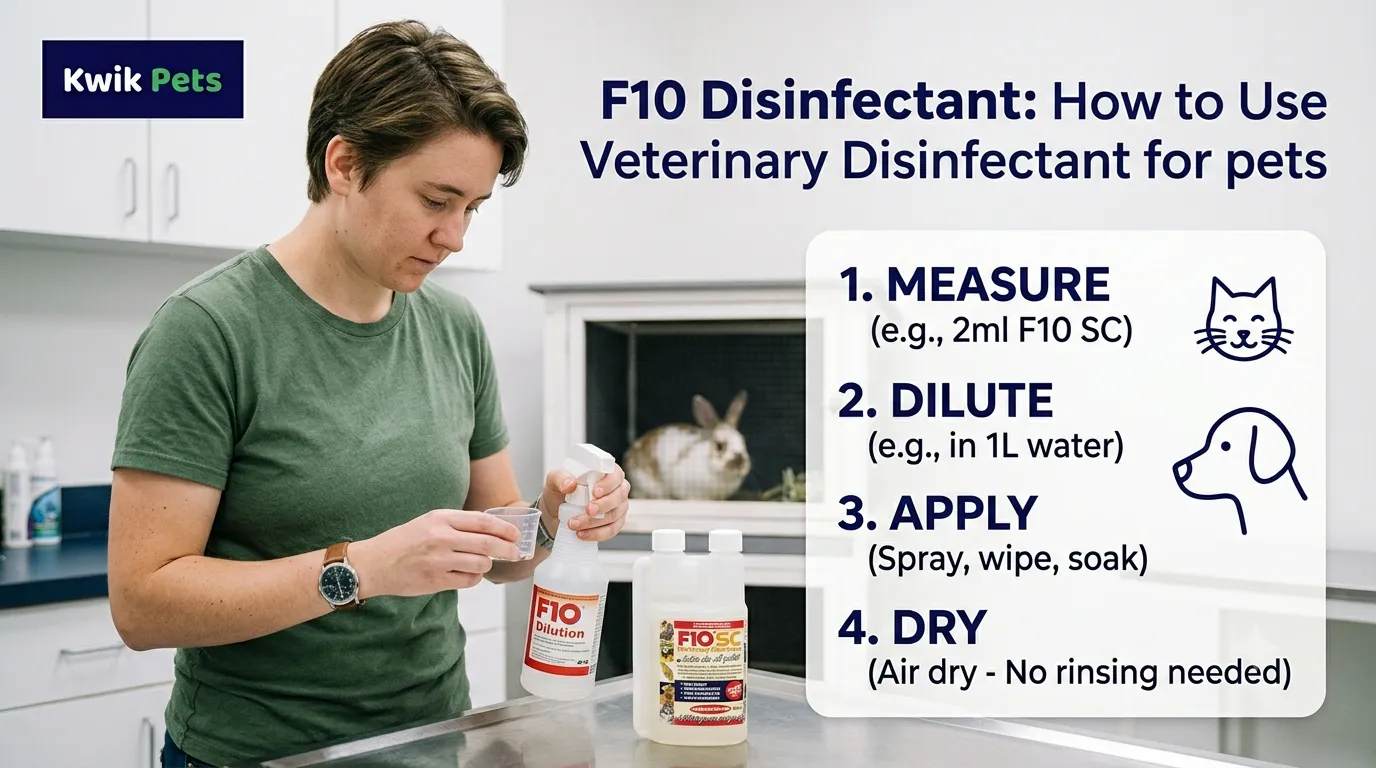
Step 3: Prepare the F10 Solution
Prepare the solution according to the manufacturer's instructions for the intended application.
Do not estimate the dilution by eye. Concentrated veterinary disinfectants should be measured carefully.
Keep the original product container available so you can check the directions whenever you prepare a new solution.
Step 4: Apply the Disinfectant
Apply the prepared F10 veterinary disinfectant to the appropriate hard surfaces.
Make sure the surface receives adequate coverage. Follow the manufacturer's stated contact time instead of wiping the product away immediately.
Step 5: Rinse When Required
Some applications require rinsing after disinfection, while others may have different instructions.
Follow the product label for the specific use. When cleaning items that come into direct contact with food or drinking water, pay particular attention to the manufacturer's directions.
Step 6: Dry the Enclosure
Allow cleaned surfaces and equipment to dry completely before returning the reptile.
This also gives you an opportunity to check that no cleaning residue or standing liquid remains in areas where the reptile could contact it.
Which Reptile Supplies Can Be Cleaned?
The suitability of a disinfectant depends on the surface and the product directions.
Hard, non-porous surfaces are generally easier to clean and disinfect than porous materials. Enclosure walls, plastic equipment, feeding dishes, and other suitable washable items can be included in a cleaning routine when the product label permits their use.
Porous materials such as untreated wood, certain natural decorations, and some types of substrate can be harder to disinfect effectively. In these cases, replacing the material may be more practical than relying on surface disinfection.
Always check the manufacturer's instructions before applying F10 SC to a particular material.
F10 Veterinary Disinfectant for Water and Food Equipment
Food and water equipment needs special attention because reptiles can come into direct contact with these items.
Water bowls can collect waste, slime, and other buildup. Food dishes can also become contaminated with leftover food.
Remove visible debris first, then clean and disinfect suitable equipment according to the product directions. If the label requires rinsing, rinse thoroughly with clean water before the equipment is used again.
Never assume that a disinfectant can be left on every food or water-contact surface without following the product instructions.
F10 Disinfectant vs. Regular Cleaning
Cleaning and disinfection are related but different steps.
Cleaning removes visible dirt, waste, food, and organic material.
Disinfection uses an appropriate chemical product to reduce or eliminate microorganisms on suitable surfaces under the conditions specified by the manufacturer.
For a reptile enclosure, both steps can be useful. Applying a disinfectant to a dirty enclosure without first removing waste is not a substitute for proper cleaning.
A simple routine can therefore look like this:
Remove debris → Clean → Apply F10 solution → Follow contact time → Rinse if required → Dry → Return equipment
This process is easier to follow when cleaning becomes part of a regular enclosure-maintenance schedule.
Common Mistakes When Using F10 SC
Using the Wrong Dilution
Do not make a stronger solution because you think it will provide better results. Follow the manufacturer's dilution instructions for the specific application.
Skipping Physical Cleaning
Disinfectant should not be used as a replacement for removing visible waste and organic material.
Ignoring Contact Time
A product needs enough contact time to work as directed. Wiping it away too quickly can reduce the effectiveness of the disinfection process.
Returning the Reptile Too Soon
Make sure the enclosure and equipment are ready before putting the reptile back. Follow all label instructions regarding rinsing, drying, and ventilation.
Using It on Every Material
Not every enclosure material reacts the same way to cleaning chemicals. Check whether the surface is suitable before applying the product.
Choosing F10 Reptile Disinfectant
When selecting a product for reptile habitat cleaning, look at more than the product name.
Check:
- Whether the product is intended for veterinary or animal-care use
- The concentration of the formulation
- Available dilution instructions
- Recommended contact time
- Suitable surfaces
- Rinsing requirements
- Storage and safety instructions
- Size of the container based on your cleaning needs
F10 SC is a concentrated product, so a small container may provide multiple prepared cleaning solutions when diluted according to the manufacturer's instructions.
For reptile owners who clean multiple enclosures, breeders, or animal-care facilities, selecting the appropriate product size can also make routine cleaning easier.
Safe Cleaning Practices Around Reptiles
Good cleaning habits are just as important as the disinfectant itself.
Keep concentrated products stored safely and away from children and animals. Use the product according to the label and avoid mixing disinfectants with other cleaning chemicals unless the manufacturer specifically says it is safe.
Use appropriate personal protective equipment when required by the product instructions.
Also keep cleaning equipment separate from household kitchen items. Dedicated brushes, cloths, buckets, and other supplies can help prevent accidental cross-contamination.
If a reptile has a health problem or your enclosure requires specialized sanitation, ask a qualified reptile veterinarian for advice.
Where to Find F10 Veterinary Disinfectant
Kwik Pets offers F10 veterinary disinfectant products through its F10 Products collection. The collection is designed for customers looking for F10 cleaning and disinfecting products for animal-care applications.
Before purchasing, review the product information and select the formulation and size that fit your cleaning routine. Always read the manufacturer's instructions before preparing or using an F10 solution.
For routine reptile enclosure care, the goal is simple: remove waste, clean surfaces properly, use the disinfectant as directed, and make sure the habitat is ready before your reptile returns.
Frequently Asked Questions
What is F10 reptile disinfectant used for?
F10 reptile disinfectant is used as part of a cleaning and disinfection routine for suitable reptile enclosure surfaces and equipment. It should be used according to the manufacturer's dilution, contact-time, surface, rinsing, and safety instructions. Physical cleaning should come first to remove visible waste and organic material.
What is F10 SC veterinary disinfectant?
F10 SC veterinary disinfectant is a concentrated F10 veterinary disinfectant formulation. It is designed for veterinary and animal-care applications and must be diluted according to the manufacturer's instructions. Users should follow the product label for the correct dilution and application method.
Can F10 disinfectant be used on reptile cages?
F10 disinfectant can be used on suitable enclosure surfaces when the product instructions permit that application. Clean visible dirt and waste first, prepare the solution according to the label, follow the required contact time, and rinse or dry the surface as directed before returning the reptile.
How often should I disinfect a reptile enclosure?
The required cleaning frequency depends on the reptile species, enclosure setup, substrate, humidity, waste production, and whether there are other sanitation concerns. Spot cleaning should be performed regularly, while deeper cleaning and disinfection can be scheduled as needed. A veterinarian can provide guidance for reptiles with specific health concerns.
Can I use F10 veterinary disinfectant on food and water bowls?
Food and water bowls should be cleaned regularly, but the product label should determine whether and how F10 can be used on these items. Remove food and waste first, follow the correct dilution and contact time, and rinse when required before putting the bowl back into use.






















Sign in to leave a comment.