
In the fast-paced Indian economic landscape, large-scale enterprises rely heavily on a complex ecosystem of smaller businesses to maintain their operations. These smaller entities—ranging from regional distributors and local dealers to raw material suppliers and logistical vendors—form the vital connective tissue of the industrial sector. However, a major structural vulnerability continues to threaten this network: the critical shortage of working capital. While large corporate buyers often operate on extended credit cycles to optimize their internal metrics, their smaller partners are frequently left waiting for months to clear their accounts receivable, creating a massive liquidity bottleneck.
To bridge this fundamental gap, digital trade finance platforms are completely redesigning how businesses access cash. Loan Frame connects India’s leading corporates and their supply chains with fast, affordable, and flexible working capital solutions. By utilizing data-driven infrastructure, platforms can move beyond the restrictive, collateral-heavy underwriting of traditional banking and instead focus on the strength of commercial relationships. This shifts the focus from an individual business's asset base to the verifiable transaction volume moving across the supply network.
The Mechanics of Supply Chain Optimization
When an enterprise looks to stabilize its cash flows, it must address two main vectors: accelerating incoming revenue from buyers and optimizing the payment terms extended to its suppliers. In traditional financial ecosystems, these processes are treated as isolated corporate loans, requiring long processing times and immense administrative overhead.
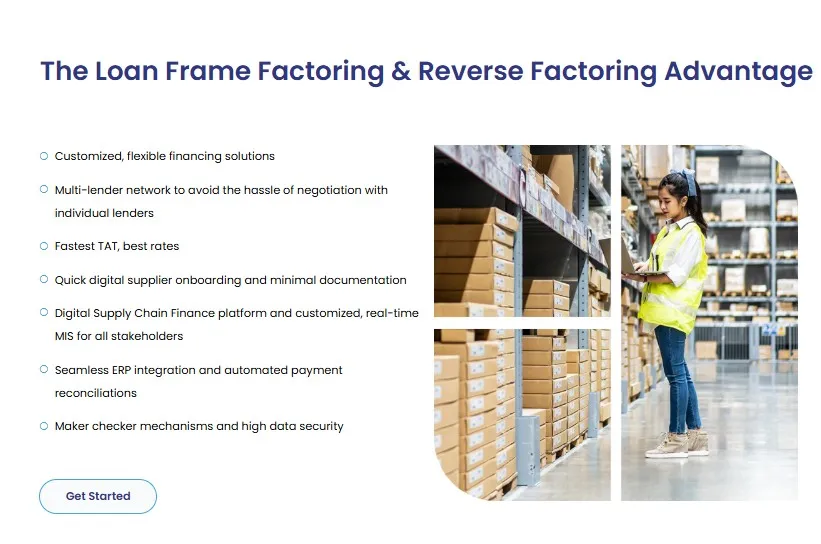
Modern digital finance, however, treats the corporate buyer and the vendor as parts of a unified financial ecosystem. This relationship-first approach allows for the seamless deployment of structured Factoring & Reverse Factoring mechanisms directly within the transaction cycle. In standard factoring, a small supplier can immediately convert its approved corporate invoices into liquid cash, bypassing the typical 60-to-90-day waiting period. Conversely, reverse factoring allows a large corporate anchor to initiate early payments to its vendors by leveraging its own superior credit rating, allowing suppliers to access low-cost capital while the corporate buyer retains its preferred payment terms.
To execute these models smoothly, businesses need a platform capable of handling real-time data verification and automated risk matching. Our end-to-end platform empowers small businesses—distributors, dealers, suppliers, and vendors, with on-demand access to capital through a vast multi-lender network of top banks and NBFCs, backed by cutting-edge technology and deep expertise in small business credit.
The Power of a Multi-Lender Network
Historically, supply chain finance programs were tied to a single banking partner. If that bank changed its risk appetite or reached its regulatory exposure limit for a specific sector, the entire program could instantly freeze, leaving hundreds of small vendors without access to operational capital.
The transition to a multi-lender digital marketplace solves this systemic vulnerability. By bringing India’s premier commercial banks and Non-Banking Financial Companies (NBFCs) onto a single interface, platforms create an automated marketplace. When a distributor or vendor requests funding against an invoice, the platform’s underlying algorithms automatically direct the transaction to the lender best suited for that specific deal size and risk profile.
This network effect drives down borrowing costs through healthy competition while expanding total credit availability. For the first time, small businesses do not have to struggle through manual applications at individual bank branches; instead, they receive formal institutional capital with the speed and flexibility of a consumer digital app.
Conclusion
Strengthening the financial foundation of India's supply chains requires a holistic approach that seamlessly combines technological scale with institutional capital. By replacing legacy, manual processes with automated marketplace lending, corporate ecosystems can successfully shield their suppliers from severe cash flow volatility. When vendors and distributors are consistently equipped with fluid, on-demand financing, the entire B2B value chain benefits from increased stability and faster operational velocity. Ultimately, the smart integration of an automated Factoring & Reverse Factoring infrastructure across an expansive multi-lender network provides the robust, modern framework that small businesses need to confidently scale alongside their corporate partners.

























Sign in to leave a comment.