
Businesses are gathering huge amounts of data, ranging from transaction histories and consumer behaviour to credit scores and stock market patterns. However, raw data is insufficient on its own. A financial data scientist is one of the qualified experts that financial companies need to drive business decisions and extract valuable insights.
To evaluate complicated financial data and offer useful insights, a financial data scientist integrates knowledge of computer science, mathematics, statistics, and finance. This blog will provide a simple overview of what it takes to succeed in this industry, whether you're thinking about pursuing a career in it or not.
Who is a Financial Data Scientist?
An expert who uses data to address financial issues is known as a financial data scientist. To identify patterns, predict trends, and make predictions, they mostly rely on technology, sophisticated analytics, and programming abilities, in contrast to traditional financial analysts. In fields including trading, risk management, investment banking, and financial planning, their job is important.
They look into financial data to find trends, identify fraud, improve investment strategies, and assist businesses in making better decisions. Think of them as detectives who use numbers rather than magnifying glasses.
Key Responsibilities of a Financial Data Scientist
The role of a Data Scientist is diverse and dynamic. Below are the main responsibilities they typically handle:
1. Data Collection and Cleaning
Financial data comes from multiple sources: stock exchanges, bank records, transaction histories, customer feedback, and economic reports. A significant part of their job is to collect this data and make sure it is clean and usable.
This process includes removing errors, handling missing values, and converting data into a format suitable for analysis. Without clean data, even the most advanced algorithms can give misleading results.
2. Data Analysis and Interpretation
Once the data is ready, the next step is analysis. They use statistical techniques and machine learning models to explore the data. They identify patterns, trends, correlations, and anomalies that can provide valuable insights.
For example, they might analyze customer spending behaviour to predict which customers are likely to default on loans or forecast stock prices based on historical trends.
3. Financial Modeling
Making mathematical models of financial situations is known as financial modeling. Models are created by them to replicate credit risks, investment returns, and market circumstances.
These models help companies make wise choices. For example, a bank can use a model to assess the possible effects of market swings on its portfolio or to calculate the risk involved in lending to a new client.
4. Risk Management
Risk is inherent in finance. They play a crucial role in identifying and managing risks. They develop predictive models to detect potential fraud, credit defaults, or market downturns.
By analyzing historical data, they can provide early warnings and suggest preventive strategies. This helps organizations minimize financial losses and protect their assets.
5. Reporting and Visualization
Numbers alone are not enough. They create reports and visualizations to present their findings clearly to stakeholders.
Using tools like Tableau, Power BI, or Python libraries like Matplotlib and Seaborn, they turn complex data into charts, dashboards, and graphs that are easy to understand. This helps decision-makers quickly grasp insights and take action.
6. Collaboration with Other Teams
They frequently collaborate closely with management, marketing, finance, IT, and other areas. They work together to understand corporate objectives, coordinate data strategies, and put solutions into action that add value to the company.
Key Skills Required for a Financial Data Scientist
They need a unique combination of technical, analytical, and financial skills. Here’s a breakdown:
1. Strong Analytical Skills
Analyzing financial data requires critical thinking and attention to detail. They should be able to interpret data, identify trends, and make data-driven recommendations.
2. Programming Skills
Programming is essential for data manipulation and building models. Languages like Python, R, and SQL are commonly used. Knowledge of big data tools like Hadoop or Spark can be an added advantage.
3. Knowledge of Finance and Economics
It is essential to understand financial concepts such as credit risk, investment strategies, stock markets, and financial statements. To properly evaluate data, they need to understand how financial systems operate.
4. Statistical and Mathematical Skills
Statistics and mathematics form the foundation of financial modeling and predictive analytics. Skills in probability, regression analysis, hypothesis testing, and machine learning are necessary.
5. Data Visualization Skills
Communicating insights effectively is as important as analyzing data. They should know how to create clear and compelling visualizations that help non-technical stakeholders understand the findings.
6. Problem-Solving Ability
Financial problems are often complex and multi-dimensional. A good Data Scientist can break down problems, analyze them from different angles, and provide innovative solutions.
7. Knowledge of Regulatory Requirements
Finance is a highly regulated sector. Understanding compliance, reporting standards, and financial regulations ensures that data analysis and modeling are accurate and legal.
Tools Commonly Used by Financial Data Scientists
They rely on a range of tools to manage, analyze, and visualize data. Some of the commonly used tools include:
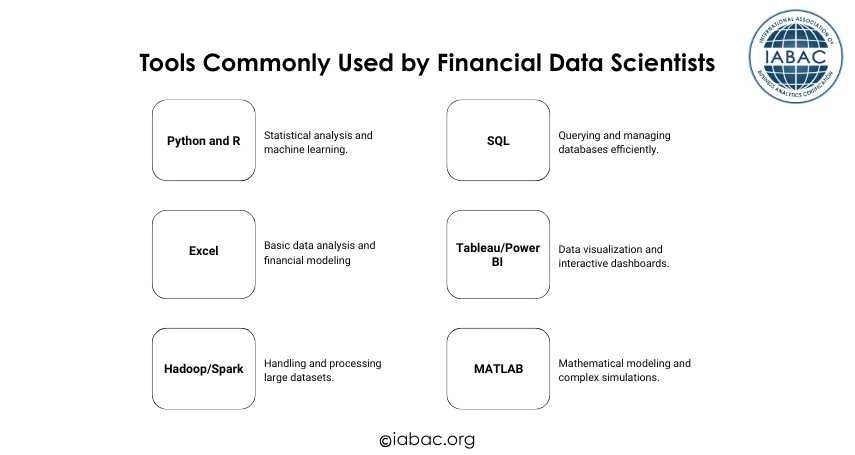
- Python and R: For statistical analysis and machine learning
- SQL: For querying and managing databases
- Excel: For basic data analysis and financial modeling
- Tableau/Power BI: For data visualization and dashboards
- Hadoop/Spark: For handling large datasets
- MATLAB: For mathematical modeling and simulations
Proficiency in these tools helps to process complex datasets efficiently and deliver actionable insights.
Career Path and Growth Opportunities
Being on them is a very profitable and intellectually fulfilling career. Data analyst, junior quantitative analyst, and risk analyst are examples of entry-level jobs.
With experience, professionals can move into senior roles such as:
- Senior Financial Data Scientist
- Quantitative Analyst (Quant)
- Risk Manager
- Investment Analyst
- Chief Data Officer
Additionally, certifications like the IABAC Data Scientist - Finance certification can boost credibility and career prospects in this field.
Why Financial Data Science is Important
Financial institutions today face enormous pressure to make data-driven decisions. The ability to analyze vast amounts of financial data quickly and accurately can lead to:
- Better investment decisions: Predict market trends and identify profitable opportunities.
- Improved risk management: Detect fraud, defaults, and market risks before they cause losses.
- Operational efficiency: Automate processes, reduce manual errors, and optimize resources.
- Enhanced customer experience: Understand customer behaviour and offer personalized financial products.
In short, they help organizations turn raw data into a strategic asset that drives growth and stability.
The role of a Financial Data Scientist is both challenging and rewarding. It requires a strong foundation in finance, mathematics, statistics, and programming, along with problem-solving abilities and communication skills.
Whether it’s predicting market trends, detecting fraud, managing risk, or optimizing investments, they play a critical role in shaping the financial landscape.
For aspiring professionals, gaining the right skills, mastering analytical tools, and pursuing certifications like the IABAC Data Scientist - Finance certification can open doors to exciting career opportunities.






















Sign in to leave a comment.