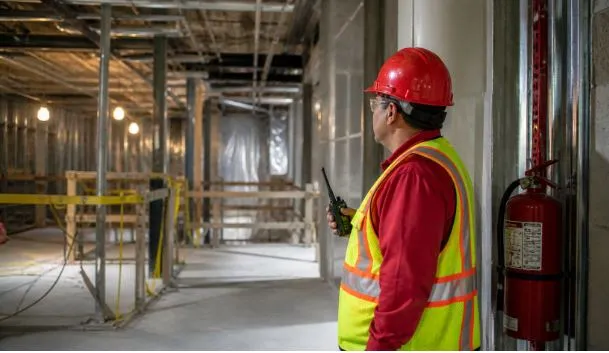

Temporary projects move fast. Whether it’s a construction site, system upgrade, seasonal installation, or emergency repair work, the focus is usually on speed, execution, and deadlines. But speed introduces instability and instability is where fire risk quietly increases. Unlike permanent facilities with established fire protection systems, temporary setups operate in incomplete, evolving environments. Systems may be partially installed, disabled, or not yet functional. Fire Watch Services Near Me help ensure that fire risks are minimized at all times through constant supervision and proactive monitoring. That gap between setup and full protection is exactly where fire watch services become essential, ensuring that safety doesn’t fall behind progress.

What Happens If Fire Watch Is Missing? (The Risk Reality)
Let’s approach this from a risk-first perspective.
Imagine a temporary construction project inside an active commercial building. Electrical lines are exposed, temporary lighting is installed, and welding work is ongoing. At the same time, sections of the building’s fire alarm system are offline.
Now remove fire watch from the equation.
What happens?
- Sparks from welding travel beyond the immediate work zone
- Combustible materials nearby begin to smolder
- No alarm triggers because the system is disabled
- Workers leave at the end of the shift
- Hours later, ignition occurs unnoticed
By the time smoke is visible, the damage is already extensive.
This is not a rare scenario it’s exactly the type of risk fire watch services are designed to prevent.
Fire Watch Defined Through Its Role in Temporary Risk
Fire watch is a structured safety practice where trained personnel monitor a site for fire hazards when fire protection systems are impaired or when high-risk activities are underway.
In temporary projects, this definition becomes more practical:
Fire watch services act as real-time, adaptive fire risk monitoring in environments where stability doesn’t exist yet.
They provide:
- Continuous observation in changing work zones
- Early detection of heat, smoke, or ignition sources
- Immediate response before escalation
- Support for maintaining fire safety compliance
In short, they replace certainty with vigilance.
Why Temporary Projects Are More Vulnerable Than Permanent Sites
Temporary environments don’t just have fire risk they amplify it.
Here’s why:
- Incomplete systems: Fire alarms and sprinklers may not be fully installed or active
- Temporary wiring: Often more prone to faults and overheating
- Frequent layout changes: New hazards appear daily
- Mixed workforce: Contractors unfamiliar with site-specific risks
- Hot work activities: Welding, cutting, grinding all common in short-term projects
This combination creates a high-risk environment where traditional safety systems alone are not enough.
Real-World Scenario: When Timing Matters
During a warehouse expansion project, a temporary partition separated active operations from a construction zone. The fire suppression system in the new section was not yet installed, but welding work had already begun.
Late in the afternoon, sparks from grinding equipment traveled beneath the partition and landed in stored packaging materials.
There was no detection system in that zone.
A fire watch guard stationed nearby noticed a slight smoke trail within minutes. The material was extinguished immediately.
Without that presence, ignition could have occurred after workers left when detection and response would be delayed.
This is the difference between controlled risk and uncontrolled loss.
When Fire Watch Requirements Become Mandatory
Temporary projects frequently trigger fire watch requirements under safety regulations.
These situations include:
- Fire alarm or sprinkler systems not yet installed or temporarily disabled
- Active hot work operations (welding, cutting, grinding)
- Construction or renovation within occupied buildings
- Temporary shutdowns during system integration
- Post-work monitoring to detect delayed ignition
Authorities such as fire marshals often require fire watch services before approving work continuation.
What Fire Watch Guards Actually Do on Temporary Sites
Fire watch is not passive observation it is structured, active safety enforcement.
1. Adaptive Patrol Strategy
Guards don’t follow static routes. They adjust based on:
- Active work zones
- Newly introduced risks
- Equipment locations
2. Early Hazard Recognition
They identify subtle indicators like:
- Heat buildup in wiring or machinery
- Dust ignition potential
- Smoldering materials hidden from view
3. Immediate Intervention
If a hazard appears, guards:
- Alert workers instantly
- Stop unsafe activity if required
- Contact emergency services if needed
4. Post-Work Monitoring
One of the most critical roles monitoring continues even after work ends to catch delayed ignition.
Compliance Isn’t Optional Even for Temporary Work
A common misconception is that temporary projects have relaxed safety expectations. In reality, they often face stricter scrutiny.
Key compliance frameworks include:
- OSHA: Requires fire watch during hot work and hazardous conditions
- NFPA: Defines fire watch procedures, duration, and documentation
- Fire marshal regulations: Often mandate fire watch for permits
Failure to comply can result in:
- Immediate work stoppages
- Fines and penalties
- Project delays
- Liability exposure in case of fire
Fire watch services ensure that compliance is maintained even in incomplete environments.
Emergency Fire Watch: When Things Don’t Go as Planned
Temporary projects rarely follow a perfect plan. Unexpected issues happen:
- Electrical systems fail mid-installation
- Fire protection infrastructure is accidentally damaged
- Power outages disrupt safety systems
- Hidden hazards are discovered during work
Emergency fire watch services are deployed in these moments to restore safety instantly.
Choosing Fire Watch Services Near Me becomes critical here because response time directly impacts risk control.
The Business Impact of Ignoring Fire Watch
Temporary projects are often budget-driven, and fire watch can be seen as an additional cost.
But the real cost comes from not having it.
Potential consequences:
- Damage to partially completed work
- Project delays costing thousands per day
- Replacement of materials and equipment
- Insurance complications due to non-compliance
- Safety risks to workers and surrounding facilities
In comparison, fire watch is a low-cost, high-impact risk control measure.
Choosing the Right Fire Watch Provider for Temporary Projects
Not all fire watch providers are equipped for dynamic environments.
When selecting a provider, look for:
- Experience in construction and temporary setups
- Ability to adapt to changing site conditions
- Strong communication with contractors and supervisors
- 24/7 availability for emergency fire watch
- Knowledge of local compliance requirements
The right provider doesn’t just monitor they integrate into the project’s safety workflow.
Turning Fire Watch Into a Strategic Advantage
Safety-conscious project managers treat fire watch as part of planning not a last-minute fix.
Best practices include:
- Scheduling fire watch alongside project phases
- Mapping risk zones before work begins
- Coordinating with contractors and safety officers
- Maintaining documentation for inspections
This approach transforms fire watch from a reactive service into a proactive risk management tool.
Why Human Oversight Is Critical in Temporary Environments
Automated systems rely on stability. Temporary projects are anything but stable.
Fire watch services provide:
- Real-time decision-making
- Flexibility to adapt to new risks instantly
- Detection of issues that technology may miss
This human layer ensures that safety remains active even when systems are incomplete or unreliable.
Conclusion
Temporary projects are defined by progress, but progress often comes with hidden risks. As systems are installed, modified, or temporarily disabled, fire hazards can develop in ways that are difficult to predict and even harder to detect without active monitoring. Fire watch services fill this critical gap, providing continuous protection during the most vulnerable phases of a project. By ensuring early detection, immediate response, and ongoing compliance, fire watch transforms temporary environments into controlled, manageable spaces. For organizations committed to completing projects safely and efficiently, it is not just a requirement it is a fundamental part of responsible execution.





















Sign in to leave a comment.