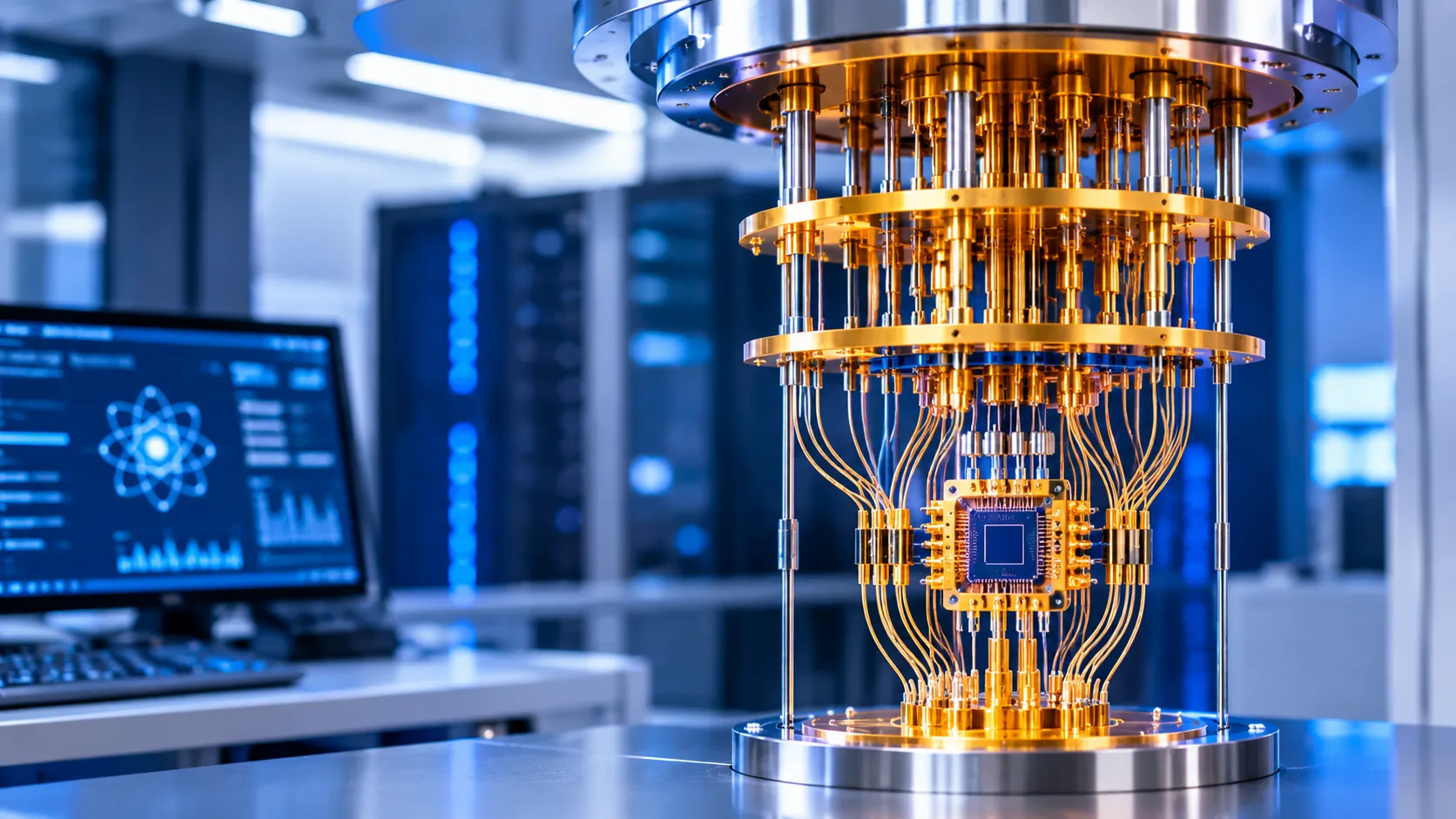

Quantum computing breakthroughs used to sound like something ten years away. That's changed. In 2026, several labs and companies crossed a real technical threshold. Error rates dropped low enough for quantum machines to start producing useful results instead of noise.
This guide explains what actually happened, in plain language, and what it means if you're trying to figure out whether this technology matters for your work. You'll learn how qubits differ from regular computer bits. What changed in error correction, which industries already run quantum pilots, and what to realistically expect before any of this reaches everyday computing.
What Changed in Quantum Computing Breakthroughs This Year
A regular computer stores information as bits, each one either a 0 or a 1. A qubit can hold both states at once, a property called superposition. Pair that with entanglement, where qubits stay linked no matter the distance between them. And you get a machine that can explore many possible answers.
The problem has always been noise. Qubits are fragile. Heat, vibration, and stray electromagnetic signals knock them out of their quantum state in microseconds, and every error compounds as you add more qubits. For years, more qubits meant more mistakes, not more power.
That pattern broke in 2026. Multiple organizations demonstrated exponential error suppression, meaning logical error rates now go down as more qubits are added instead of going up. Google's Willow processor, a 105-qubit superconducting chip, showed logical error rates dropping by roughly 2.14 times with each increase in the surface-code lattice size. That's the first hardware proof that fault-tolerant quantum computing behaves the way theorists predicted on paper.
Gate error rates for two-qubit operations also dropped below the 1% mark across all major hardware platforms this year. None of this means quantum computers beat classical ones at general tasks yet. It means the specific engineering barrier that stalled the field for two decades is finally giving way.
Qubit Types Behind the Progress
Different companies are betting on different physical approaches to building a qubit. Each has trade-offs worth knowing if you read further quantum computing news this year.
| Qubit type | How it works | Where it stands in 2026 |
| Superconducting | Microwave circuits cooled to near absolute zero | Most mature; used by IBM and Google; needs dilution refrigerators |
| Trapped ion | Individual ions held by electromagnetic fields | Very low error rates; slower gate speeds |
| Neutral atom | Atoms arranged with laser tweezers | Scaling quickly; used by QuEra and Atom Computing |
| Photonic | Particles of light carry the quantum information | Can run near room temperature; still early stage |
From Lab to Real Applications
Breakthroughs in error correction only matter if they translate into something a business can use. A handful of industries are already testing quantum hardware for specific, narrow problems rather than waiting for a general-purpose machine.
Where Quantum Computing Is Already at Work
Drug discovery. Simulating how a molecule folds or binds to a protein is exactly the kind of problem classical computers struggle with once the molecule gets large. Pharmaceutical companies including Roche, Pfizer, and Merck now run quantum simulations alongside their classical research methods. This work is active today, though wider adoption across the industry is still several years out.
Finance. Banks use quantum methods to model risk faster than classical Monte Carlo simulations allow. Goldman Sachs has reported roughly a 100 times speedup for certain path-dependent options pricing compared with classical methods, though the actual run time is still measured in minutes rather than seconds.
Logistics and supply chains. Routing trucks, ships, or aircraft under multiple constraints is a combinatorial optimization problem, the kind quantum algorithms are built for. Most of this work runs as a hybrid: quantum hardware handles the hardest part of the calculation while classical systems manage everything else.
Cybersecurity. A large enough quantum computer could eventually break current encryption standards like RSA. Estimates for when that becomes possible range from 2030 to 2040, but organizations are already moving to quantum-resistant encryption because data intercepted and stored today could be decrypted later once the hardware catches up.
Practical Considerations Before You Invest
Almost none of this runs on a pure quantum machine yet. Most real enterprise value today comes from hybrid quantum-classical setups, where the quantum processor solves one specific bottleneck inside a larger classical workflow. That's a realistic starting point for a business pilot, not a full technology overhaul.
Cost has come down thanks to cloud access. You no longer need to own a dilution refrigerator to run an experiment; providers rent time on quantum hardware the same way cloud computing works for regular servers. The bigger bottleneck now is talent and integration, not the hardware bill. This is also where most companies fold quantum experiments into their broader AI and automation strategy rather than treating it as a separate initiative.
Be wary of timelines that sound too clean. Most industries remain in the pilot or proof-of-concept stage, and today's machines are better described as powerful research tools than practical replacements for classical systems. A useful approach is picking one narrow, high-cost optimization or simulation problem, benchmarking it against your existing classical method, and only then deciding whether it's worth building custom AI infrastructure around it.
Conclusion
Quantum computing breakthroughs in 2026 solved a real problem: error rates that once made results unreliable have started falling as hardware scales up. That progress is showing up as narrow, hybrid applications in pharma, finance, and logistics rather than a wholesale replacement for classical computing. If you're evaluating this technology for your own work, start small, measure against a classical baseline, and treat current timelines as estimates rather than guarantees.
FAQ
Is quantum computing actually useful yet, or still experimental?
It's useful for specific, narrow problems tested through hybrid quantum-classical setups, mainly in optimization and simulation. General-purpose quantum advantage is still years away.
What is the biggest quantum computing breakthrough of 2026?
The clearest one is exponential error suppression: logical error rates now fall as more qubits are added, instead of getting worse, which several hardware platforms demonstrated for the first time this year.
When will quantum computers break current encryption?
Estimates range from 2030 to 2040 for a machine powerful enough to break standard 2048-bit encryption, which is why many organizations are already adopting quantum-resistant methods.
Do I need to own quantum hardware to experiment with it?
No. Cloud platforms from IBM, Google, and other providers let you rent time on real quantum processors, which is how most businesses run early pilots today.



























Sign in to leave a comment.