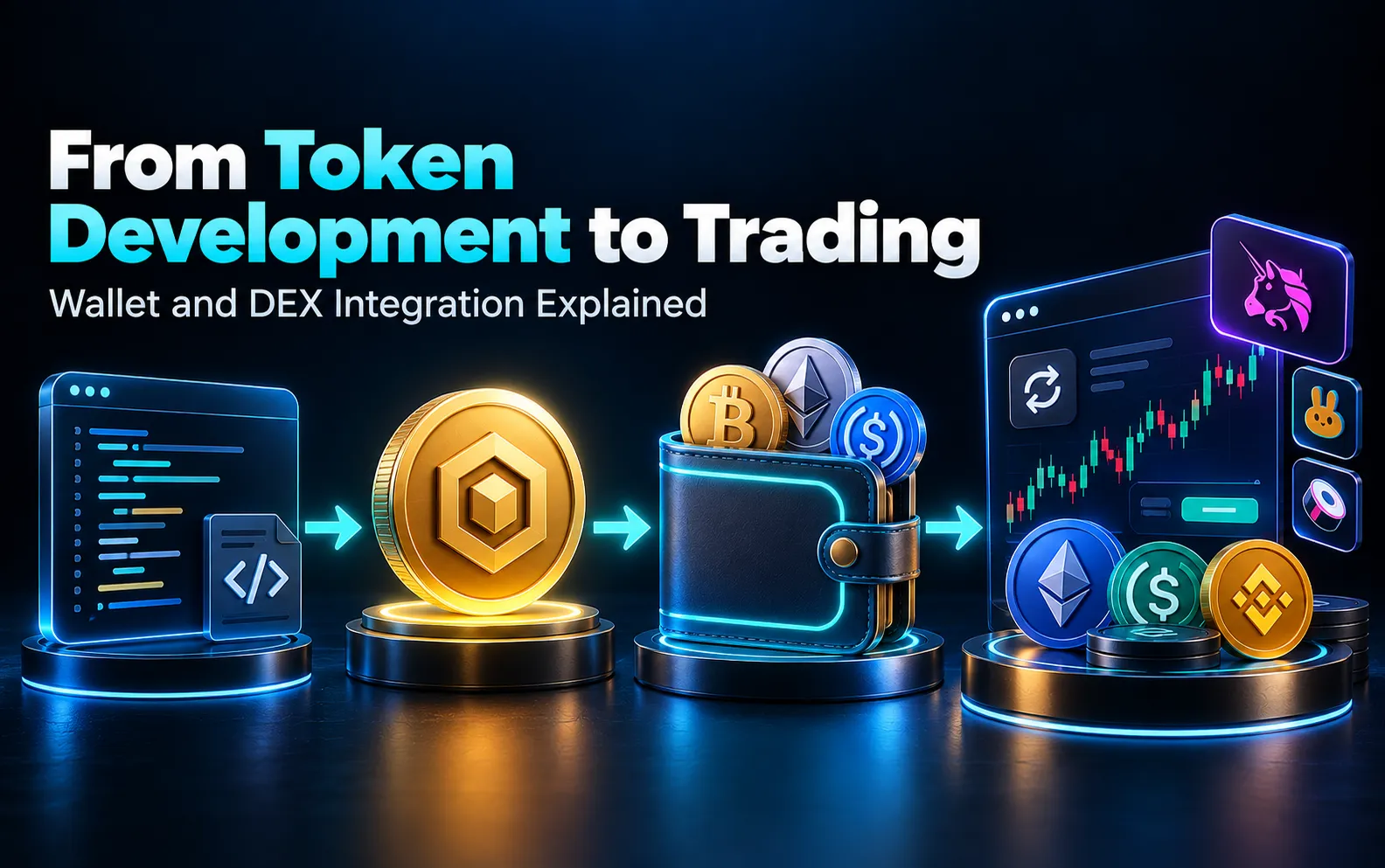

Launching a cryptocurrency token involves more than deploying a smart contract. To make the token useful, projects must connect it with compatible wallets, decentralized exchanges (DEXs), and blockchain infrastructure that supports transfers and trading.
These integrations help users view token balances, transfer assets, provide liquidity, and exchange tokens. For founders, getting these components right is essential to building a reliable token ecosystem.
1. Prepare the Token for Integration
Before integrating a token with wallets or exchanges, developers must confirm that its smart contract works correctly on the selected blockchain.
The first step is choosing an appropriate token standard. ERC-20 is widely used for fungible tokens on Ethereum and compatible networks. Solana uses its own token programs and associated token standards. Each ecosystem has different requirements for transfers, metadata, permissions, and application compatibility.
Developers should verify the token's name, symbol, decimal precision, supply, and contract or mint address. They must also confirm that transfer functions work as expected and that any additional features, such as transfer restrictions or transaction fees, are compatible with intended integrations.
Smart contract testing is particularly important because a token can be deployed successfully while still containing logic errors that affect transfers or trading. Testing on a development network helps identify problems before real assets are involved.
Projects should also document the official token address and publish verified contract information through the relevant blockchain explorer. This gives wallet users and liquidity providers a reliable way to identify the genuine asset.
2. Integrate the Token With Crypto Wallets
Wallet integration allows users to view, receive, store, and transfer tokens. However, deploying a token does not guarantee that every wallet will automatically display it.
Wallet compatibility depends on the blockchain network, token standard, metadata availability, and the wallet's asset-detection features.
For example, MetaMask can automatically display many popular ERC-20 and Solana tokens on supported networks. Users can also manually import an unlisted token using its contract or token address. This means a newly developed token may be transferable even when it does not immediately appear in a wallet's default asset list. MetaMask's token display guide explains these options.
Developers should focus on three integration requirements.
Network compatibility: The wallet must support the blockchain on which the token was deployed. If a token exists on an EVM-compatible network, users must select the correct network before interacting with it.
Token metadata: The name, symbol, and other supported details should be configured correctly. On Solana, token metadata can be stored through the Token Extensions Program or associated metadata mechanisms. The Solana token metadata documentation explains the available approaches.
Transaction functionality: Users should be able to receive and send tokens without unexpected failures. Developers should test transfers, balance updates, transaction confirmations, and any special token behavior across the wallets they intend to support.
If a project is building its own wallet or decentralized application, developers may also need wallet connection libraries, blockchain RPC access, transaction-signing workflows, and clear confirmation screens.
The objective is not simply to make the token visible. It is to provide a predictable user experience from receiving the asset to completing a transaction.
3. Connect the Token to a Decentralized Exchange
Wallet support makes a token accessible to holders, but exchange integration introduces another requirement: a market where users can trade it.
DEXs generally allow users to exchange assets through smart contracts rather than relying on a centralized exchange to maintain customer trading accounts. Many automated market maker platforms use liquidity pools containing two assets.
For example, a project might create a token-to-ETH or token-to-USDC trading pair. Traders can then swap between the assets, provided the selected DEX supports the relevant network and pool.
On platforms such as Uniswap, developers can create liquidity pools using supported protocol versions. The Uniswap developer documentation explains pool creation and initial liquidity provision.
A typical integration process involves deploying the token, selecting a compatible DEX and trading pair, creating or initializing the pool, and supplying initial liquidity. Developers must also configure the starting price and applicable pool parameters.
The exact process varies by exchange and protocol version. Some DEXs use permissionless pools, while others apply different listing or market-creation mechanisms.
It is also important to distinguish between creating a pool and making a token discoverable across the wider market. A pool may be available for trading without the token appearing immediately in every DEX interface, wallet search, or market-data platform.
4. Plan Liquidity Before Enabling Trading
Creating a trading pool does not automatically create a healthy market. The pool needs sufficient liquidity for users to buy and sell tokens without excessive price movements.
Liquidity providers deposit assets into a pool and may earn a share of trading fees. In return, they face risks such as impermanent loss, price volatility, and changes in the value of their deposited assets.
The initial liquidity ratio also influences the pool's starting price. In a conventional two-asset pool, depositing unequal values relative to the intended market price can create opportunities for arbitrage. Uniswap's pool documentation explains how initial reserves establish trading conditions.
Consider a project launching a token against ETH. If the pool contains very little liquidity, a relatively small trade may move the price substantially. Larger trades can experience greater slippage, discouraging users from trading.
Founders should therefore assess expected trading demand, available liquidity capital, token distribution, and the risks associated with their chosen pool design. Concentrated-liquidity pools may improve capital efficiency, but liquidity providers must understand the selected price range and its management requirements.
Projects should also communicate liquidity arrangements transparently. Marketing a token as tradable does not guarantee deep liquidity, stable pricing, or consistent trading volume.
5. Test Security and Integration Reliability
Wallet and DEX integrations introduce risks beyond the token contract itself. A mistake in token addresses, liquidity settings, transaction approvals, or interface configuration can expose users to financial losses.
Before launch, developers should test the complete transaction journey on a test network or controlled environment. This includes wallet connection, token display, transfers, approvals, swaps, liquidity provision, and transaction failure handling.
Smart contracts should undergo appropriate security reviews and testing. Particular attention should be paid to privileged permissions, minting controls, upgrade mechanisms, transfer restrictions, and any custom logic that could interfere with exchange operations.
Users should also receive clear information about the official contract address and supported networks. Fake tokens can copy a project's name and symbol, making address verification especially important.
For DEX integrations, developers must check the selected protocol's contract addresses, pool configuration, fee settings, and slippage protections. Uniswap's developer guidance warns that an empty pool's initial price can be manipulated and recommends appropriate slippage controls when adding initial liquidity. Read the pool creation guidance.
Security testing should continue after launch. Monitoring failed transactions, unusual token transfers, liquidity changes, and unexpected contract activity can help teams identify issues before they escalate.
6. Improve Token Discoverability and User Adoption
Once wallet and DEX functionality is working, the project must help users find and identify the token.
Founders should publish official token details on their website, provide links to the correct blockchain explorer, and explain how users can add the asset to supported wallets. The project should also link directly to its verified trading pool where appropriate.
Token metadata, market-data integrations, and third-party listings may require separate submissions or reviews. Acceptance is not automatic, and requirements vary by platform.
A clear launch page should explain the token's purpose, supported network, official address, available trading pairs, and relevant risks. Consistent information across these channels reduces confusion and helps users distinguish the genuine asset from imitations.
Projects should monitor practical indicators such as successful transfers, swap activity, liquidity depth, failed transaction rates, and repeat usage. These measurements provide more useful feedback than token visibility alone.
Conclusion
Moving from token development to trading requires coordinated work across smart contracts, wallet compatibility, metadata, DEX pools, liquidity, and security.
Founders should verify the token before deployment, test wallet functionality, choose an appropriate trading venue, and plan liquidity around realistic market demand. They should also maintain accurate token information and monitor integrations after launch.
Blockchain App Factory supports businesses exploring token development, smart contract implementation, and deployment planning. A structured integration strategy can help projects move beyond token creation toward a more accessible, secure, and usable token ecosystem.














Sign in to leave a comment.