

Organizations are generating and processing unprecedented volumes of data across distributed applications, cloud platforms, analytics environments, and AI-driven workflows. As data ecosystems become more complex, enterprises require storage infrastructures that can support automation, intelligent data management, and seamless access across diverse environments. In this evolving landscape, NAS Storage is emerging as a foundational component that bridges performance, accessibility, and operational efficiency.
Rather than functioning solely as a centralized file repository, modern storage architectures are increasingly designed to support automated workflows, policy-driven data movement, and intelligent resource allocation. As enterprises modernize their infrastructure strategies, Network Attached Storage continues to play a significant role in enabling scalable and automated data operations.
NAS Storage as the Foundation of Intelligent Data Management
Intelligent data management relies on the ability to classify, organize, protect, and distribute information based on business requirements. Traditional storage silos often create operational challenges by limiting visibility and increasing administrative complexity. Centralized file-based architectures address these issues by providing a unified platform for storing and managing enterprise data.
Modern NAS Storage systems support advanced metadata management, automated tiering, and policy-based administration. These capabilities allow organizations to place data on the most appropriate storage resources while maintaining accessibility across departments and applications.
As automation becomes a core requirement within enterprise IT operations, storage systems are increasingly integrated with orchestration tools that can automate provisioning, workload balancing, and lifecycle management. This reduces manual intervention while improving consistency across large-scale environments.
The Expanding Role of Enterprise NAS in Automated Infrastructure
Automation initiatives require storage platforms that can respond dynamically to changing workload demands. This is where Enterprise NAS solutions provide significant value. Unlike conventional file storage systems, enterprise-grade architectures are designed to support large user populations, high-performance applications, and continuous availability requirements.
Organizations operating data-intensive workloads such as analytics, software development, media processing, and machine learning require storage infrastructures that can scale without introducing complexity. Enterprise NAS platforms provide centralized storage pools that can be expanded while maintaining consistent performance and management controls.
Automation frameworks increasingly leverage APIs and infrastructure-as-code practices to provision storage resources automatically. Enterprise storage platforms capable of integrating with these tools enable IT teams to accelerate deployment cycles while maintaining governance and compliance standards.
As enterprises continue to adopt automated operations models, Enterprise NAS is expected to become more tightly integrated with intelligent monitoring systems that can predict capacity requirements, identify performance bottlenecks, and optimize resource allocation before issues impact business operations.
Integrating File and Block Workloads with iSCSI NAS
One of the most important developments in modern storage architecture is the convergence of file and block storage services. Organizations frequently operate applications that require both shared file access and block-level storage. Managing separate infrastructures for these workloads can increase costs and administrative overhead.
iSCSI NAS platforms address this challenge by supporting block-level connectivity alongside traditional file-sharing protocols. Through iSCSI technology, storage resources can be presented directly to servers as block devices while still maintaining centralized management capabilities.
This flexibility is particularly valuable in virtualization environments where virtual machines, databases, and application workloads require predictable performance characteristics. iSCSI NAS enables organizations to consolidate infrastructure while supporting diverse application requirements.
As automation technologies mature, iSCSI NAS systems are increasingly integrated with orchestration platforms that automatically allocate storage volumes based on workload policies. This capability simplifies storage management while improving resource utilization across enterprise environments.
The growing adoption of containerized applications and virtualized infrastructure is also driving demand for storage platforms capable of supporting both file and block workloads from a unified architecture. This trend positions iSCSI NAS as an important component of future intelligent data ecosystems.
Scalability, Performance, and Data Protection in Future Storage Architectures
The future of enterprise storage will be defined by the ability to scale efficiently while maintaining consistent performance. Data growth continues to accelerate due to analytics initiatives, IoT deployments, AI training datasets, and regulatory retention requirements.
Modern NAS Storage architectures are evolving to support scale-out designs that distribute workloads across multiple nodes. This approach enables organizations to expand storage capacity and throughput simultaneously without disrupting operations. Intelligent load balancing further improves performance by ensuring that storage resources are utilized efficiently.
Performance optimization is increasingly supported through technologies such as flash storage, automated caching, and workload-aware resource allocation. These capabilities allow storage infrastructures to meet the demands of latency-sensitive enterprise applications while supporting large-scale data repositories.
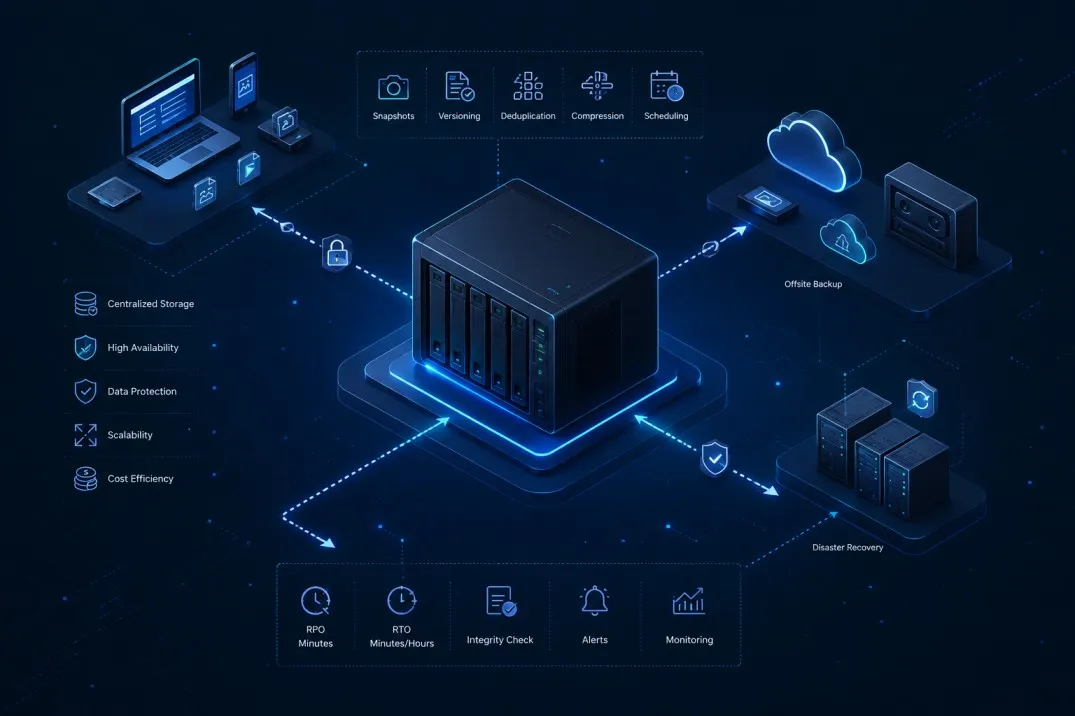
Data protection remains equally important. Enterprises must protect information against hardware failures, cyber threats, accidental deletion, and site-level disruptions. Future storage architectures are expected to incorporate increasingly sophisticated protection mechanisms, including automated replication, immutable snapshots, continuous monitoring, and policy-driven backup workflows.
These technologies help organizations strengthen resilience while reducing the operational burden associated with traditional disaster recovery processes.
The Future Outlook for Intelligent and Automated Storage Operations
As organizations continue their digital transformation journeys, storage infrastructure will become more closely aligned with automation, analytics, and intelligent decision-making systems. Rather than serving as passive repositories, storage platforms will actively participate in workload optimization and operational efficiency initiatives.
Future Enterprise NAS deployments will likely incorporate predictive analytics capable of identifying usage trends, forecasting capacity requirements, and automating resource adjustments. Machine learning technologies may further enhance storage management by detecting anomalies and recommending optimization strategies before performance issues emerge.
Similarly, advancements in iSCSI NAS capabilities will continue supporting increasingly complex application environments where block and file services must coexist within a unified management framework. This convergence will simplify operations while improving infrastructure flexibility.
Ultimately, the future of NAS Storage lies in its ability to function as an intelligent data platform rather than merely a storage destination. By combining automation, scalability, performance optimization, and advanced protection capabilities, NAS architectures are positioned to support the next generation of enterprise data management strategies.
The evolution of enterprise IT is driving demand for storage infrastructures that can manage growing data volumes while supporting automation and operational intelligence. NAS Storage is increasingly becoming a strategic component of modern data architectures because it provides centralized management, scalable performance, and strong integration capabilities across diverse workloads. As organizations expand their use of automation, analytics, and data-driven operations, technologies such as Enterprise NAS and iSCSI NAS will continue playing a critical role in enabling efficient, resilient, and intelligent storage environments for the future.




























Sign in to leave a comment.