
Ever asked a video game character a question that wasn't on the script, and watched the conversation collapse into the same three lines it always says?
That moment is the clearest signal of where game design still lags behind what players now expect from interactive characters. A gaming avatar built on conversational AI does not eliminate that gap by being smarter in the abstract. It closes it by staying in character while actually responding to what the player said.
This piece looks at what separates a real gaming NPC upgrade from a tech demo, what production teams need to plan for before shipping one, and where this is already showing up across genres.
Table of Contents
- Where Scripted NPCs Lose Players
- What Makes a Gaming Avatar Different From a Chatbot
- Building an AI NPC Without Breaking the Game's Lore
- Shipping Considerations for Studios
- Comparison Table
- Applications Across Industries
- Benefits
- Future Outlook
- FAQs
- Conclusion
Where Scripted NPCs Lose Players
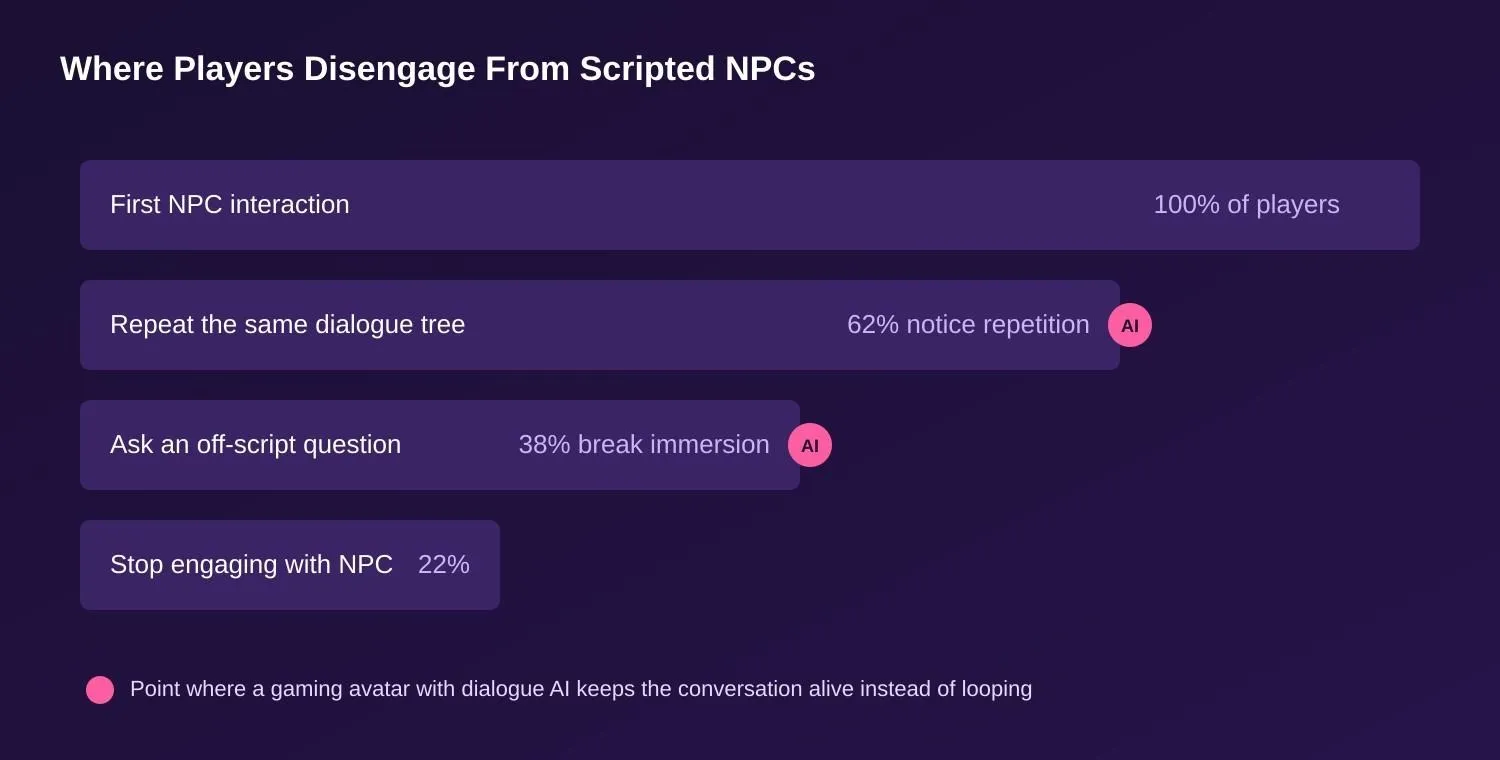
Dialogue trees and bark systems were built for a constraint that no longer fully applies: limited memory, limited compute, and a fixed number of voice lines a studio could afford to record. Inside that constraint, branching trees and randomized barks were a genuinely good solution. Players simply did not expect more.
That expectation has shifted. Players who spend time with live-service titles, companion apps, and conversational tools elsewhere now notice immediately when a character loops the same four lines or stalls on a question slightly outside its script. The break in immersion is small individually, but it accumulates across a playthrough.
This is the specific gap an avatar for gaming closes. Instead of routing the player through a fixed tree, the character holds a flexible conversation inside a defined lore and behavior boundary, so it can respond to genuine player input without going off the rails of the story.
What Makes a Gaming Avatar Different From a Chatbot
A generic chatbot answers questions. A gaming avatar stays in character while answering questions, which is a meaningfully harder constraint. It needs to know what it is allowed to reveal, what breaks the fourth wall, and what contradicts established lore, all while sounding like a consistent personality rather than a search interface wearing a costume.
That distinction is why a generic large language model wrapper, dropped into a game without additional structure, tends to fail quickly. It will answer questions about the real world, break character under pressure, or contradict the story bible the writing team spent months building. None of that is a model problem. It is a missing behavioral layer.
Three layers typically separate a working in-game character from a tech demo: a persona and voice profile, a lore and topic boundary system, and a real-time integration layer that keeps response latency inside what a player will tolerate mid-combat or mid-dialogue.
Building an AI NPC Without Breaking the Game's Lore
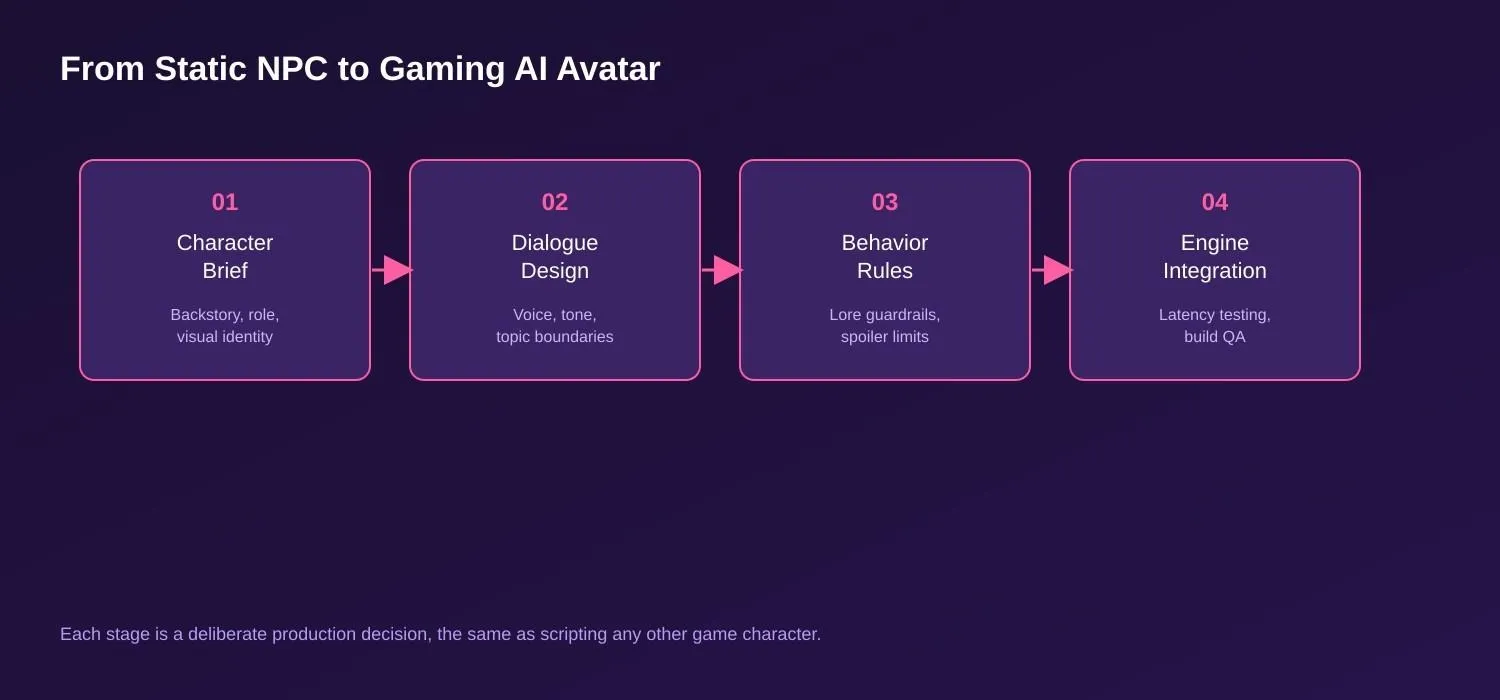
Games already have a process for keeping characters consistent: a story bible, a voice direction document, and a continuity pass before each build ships. A gaming NPC built on conversational AI needs the same process, just applied to a system that can generate new lines instead of only playing back recorded ones.
Mimic Minds has covered the mechanics of this in more depth in AI NPCs in Gaming, which walks through how studios structure the lore guardrails that keep a conversational character from contradicting the world it lives in.
What the guardrail layer typically covers
- Topic boundaries: what the character will and will not discuss, including spoilers for content the player has not reached
- Voice and tone consistency: matching the studio's established character bible, not a generic assistant voice
- Escalation behavior: what happens when a player tries to break the character or extract system instructions
- Patch compatibility: how the character's knowledge updates when new content ships
Shipping Considerations for Studios
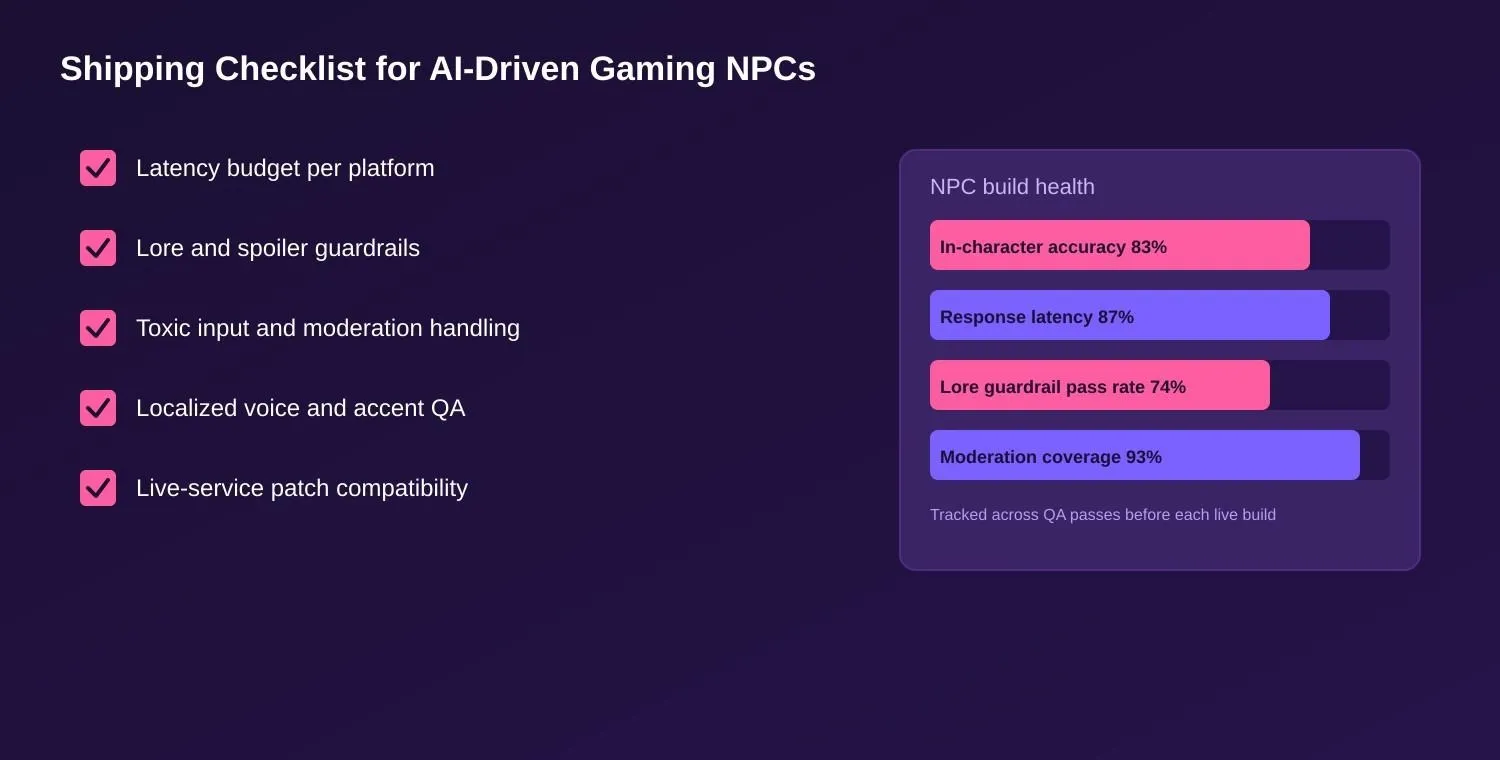
Latency is the first wall most teams hit. A response that takes three seconds to generate is fine in a chat app and unacceptable in the middle of a boss encounter or a fast-paced dialogue scene. Studios need a clear latency budget per platform before committing to a conversational NPC in any time-sensitive context.
Moderation is the second wall. Multiplayer titles in particular need a plan for adversarial input, players who will deliberately try to make the character say something off-brand, break lore, or produce content that violates platform policy. This is not a hypothetical; it is one of the first things a live community will test.
Treating Games Avatars as a production feature with its own QA pass, rather than a bolt-on chatbot, is what separates a launch that holds up from one that gets clipped and circulated for the wrong reasons. The same discipline applies whether the character is a companion, a merchant, or a rival.
For studios scoping this for the first time, the gaming avatar page outlines the production approach Mimic Minds uses to take a character from brief to a shippable, in-engine build.
Comparison Table
| Approach | Best For | Limitations | Ideal Use Case |
|---|---|---|---|
| Branching dialogue tree | Linear story beats | Repeats once players exhaust the tree | Single-player narrative quests |
| Bark system (random lines) | Ambient world flavor | No real responsiveness to player input | Crowd NPCs, background chatter |
| Rule-based quest giver | Fetch and delivery quests | Breaks immersion on off-script questions | MMO hub towns |
| Gaming avatar (general AI NPC) | Reactive, in-character conversation | Needs lore guardrails and latency tuning | Companions, merchants, rivals |
| Studio-produced games avatar | Persistent characters across a live-service title | Requires ongoing content and QA investment | Flagship NPCs, esports hosts, social hubs |
Applications Across Industries
Conversational gaming avatars are not limited to traditional console and PC titles. A partial view of where this is already showing up:
- Live-service RPGs: Companion characters that remember prior player choices and reference them naturally in later conversations.
- MMOs: Quest givers and merchants that handle off-script questions without breaking the hub town's tone.
- Mobile and casual games: Lightweight conversational mascots that increase session length through ongoing dialogue rather than one-off barks.
- Esports and streaming: AI-hosted commentary or lobby characters that interact with chat in real time during events.
- Location-based entertainment: Themed gaming lounges and arcades using avatar hosts as an interactive front-of-house presence.
- Training and simulation: Game-engine-based training scenarios where the AI character plays a realistic counterpart for practice conversations.
- Social and virtual worlds: Persistent avatar residents that give a virtual space a sense of being inhabited rather than empty.
Each of these contexts has a different tolerance for latency, a different lore complexity, and a different moderation risk profile, which is exactly why the production pipeline matters more than the underlying model choice.
Benefits
When built with the right production discipline, the benefits show up in player behavior, not just in a demo reel.
- Longer engagement per session: players linger in conversations that feel responsive rather than scripted.
- Reduced perceived repetition: the same character can vary its phrasing without losing its established personality.
- Stronger narrative immersion: off-script questions get an in-world answer instead of a dead end.
- Lower voice-recording overhead over time: new dialogue can be generated within guardrails instead of fully re-recorded for every patch.
- Better live-service retention: characters that evolve with the story keep returning players curious about what changed.
- Differentiated marketing moments: a genuinely responsive NPC is the kind of feature that generates organic player-shared clips.
Future Outlook
The current generation of AI-driven NPCs mostly reacts to direct player input. The next step is proactive behavior: characters that notice what the player has been doing across a session and bring it up unprompted, the way a real companion would.
Cross-title persistence is the other emerging direction. As studios build connected universes and live-service ecosystems, a character's memory of a player may eventually carry across related titles or seasons rather than resetting with every new build.
Expect to see:
- Tighter integration between dialogue AI and animation systems for more natural facial reaction
- Per-player memory systems that persist across long-running live-service seasons
- Studio tooling that lets narrative writers edit guardrails without touching engineering code
- More granular moderation tooling tuned specifically for in-character adversarial testing
As this matures, the studios that treat their gaming avatar the way they treat any other named character, with a writer's room, a voice direction pass, and a QA cycle, will be the ones whose NPCs hold up across a multi-year live-service run.
FAQs
What is a gaming avatar?
It is a character inside a game, a companion, merchant, rival, or host, powered by conversational AI rather than a fixed dialogue tree, designed to respond to player input while staying within the game's lore and tone.
How is an AI NPC different from a regular chatbot dropped into a game?
A regular chatbot answers generically and can break character under pressure. An AI NPC is built with lore guardrails, a defined voice, and topic boundaries so it behaves like a consistent character rather than a generic assistant wearing a skin.
Does this replace voice actors?
Not typically. Most production pipelines still use recorded voice talent for core lines and rely on the conversational layer for variation and responsiveness within that established voice, rather than replacing the actor outright.
What is the biggest technical risk when shipping an AI-driven NPC?
Latency and moderation are the two most common failure points. A slow response breaks pacing, and an unmoderated character can be pushed by players into saying something off-brand or lore-breaking.
Can players break an AI NPC's character on purpose?
They will try, especially in multiplayer titles. A well-built guardrail layer anticipates this and has defined fallback behavior, rather than hoping players play nice.
Does this work for single-player narrative games as well as live-service titles?
Yes. Single-player titles benefit from companions and rivals that react to player choices in a less repetitive way, even without the ongoing content cadence a live-service title requires.
How long does it take to build and ship one of these characters?
A well-scoped character, from brief through dialogue design, guardrail testing, and engine integration, typically takes between eight and fourteen weeks depending on lore complexity and platform requirements.
Conclusion
Players have already raised the bar for what an in-game character should be able to do. A gaming avatar that handles real conversation, while staying inside the lore and tone the writing team built, is what closes the gap between a scripted NPC and a character that feels genuinely present.
Getting there is a production discipline, not a model integration. The character brief, the guardrails, the latency budget, and the moderation plan all matter as much as the underlying AI. Studios that treat the avatar as a real character will ship something players remember. Studios that treat it as a quick chatbot bolt-on will ship something players break within a week.
About the Author
This article was contributed by the Mimic Minds team. Mimic Minds is a digital human and conversational AI studio building production-grade AI avatars and AI NPCs for game studios, live-service titles, and interactive entertainment brands. Their work spans character design, dialogue AI, and real-time engine integration.

























![Best Cloud Computing Courses & Certificates [2026]](/data/post/1865935/a3146442e219da996ed3b2fd.webp)

Sign in to leave a comment.