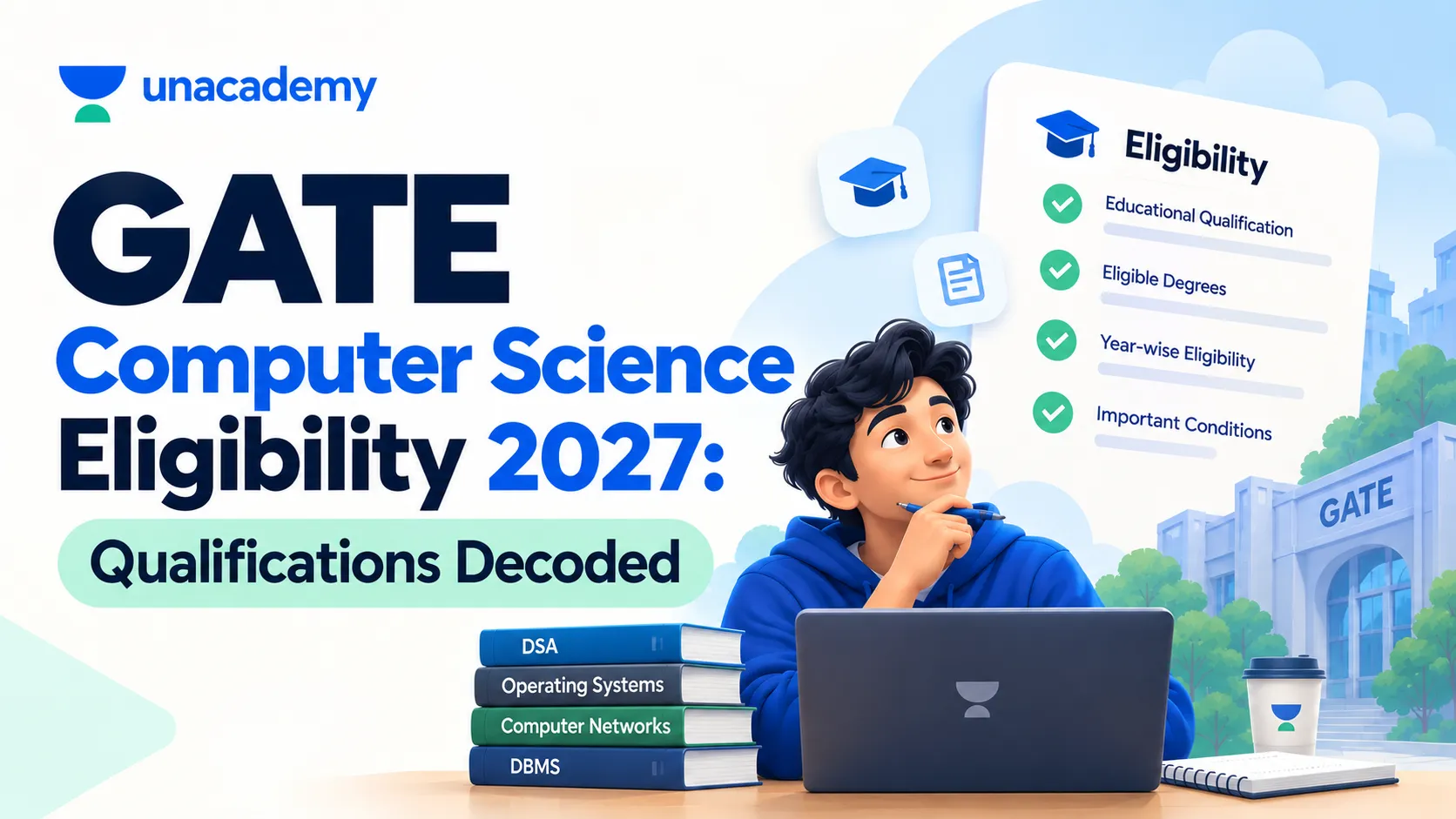

You sit down at your desk late at night, open multiple tabs on your browser, and try to map out your study schedule. Within fifteen minutes of browsing candidate forums, you run directly into conflicting advice.
One thread claims you cannot sit for the exam if you have an active academic backlog. Another insists that only graduates with an undergraduate degree in Computer Science can appear for the CS paper. A third commenter confidently asserts that you need a strict 60% minimum aggregate in college just to submit the registration form.
When you are preparing to dedicate hundreds of hours to mastering discrete mathematics, operating systems, and data structures, the last thing you need hanging over your head is ambiguity about whether you can legally take the test.
Let's clear the air once and for all. Here is an honest, practical breakdown of GATE Computer Science eligibility 2027, decoding what the organising institute actually demands from your degree, your age, and your academic background.

The Degree Breakdown: Who Can Actually Register?
The administrative framework behind GATE CSE Eligibility 2027 is far more inclusive than most students realize. The exam is designed to test foundational engineering acumen and analytical aptitude, not to penalize students based on rigid technicalities.
To satisfy GATE Computer Science eligibility 2027, you must fit into one of the following academic categories:
- B.E. / B.Tech / B.S. (4-Year Programs): You are eligible if you are currently studying in your 3rd year or higher, or if you have already completed your degree.
- MCA / M.Sc. (Computer Science, IT, Mathematics, or Statistics): Candidates currently in their 1st year or higher of a master's program, or those who have completed post-graduation, are fully qualified.
- BCA / B.Sc. (3-Year Undergraduate Programs): Under the established 10+2+3 criteria, candidates enrolled in their 3rd (final) year or those who have completed a 3-year bachelor's degree are permitted to register.
- Integrated Dual Degree / Integrated M.Tech (5-Year Programs): You can sit for the exam starting from your 3rd, 4th, or 5th year.
- Professional Society Qualifications: Candidates holding qualifications deemed equivalent to B.E./B.Tech (such as AMIE recognized by MoE/UPSC/AICTE) who have finished Section A or equivalent.
| Criterion / Qualification PNG | GATE CS 2027 Eligibility Status PNG |
|---|---|
4-Year B.Tech / B.E.
| Eligible from 3rd year onwards
|
3-Year BCA / B.Sc.
| Eligible in 3rd year or post-graduation
|
MCA / M.Sc.
| Eligible from 1st year onwards
|
Minimum Pass Marks
| No cut-off percentage required to appear
|
Active Backlogs
| Permitted (requires bonafide proof of study)
|
The Strategic Value of the 3rd-Year Rule
Being permitted to attempt the exam in your pre-final year is one of the most useful provisions in technical higher education. Your GATE score remains valid for three consecutive years from the official date of result declaration.
If you manage to secure a top rank during your 3rd year, you can hold that scorecard and use it for M.Tech admissions or selected PSU recruitments right after completing your final year. If your first attempt falls short, you walk into your final college year knowing precisely how the computer-based interface behaves, how time pressure feels under exam hall conditions, and where your conceptual gaps lie.
Age, Nationality, and Attempt Rules
Academic rumors often intimidate older candidates and working professionals into believing they have aged out of technical entrance exams. Here are the exact boundaries:
The GATE CS 2027 age limit
There is officially no GATE CS 2027 age limit. You can register whether you are 21, 32, or 48. Whether you are an undergraduate, someone returning from a five-year stint in the software industry, or a professional aiming to pivot your research profile, age does not restrict your eligibility.
The GATE CS 2027 attempt limit
There is no GATE CS 2027 attempt limit. You are free to attempt the exam as many times as you deem necessary. There is no cumulative lifetime cap, and previous unsuccessful attempts do not reflect on or penalize your subsequent scorecards.
Nationality Requirements
Indian citizens are naturally eligible. International candidates including applicants from Nepal, Bangladesh, Sri Lanka, Singapore, Ethiopia, and the UAE can also register and attempt the paper.
Switching Streams: Can Non-CS Students Write the CS Paper?
One of the most frequent dilemmas faced by engineering students is branch transition. If you are enrolled in Mechanical, Civil, Electrical, or Electronics and Communication Engineering, can you write the GATE CS paper?
The short answer is: yes, absolutely.
The GATE organizing body grants candidates full freedom to select any test paper code regardless of their original branch of study. If you hold a degree in Electrical Engineering but your academic passion lies in Algorithms and Databases, you can register for Computer Science and Information Technology (CS) without administrative pushback.
A Realistic Admission Warning: While the exam committee allows cross-branch appearances, postgraduate admissions are governed independently by IITs, NITs, and IIITs through portals like COAP and CCMT. Most premier IITs will gladly accept a non-CS undergraduate into their M.Tech Computer Science program if their GATE score is stellar, but select specialized departments or public sector employers insist on a core undergraduate degree in CS/IT. Always verify your specific target institute’s seat-allocation brochures ahead of time.
Things You Should Know: Common Pitfalls and Clarifications
The Minimum Marks Myth: You do not need a 60% aggregate or a specific CGPA to sit for GATE. Passing status in your qualifying degree is sufficient to write the exam. However, remember that post-exam counseling bodies (like CCMT) almost universally mandate a minimum of 60% (or 6.5 CGPA) for General/OBC categories at the time of seat confirmation.
- The Backlog Confusion: Having an uncleared subject or ATKT during registration does not disqualify you. As long as your institution certifies that you are an enrolled student in an eligible year, you can appear. You only need to present a completely clear, passed transcript when you formally report for institute admission.
Distance and Online Degrees: Degrees obtained through open universities or distance programs are recognized, provided the institution and course are officially approved by the UGC or AICTE.
- The Two-Paper Combination Rule: You can register for two papers within a single application cycle if you pick from the approved list of primary and secondary combinations (such as Computer Science paired with Data Science & Artificial Intelligence).
Realistic Candidate Perspectives
"I spent nearly four months worrying that my background in Electronics and Telecommunication would disqualify me from appearing for GATE CS. In reality, the portal accepted my registration without a second thought. I secured a double-digit rank and secured a seat for M.Tech CSE at an older IIT without experiencing any friction during document verification."
— Ananya S., M.Tech CSE
"Appearing in my 3rd year changed my entire approach. I didn't clear the cutoff on my first attempt because my preparation in Theory of Computation and Compiler Design was shaky. But experiencing the virtual calculator and managing rough sheets under actual exam pressure took away all the anxiety for my final year attempt."
— Karthik R., Research Scholar
Frequently Asked Questions
What documents must I submit to prove my eligibility if I am still in college?
If you have not yet completed your degree, you need to upload an official Certificate from the Head of the Department/Institute or a signed Bonafide Certificate stating that you are currently enrolled in the 3rd year or higher. A valid college identity card alongside recent mark sheets can also suffice depending on specific organizing portal requirements.
Is there an upper age limit for PSU recruitment through GATE CS?
Even though there is no GATE CS 2027 age limit for writing the exam itself, public sector undertakings (PSUs) enforce their own recruitment limits. Most PSUs require general-category candidates to be between 26 and 30 years old at the time of recruitment, with standard category relaxations.
Can a 3-year BCA graduate directly join an M.Tech program after clearing GATE CS?
While 3-year degree holders meet basic GATE CSE Eligibility 2027 criteria to sit for the paper, most IITs and NITs demand a minimum of 4 years of undergraduate study or a completed Master's degree (like MCA or M.Sc.) for direct entry into M.Tech programs. BCA graduates typically utilize their GATE scores during or after an MCA.
How does the GATE attempt count impact PSU selections?
The GATE CS 2027 attempt limit does not exist, and PSUs do not evaluate how many times you wrote the test in previous years. They evaluate only the single, valid scorecard and rank you choose to submit during their active hiring cycle.
Can I change my examination discipline after submitting the application?
Once the application window closes, the organizing committee usually opens a brief correction window where candidates can change their selected test paper upon payment of an administrative fee. However, choosing the correct paper code during initial registration prevents unnecessary portal complications.
A Grounded Next Step
Confirming your GATE Computer Science eligibility 2027 is an essential checklist item, but it is ultimately just the baseline. The examination syllabus requires deep, structured comprehension of Core Computer Science principles rather than rote learning.
Instead of spending more hours scanning discussion boards for eligibility minutiae, direct your energy toward reviewing standard syllabus weightages, working through standard reference materials, and solving previous years' questions. If your graduation timeline aligns with the 2027 test cycle, your window to establish a steady, calm study routine is open right now.


























Sign in to leave a comment.