
You have probably spent hours reviewing past-year question banks, planning a study calendar, or checking out PSU career pathways. Yet, for many aspirants, the first hurdle isn't mastering complex calculus or thermodynamics it is figuring out whether you are formally qualified to sit for the paper in the first place.
Misinformation spreads quickly through college corridors and messaging groups. You will hear claims that third-year students are no longer permitted to apply, that an active semester backlog immediately invalidates your registration, or that your undergraduate percentage must clear a strict barrier just to write the test.
The reality is much more straightforward once you look past the noise. Below is a clear, grounded breakdown of the official gate exam eligibility standards, qualifying academic pathways, and the practical details you should know before registering.

What Determines Your GATE Exam Eligibility?
To figure out whether you satisfy the fundamental gate eligibility criteria, you only need to look at three factors: your enrolled or completed academic degree, your current stage within that program, and the regulatory recognition of your college or university.
The organizing bodies the Indian Institute of Science (IISc) and the Indian Institutes of Technology (IITs) intentionally maintain an open doorway for candidates. Unlike many competitive recruitment exams, GATE functions primarily as a national-level evaluation of fundamental aptitude and engineering comprehension.
1. Age Limit and Attempt Count
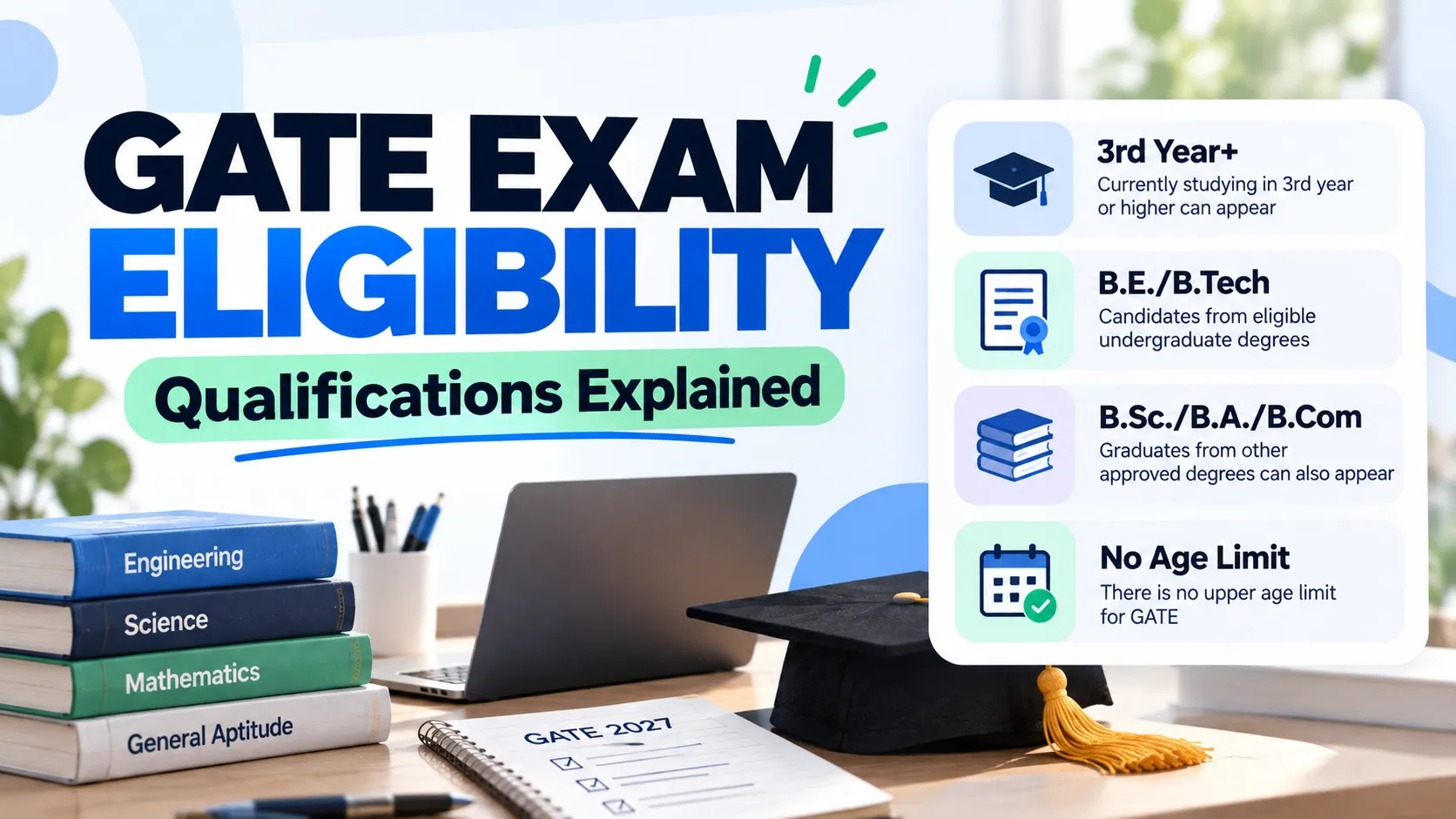
There is no upper age limit and no restriction on the number of attempts. Whether you are an undergraduate student sitting for your first mock test or a professional returning to technical research after years in the industry, you can register and write the exam as many times as you like.
2. Minimum Graduation Marks to Appear
A frequent misunderstanding is that you must carry a minimum of 60% aggregate or a 6.5 CGPA in your bachelor's degree just to appear for the test. To register and sit for the exam, there is no minimum percentage requirement. You only need to be in the eligible study year or hold a completed degree.
Note: While the exam itself sets no baseline percentage cut-off, individual institutions (such as IITs, NITs, and IIITs) and Public Sector Undertakings (PSUs like ONGC, IOCL, or NTPC) enforce their own qualifying graduation cut-offs (often 60% or 6.5 CGPA for General/OBC candidates, and 50–55% for reserved categories) during subsequent admission counseling and job shortlisting.
Qualifying Degrees: The Academic Pathways
The exam accommodates nearly every accredited program across engineering, technology, architecture, science, and the humanities. If you are aligning your preparation with the gate 2027 eligibility criteria, here is how your academic background fits into the requirements:
- B.E. / B.Tech. / B.Pharm. (4-year programs): You are eligible if you are currently in your 3rd year or higher, or if you have already graduated. This also applies to candidates who joined via lateral entry (such as diploma-to-degree tracks) starting from their 5th semester.
B.Arch. / B.Planning (4 to 5-year programs): You become eligible once you enter your 3rd year of study or if you have completed the degree.
- B.Sc. / B.A. / B.Com. (3-year undergraduate programs): You can apply if you are currently enrolled in your 3rd (final) year or have already completed your degree.
- B.S. / B.Sc. Research (4-year programs): Students in their 3rd year or higher, as well as degree holders, are fully eligible.
M.Sc. / M.A. / MCA (2-year master’s programs): You become eligible from your 1st year of postgraduate study onwards, or after completion.
Integrated M.E. / M.Tech. / Dual Degree (5-year programs): You can register once you reach your 3rd year or any subsequent semester.
Professional Society Examinations (AMIE, AMICE, etc.): Candidates who have passed Section A or its recognized equivalent are eligible, provided their course registration satisfies government regulatory criteria.
The Impact of 3rd-Year Eligibility
The policy allowing third-year undergraduate students to appear for the exam offers a major practical benefit. Under the established gate eligibility criteria 2027, a third-year student can sit for the test, secure an official scorecard that remains valid for three years from the date of result announcement, and use that score directly upon graduation without being forced to take an unpaid preparation gap year.
Backlogs, Lateral Entry, and Distance Education: What Applies to You?
Standard qualification summaries rarely cover real-world academic hurdles. Here is how the governing rules address common situations:
Active Backlogs
If you are in your third or fourth year of college and carry an active backlog in an earlier semester, you can still register and appear for the exam. The application process requires proof of study or a bona fide certificate from your college confirming your enrollment in the qualifying year. However, keep in mind that by the time you report for M.Tech admissions or PSU document verification, you must present a clean mark sheet and a completed provisional degree.
Lateral Entry Candidates (Diploma to Degree)
If you finished a three-year polytechnic diploma and joined an engineering program directly in the second year, you are treated exactly like a traditional four-year candidate. The moment you begin your fifth semester (the start of your third academic year in college), you satisfy all criteria.
Distance Learning and Open Universities
Degrees completed through distance education or open universities (such as IGNOU) are fully recognized, provided your specific program and university carry formal approval from the UGC, AICTE, or the Ministry of Education.
Common Mistakes Candidates Make with Eligibility
Every registration cycle, many application forms face delays, corrections, or rejections due to avoidable oversights:
Mismatched identification details: The name, date of birth, and parent details on your qualifying documents must match your government-issued ID card (such as Aadhaar, Voter ID, or Passport). Minor spelling differences often create bureaucratic headaches later during verification.
Confusing exam eligibility with institutional admission criteria: Qualifying in GATE does not automatically guarantee you an interview call or seat everywhere. Certain specialized M.Tech programs require specific undergraduate branches or mandate that you studied mathematics at the 10+2 level.
Submitting incomplete college certificates: If you have not yet completed your final exams, your college certificate must carry the signature and official stamp of your Head of Department or Principal in the exact template issued by the organizing committee.
Overlooking paper combination rules: If you choose to write two papers, you must ensure that your combination is part of the approved official list and that the exam sessions do not run concurrently.
Real Candidate Perspectives
"I decided to write the paper in my third year with a focus on six core subjects. I didn't get a top rank on that attempt, but learning how the virtual calculator and exam screen actually felt removed almost all my anxiety. By the time I sat for it in my final year, I improved significantly because the exam hall was no longer unfamiliar."
— Arjun M., M.Tech Student (Mechanical), IIT Madras
"Coming from a B.Sc. in Physics, I assumed GATE was exclusively an engineering affair. Once I checked the subject options and verified the science degree eligibility, it opened up direct research pathways at national labs that regular university entrances just didn't provide."
— Sneha R., Research Fellow
Frequently Asked Questions
1. Can I appear for two test papers under the eligibility guidelines?
Yes. Candidates can choose to appear for either one paper or an approved combination of two papers from the official subject pair list published by the organizing institute. The examination schedule is specifically structured so approved combinations do not have overlapping exam slots.
2. Does my undergraduate degree discipline have to match my GATE test paper?
No. You are free to choose any test paper regardless of your graduation branch. For example, a student pursuing an undergraduate degree in civil or electrical engineering can appear for the Computer Science or Data Science & Artificial Intelligence papers. However, make sure your target post-graduate department or employer accepts that cross-disciplinary background.
3. What documents do I need to submit if I am still in college?
If you have not graduated yet, you can upload a certificate of enrollment (bona fide certificate) signed by your college Principal or Head of Department, or an official grade card from your preceding semester proving your enrollment in the 3rd year or higher.
4. Are international candidates eligible to register?
Yes. Candidates residing outside India or holding foreign citizenship can apply. You must have completed or be in the final or pre-final year of a bachelor's degree in engineering/technology or a master’s degree in a relevant science discipline.
5. How long does the GATE scorecard stay valid?
Your scorecard is valid for three years from the date the official results are declared. This extended validity allows students who take the exam in their third year to keep their score on record and apply for admission directly after completing their final year.
Conclusion
Understanding the qualification rules protects your preparation schedule, effort, and registration fees. The guidelines set by the organizing committee are designed to be inclusive across disciplines, giving students the flexibility to test their conceptual depth earlier in their academic timeline.
Take a few moments to review your college mark sheets, confirm that your administrative certificates are signed and stamped, and double-check any department-specific rules at the institutes you plan to join. Once your eligibility details are confirmed, you can focus your time and attention on mastering your syllabus.



























Sign in to leave a comment.