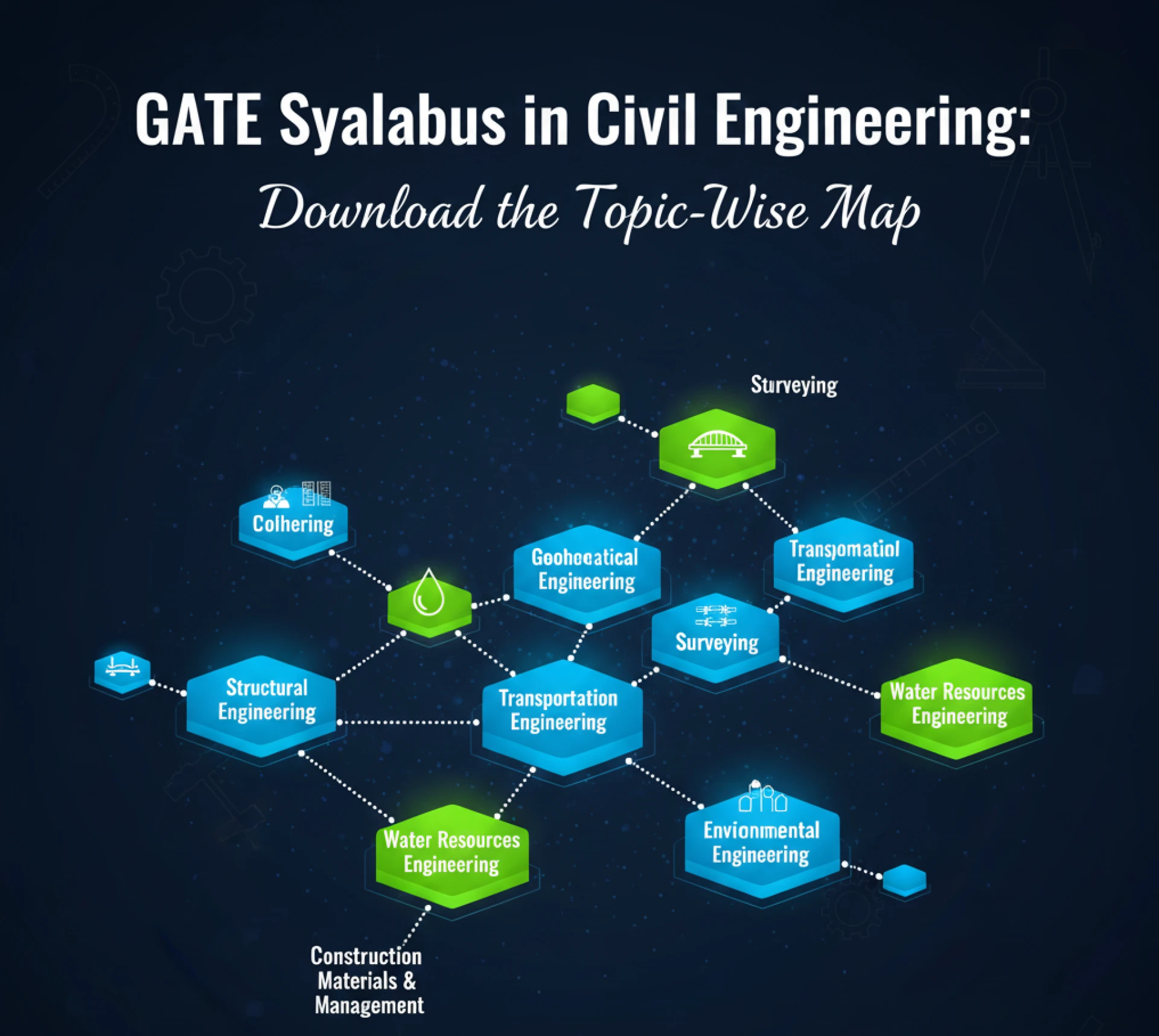

Are you feeling overwhelmed by the sheer volume of subjects in your GATE Civil Engineering preparation? You aren’t alone. Every year, over a lakh of aspirants dive into this journey, but only those with a clear, strategic map actually reach the finish line.
If you want to stop "studying hard" and start "studying smart," you need more than just a list of topics. You need to understand the weightage, the core concepts, and the exact path to 70+ marks. In this guide, we break down the GATE syllabus in civil engineering so you can prioritize your time and energy effectively.
The Strategic Breakdown of the GATE Civil Engineering Syllabus
The GATE civil engineering syllabus is broadly divided into three main components. Understanding this split is your first step toward a top rank.
- General Aptitude (15 Marks): Often called the "low-hanging fruit," this section is common across all papers and is a massive score booster for those who master the GATE CE syllabus.
- Engineering Mathematics (13–15 Marks): This is the backbone of your technical score. Mastering this section of the GATE syllabus for civil often differentiates the toppers from the average scorers.
- Core Civil Engineering Subjects (70–72 Marks): This is where the heavy lifting happens, covering everything from soil mechanics to structural design as outlined in the official GATE syllabus in civil engineering.
Section-Wise Topic Map & Weightage
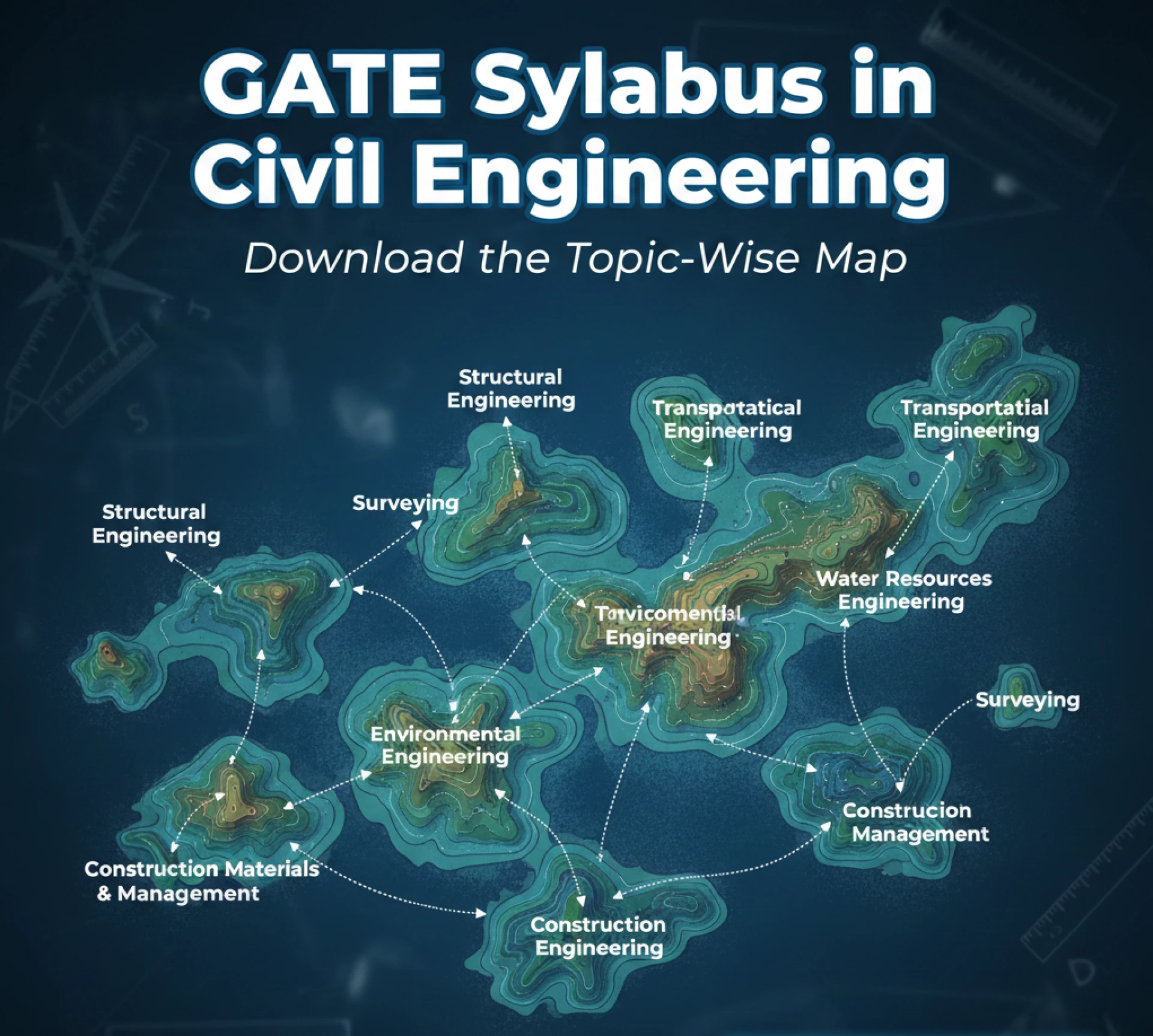
To help you visualize your preparation, here is a topic-wise map based on recent year trends. When navigating the GATE civil engineering syllabus, focus on the high-weightage subjects first to secure your qualifying marks early.
1. The "Big Three" (High Weightage)
These subjects typically account for nearly 35–40% of the marks within the GATE CE syllabus.
- Geotechnical Engineering (12–15 Marks): Covering soil mechanics and foundation engineering, this is arguably the most critical part of the GATE syllabus in civil engineering.
- Environmental Engineering (10–12 Marks): A staple of the GATE syllabus for civil, focusing on water/wastewater treatment and air pollution.
- Transportation Engineering (8–10 Marks): Essential for any GATE civil engineering syllabus plan, covering highway and traffic engineering.
2. The Structural Core
- Structural Analysis & Solid Mechanics (10–12 Marks): Key components of the GATE CE syllabus involving SFD/BMD and displacement methods.
- RCC & Steel Structures (8–10 Marks): Critical design topics found in every updated GATE syllabus in civil engineering.
3. Water Resources & Surveying
- Fluid Mechanics & Hydraulics (7–9 Marks): A fundamental pillar of the GATE syllabus for civil.
- Hydrology & Irrigation (6–8 Marks): Important for scoring well in the water resources section of the GATE civil engineering syllabus.
- Geomatics Engineering (Surveying) (4–6 Marks): Though lower in weightage, this part of the GATE CE syllabus is highly scoring.
Expert Tips: How to Tackle the GATE CE Syllabus
Success in GATE isn't about knowing everything; it's about knowing the right things well.
- Front-load Mathematics: Don't leave the math portion of the GATE syllabus in civil engineering for the end. It requires consistent practice.
- Master the NATs: Numerical Answer Type (NAT) questions are a huge part of the GATE civil engineering syllabus. They have no negative marking but require high accuracy.
- Concept over Memory: The GATE CE syllabus rarely tests rote memorization. Whether it's the Mohr's circle in Geotechnical Engineering or the Hardy Cross method, understand the "why" behind the formula.
"I spent 4 months just reading textbooks and was still failing mock tests. Once I switched to a topic-wise weightage map for the GATE syllabus for civil and focused on PYQs, my score jumped from 45 to 72."
— Animesh R., AIR 241 (GATE 2024)
FAQs: Clearing Common Doubts about the GATE CE Syllabus
1. Which is the most important subject in the GATE syllabus in civil engineering?
While every mark counts, Geotechnical Engineering consistently carries the highest weightage in the GATE civil engineering syllabus, often followed by Environmental Engineering.
2. Is Engineering Mechanics part of the GATE CE syllabus?
Yes, it is included within the Structural Engineering section of the GATE syllabus for civil, covering system of forces and free-body diagrams.
3. Can I skip certain topics in the GATE syllabus for civil?
It is not recommended to skip entire subjects. However, you can prioritize high-weightage topics within the GATE civil engineering syllabus if you are short on time.
4. How long does it take to cover the GATE CE syllabus?
On average, a dedicated 6–8 months of preparation is sufficient to cover the entire GATE syllabus in civil engineering including multiple rounds of revision.
Final Strategy for the Last Mile
As you download your topic-wise map, remember that revision is the bridge between knowledge and rank. Create short notes for every subject in the GATE civil engineering syllabus. Your revision guide for the GATE CE syllabus should include
- Key formulas and empirical relations.
- Crucial assumptions for different theories.
- A log of mistakes made during practice.
The GATE syllabus in civil engineering may seem like a mountain, but with this map, you are no longer climbing blind. You are an engineer—build your success on a solid foundation!
Would you like me to create a 6-month study timetable tailored specifically to this GATE CE syllabus map?






























Sign in to leave a comment.