

Search has shifted more in the past eighteen months than in the decade before it. Most business owners I speak with still measure their digital presence by Google rankings, but their actual customers have already moved on. People type questions into ChatGPT, Gemini, Perplexity and Grok before they ever open a traditional search engine. They read the answer, scan the citations underneath, and click through to whichever brand the AI trusted enough to name.
If your brand is missing from those citations, you are missing from the conversation. Generative Engine Optimization is the work of fixing that gap.

Why Rankings No Longer Tell the Full Story
A page can sit at position one on Google and still be completely absent from the AI Overview that appears above it. That fact tends to unsettle marketing teams the first time they see it. AI engines do not pick sources based on traditional ranking factors. They sample, score and synthesize content according to a different rulebook, and the brands that understand the rulebook are quietly pulling ahead.
Customers in markets like San Diego are already asking AI assistants for service recommendations, vendor comparisons and shortlists. The brands they hear about in those answers earn trust before a sales conversation even begins. Everyone else gets filtered out before the buyer knows they existed.
What an AI Engine Actually Looks for in a Source
When a language model receives a question, it does not flip through your homepage. It runs a real-time retrieval, pulls a handful of passages from across the web, and uses those passages to construct its answer. The selection criteria are surprisingly consistent across platforms.
First, the model looks for clean, self-contained answers. A paragraph that resolves a question without forcing the reader to scroll carries real weight. Second, it favors verifiable specificity. A claim with a number, a date or a named source beats a vague statement every time. Third, it pays attention to entity signals, meaning whether your brand appears consistently across the web alongside the topics you serve. Finally, it samples structure. Schema markup, sensible headings and tidy HTML make extraction faster and more accurate for the model.
A capable GEO Agency builds for all of these signals at once rather than picking one and hoping the rest sort themselves out.
How Generative Engine Optimization Reshapes Existing Content
Most websites already contain the raw material the AI needs. The problem is usually format, not topic. Generative Engine Optimization Services typically begin with a citation-readiness audit that maps each priority page against the questions customers ask AI tools. From there, the work splits into three parallel streams.
On the page itself, content gets restructured around answer-first paragraphs, quick-answer summaries and comparison blocks that AI models can lift cleanly. Generic headings give way to the actual phrasing of buyer questions. Statistics, citations and named studies replace filler wherever they belong.
On the technical layer, schema deployment, canonical hygiene and crawler accessibility need a careful review. AI bots like GPTBot, ClaudeBot, OAI-SearchBot and PerplexityBot need a clear path through the site. Anything that blocks or slows them down quietly costs visibility.
On the authority side, the focus shifts off-page. Trade press placements, third-party reviews, expert quotes and consistent brand presentation all reinforce the entity signals AI engines lean on. This is why generative ai for seo has so much overlap with traditional digital PR. Both depend on credible third parties saying useful things about your brand in places search systems already trust.
The Mistakes That Quietly Kill Citations
Plenty of businesses publish heavily and still never appear in AI answers. The patterns behind this are easy to spot once you know what to look for.
Long, meandering introductions push the actual answer too far down the page. Vague claims without numbers or sources read as filler to a model trained on quotability. Inconsistent brand naming across the web weakens the entity signal. Outdated content keeps circulating long after the underlying facts have shifted. Internal jargon replaces the natural language customers actually use when they ask questions.
Each of these is fixable. However, none of them get fixed by accident, which is why GEO Services exist as a distinct discipline rather than a bolt-on to existing SEO contracts.
Measuring Whether Any of This Is Working
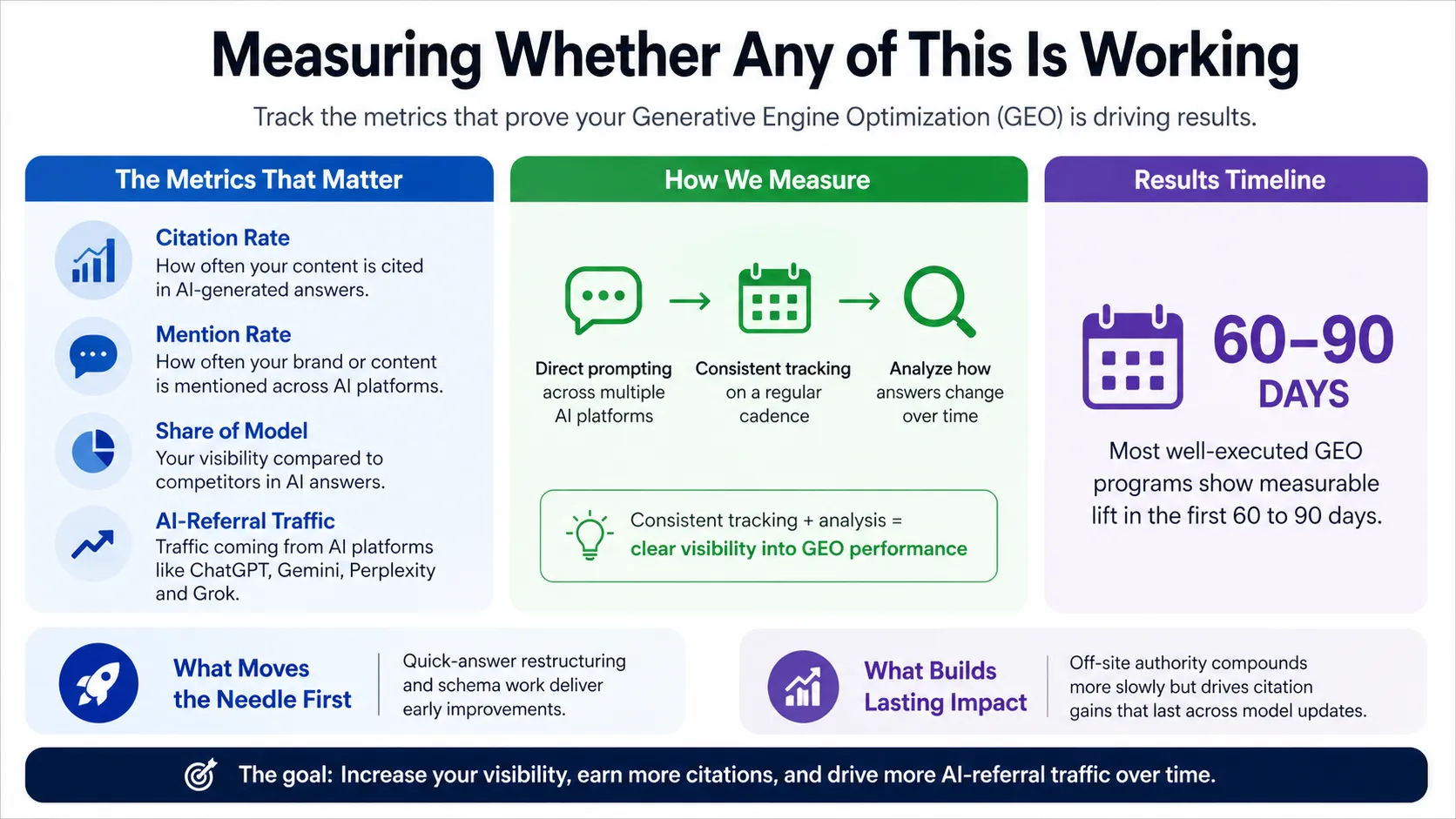
Old SEO dashboards do not capture GEO performance well. Citation rate, mention rate, share of model and AI-referral traffic are the metrics that matter now. Tracking them requires direct prompting across ChatGPT, Gemini, Perplexity and Grok on a consistent cadence, along with careful attention to how those answers shift over time.
Most well-executed Generative Engine Optimization (GEO) programs begin producing measurable lift inside the first sixty to ninety days. Quick-answer restructuring and schema work move the needle first. Off-site authority compounds more slowly, but it produces the citation gains that hold up across model updates.
Where This Leaves Forward-Looking Brands
Companies that adopt GEO now will spend the next several years compounding their position inside the citation flow. Those that wait will be playing catch-up against entities the AI already trusts. The window remains open, but it narrows every quarter.
If your San Diego business depends on being found the moment a customer asks a real buying question, the AI layer is no longer optional. High Clarity helps brands build the structure, signals and authority needed to appear inside ChatGPT, Gemini and Perplexity answers consistently. You can see how High Clarity approaches this work, and from there decide whether your team is ready to start claiming citations of your own.
FAQs
1. How is Generative Engine Optimization different from SEO in practice?
Traditional SEO works to rank pages on a results list. GEO works to get specific passages of your content lifted into AI-generated answers. The foundation overlaps, since both need clean technical health and quality content, but the on-page formatting, schema priorities and authority signals look noticeably different in execution.
2. Will my existing content need to be rewritten from scratch?
In most cases, no. The topical depth on established sites is usually solid. The work involves restructuring the format: moving direct answers higher on the page, adding quick-answer blocks, layering in cited statistics, and rewriting headings to match the actual questions customers ask AI tools.
3. Which AI platforms should I prioritize for citations?
ChatGPT, Google AI Overviews, Gemini and Perplexity drive the bulk of meaningful AI traffic right now. Grok is rising fast in specific verticals. A capable program tracks performance across all of them rather than optimizing for one in isolation, since the signals that work tend to translate well between platforms.
4. Do I need to publish an llms.txt file?
It helps, and the file is inexpensive to deploy, but adoption among major platforms remains partial. Treat llms.txt as a useful supplement to strong fundamentals like clear answers, schema markup, entity consistency and off-site authority, rather than as a shortcut around them.
5. How can I tell if a GEO Agency actually delivers results?
Ask how they measure citation rate, mention rate and share of model. Ask which prompts they track and how often. Ask to see before-and-after examples on real client sites. Agencies that lead with content volume rather than citation outcomes are usually selling traditional SEO under a newer label.


























Sign in to leave a comment.