

The best golf strength training in Minnesota targets rotational power, hip mobility, trunk stability, and posterior chain strength. Deadlifts, cable rotations, goblet squats, single-leg Romanian deadlifts, and Pall of presses cover most of what the golf swing demands. Two to three sessions a week is enough to add clubhead speed, hold your swing together across eighteen holes, and cut down the back and shoulder problems that end seasons early. If you’re over forty and you used to be an athlete, this will do more for your game than another lesson.
Watch the Back Nine
In Minnesota, golf season runs roughly April through October, about six months. The first few weeks of every season are spent finding out what the winter did to you.
Watch what happens on the back nine. Your drive on the first hole is fine. By hole thirteen you’re fifteen yards shorter, your contact has gone thin, and your lower back has started talking to you. So you blame the swing and book a lesson.
A lesson can’t fix a body that runs out of gas at hole eleven.
You were an athlete once. Maybe you played something competitively. Maybe you just moved well and never had to think about it. Now you’re balancing work, family, travel, and a calendar that fills itself. Your swing still remembers what it’s supposed to do. The body underneath it stopped cooperating somewhere along the way.
Why Strength Training Helps Golfers
The golf swing is a rotational movement that starts at the ground and finishes at the club. Force travels through your feet, hips, trunk, and shoulders in about a quarter of a second. When your hips don’t rotate well, something else has to absorb that load, usually the lower back, and usually badly.
Over sixteen years of coaching, golfers who get stronger in the hips and mid-back tend to see clubhead speed and ball-striking improve right alongside it. That one’s easy to verify: a launch monitor doesn’t care whether you believe in the training. It just reads the number back to you.
What the golf swing actually demands from your body:
- Rotational power through the hips and thoracic spine
- Trunk stability to transfer force instead of leaking it
- Hip mobility for a full backswing
- Posterior chain strength for a stable impact position
- Single-leg balance, since half the swing happens on one side
How to Structure Your Golf Strength Program
Frequency: Two to three sessions per week, enough stimulus to change something, not so much that you’re stiff on Saturday morning.
A typical session:
- Warm-up (5–10 min): hip and thoracic mobility, activation work
- Main lifts (40–50 min): 3–4 compound exercises
- Accessory work (2–3 movements): targeted mobility or stability
- Cool-down: light stretching through thoracic rotation and hamstrings
Progression: Start lighter than your ego wants, and add a small amount of load each week. You’re not chasing a powerlifting total. You’re chasing a body that still has something left on hole seventeen.
Training Through a Minnesota Golf Season
This is the part that most golf-fitness content skips because it isn’t written for people who lose half the year to winter.
- November–March: This is where the actual gains happen: three sessions a week, real loading, no competing demand from playing. Golfers who come out swinging well in May did the unglamorous work in January.
- April–May: Volume comes down, but the lifts stay in the program. This is where most golfers make the mistake of dropping training entirely because the course opened, and six weeks later the distance is gone again, with no one connecting the two.
- June–August: Two shorter sessions a week, maintenance loading, nothing heavy within 48 hours of a round you care about.
- September–October: Hold what you have, and start planning the winter block, because the winter block decides next season.
If you play year-round somewhere warmer, the same structure applies; your heaviest training block simply goes wherever you play the least.
Common Strength Training Mistakes Golfers Make
- Training the upper body and ignoring everything below the belt
- Skipping mobility work entirely, then wondering why the backswing feels short
- Loading heavy enough that form breaks down, which teaches the body the wrong pattern
- Lifting hard the day before a round
- Following a generic gym program that wasn’t designed for a rotational athlete
Can You Follow a Golf Strength Program Remotely?
Yes, most golfers I coach train this way. Online coaching means structured programming, video review of your lifts, and check-ins that keep it honest, without needing to be in the same room as your coach.
For anyone who travels, or whose tee times and work calendar already compete for time, remote programming is usually the only format that survives contact with real life. For golfers in the Twin Cities who want hands-on work as well, hybrid coaching combines in-person sessions with app-based programming for the rest of the week.
Built Specifically for Golfers
Everything above is the foundation, but golf has its own demands beyond general strength training. Our Golf Performance Coaching Services in Minnesota combine swing mechanics, rotational conditioning, and mental skills training into one system, so mobility work, rotational strength, and clubhead speed development aren’t separate projects you’re trying to piece together on your own. It’s built around the same principle as everything else we do: train how you move, feel like an athlete again, and see it show up on the course.
What the Research Says
A systematic review in the Journal of Strength & Conditioning Research found golf-specific strength training increased clubhead speed by an average of 4.1% and hitting distance by 5.2%, outperforming general strength training alone. A separate meta-analysis found explosive power, not raw strength or flexibility, correlates most strongly with swing speed, which is why the exercises above emphasize rotational force over how much weight you can move.
The Conn Human Performance Approach
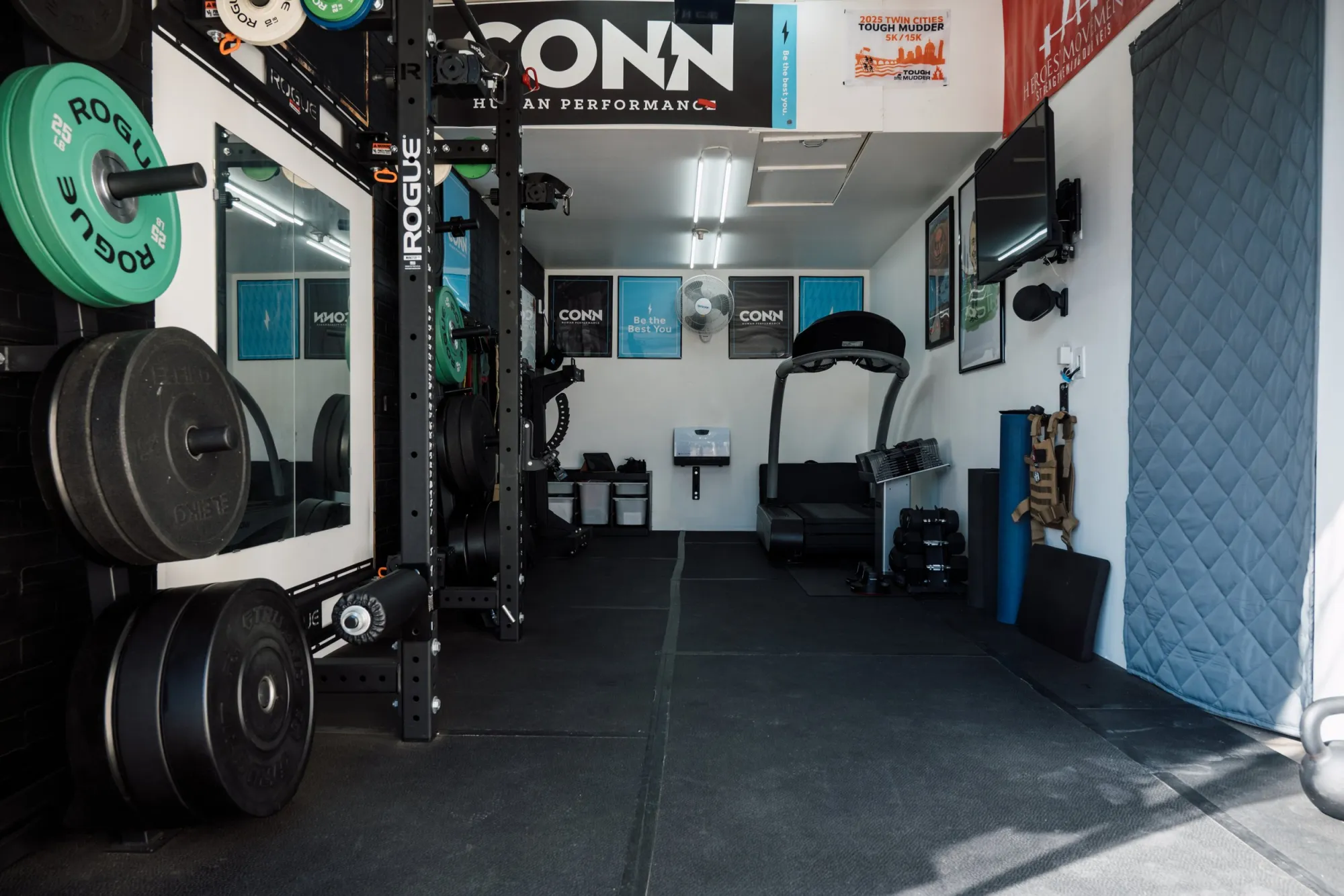
At Conn Human Performance, we don’t build workouts; we build athletes back. Founded by Garrett Conn in Champlin, Minnesota, CHP works with high-performing professionals, business owners, and former athletes who want their identity back, not just a 30-day transformation that fades by spring. Every program follows the same three pillars: Train, 3D, functional movement built around how your body actually moves.
Feel: the mindset and consistency work that keeps you showing up when motivation runs out. Look: lasting results that come from systematic, sustained training rather than crash-diet extremes. Whether you train with us online, in person in Champlin or St. Paul, or through a hybrid mix of both, the standard doesn’t change; only the format does.
Close
Golf has a way of exposing what time quietly takes away. The distance that used to be automatic. The mobility you never had to think about. The confidence that your body would do what you asked it to do.
If you want that back before next season starts, book a call, and I will map out your next ninety days.
Frequently Asked Questions
Will lifting weights make my golf swing stiff?
No, as long as the program includes mobility work. Stiffness comes from training only the muscles you can see in a mirror, not from strength training itself.
How soon will I notice results?
Most golfers feel improved balance and less fatigue late in a round before they see a measurable jump in clubhead speed. Expect early feel-based improvements within a few weeks, with measurable speed and distance gains typically building over 6–8 weeks of consistent training.
Do I need a gym, or can I train at home?
Not to start. Dumbbells, a resistance band, and floor space will take you a long way. You’ll eventually want access to cables or a rack for full progression.
Is strength training safe for older golfers?
Yes. Properly programmed training lowers the risk of injury and supports joint health. Loading and speed of progression should adjust with age and training history, but the underlying plan doesn’t change.
Should I keep training during golf season?
Yes, at reduced volume. Dropping strength training in May is the single most common reason golfers lose distance again by July.
I haven’t trained seriously in years, is this for me?
That’s most of who this is built for. The goal isn’t to build an athlete from scratch; it’s to bring back the one who played before life got in the way.

























Sign in to leave a comment.